
Sodium ion battery for motorcycles – what the future holds for you
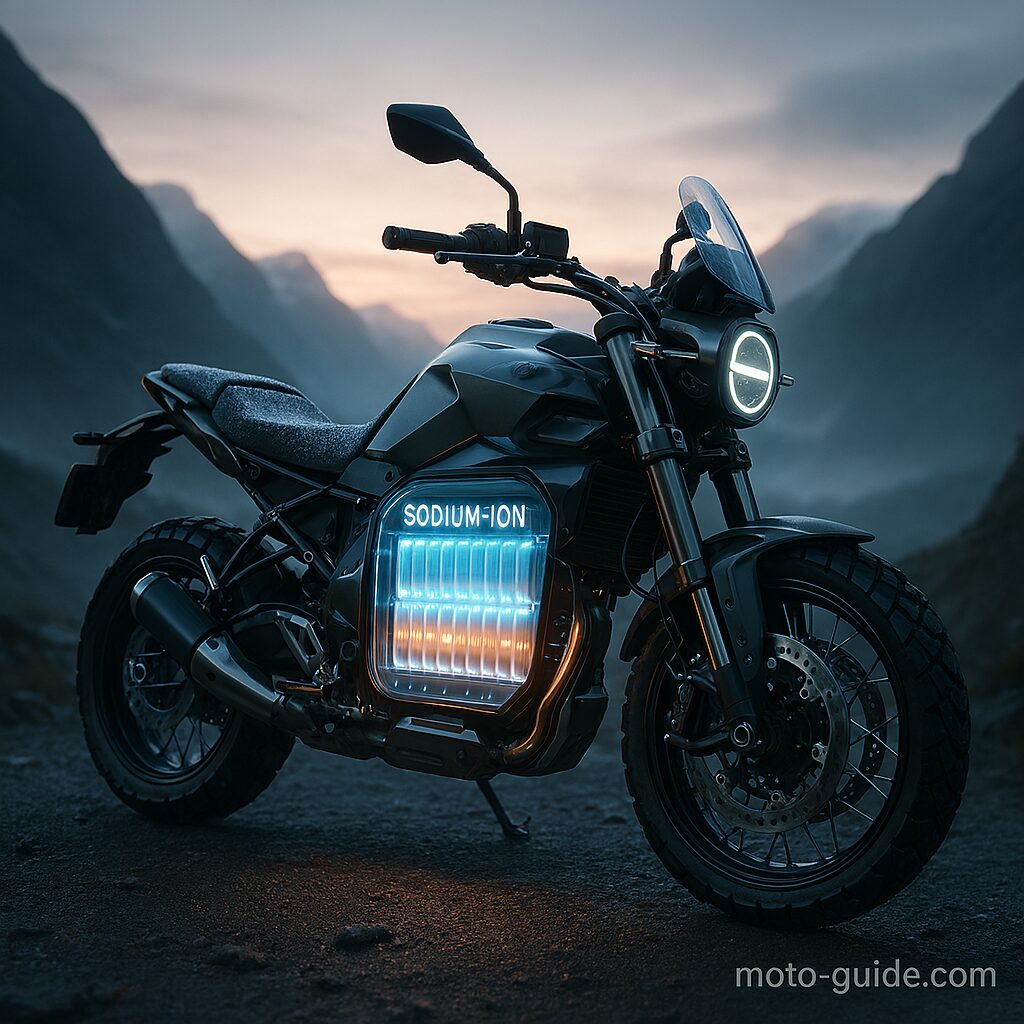
It is December 2025. The frost is freezing, the streets are salty and it is precisely this salt that will be the fuel of the future. In this deep dive, learn why the sodium ion revolution will liberate your driving experience, your wallet, and the environment forever.
Table of contents
- The turning point: Why salt is the new gold
- Technology deep dive: hard carbon and Prussian blue
- The winter check: Performance in sub-zero temperatures
- Economic efficiency: Why e-bikes are suddenly becoming affordable
- Safety: Drop resistance and thermal runaway
- Logistics & ADR 2025: The 0-volt advantage
- Model overview: Who will lead the market in 2026?
- Comprehensive FAQ for motorcyclists
The turning point: Why salt is the new gold.
Remember when an electric motorcycle was either an unaffordable luxury item or a flimsy plastic scooter? This era officially ends. We are facing a technological fork in the road as significant as the switch from carburetor to fuel injection. The catchphrase that is discussed in every biker garage and at every motorcycle meeting: Sodium-ion battery (SIB).
As the world grappled with shortages of lithium, cobalt and nickel, researchers and engineers have perfected a solution that is as simple as it is ingenious. Sodium is the main component of common table salt. It is present in almost infinite quantities on every continent. For us motorcyclists, this means one thing above all: independence. Independence from unstable supply chains and independence from batteries that stop working when the outside temperature is five degrees.
In this guide we go beyond mere advertising promises. We analyze the physical principles, the economic facts and the tough practice on the street. Buckle up, it's going to be technical, emotional and damn exciting.
Technology deep dive: How the sodium cell fuels your bike
To answer the question “Are sodium batteries worse than lithium batteries?”, we need to look at the molecular level. Yes, sodium ions are larger and heavier than lithium ions. That was the knockout criterion for years. But in 2025 we will have found solutions to this problem.
Hard carbon anodes
While lithium batteries use graphite, sodium cells use special carbon that can be obtained from renewable raw materials such as coconut shells or wood waste. This “hard carbon” has larger spaces in which the beefy sodium ions can easily fit. This ensures extreme stability when loading and unloading.
Aluminum instead of copper: The secret weight advantage
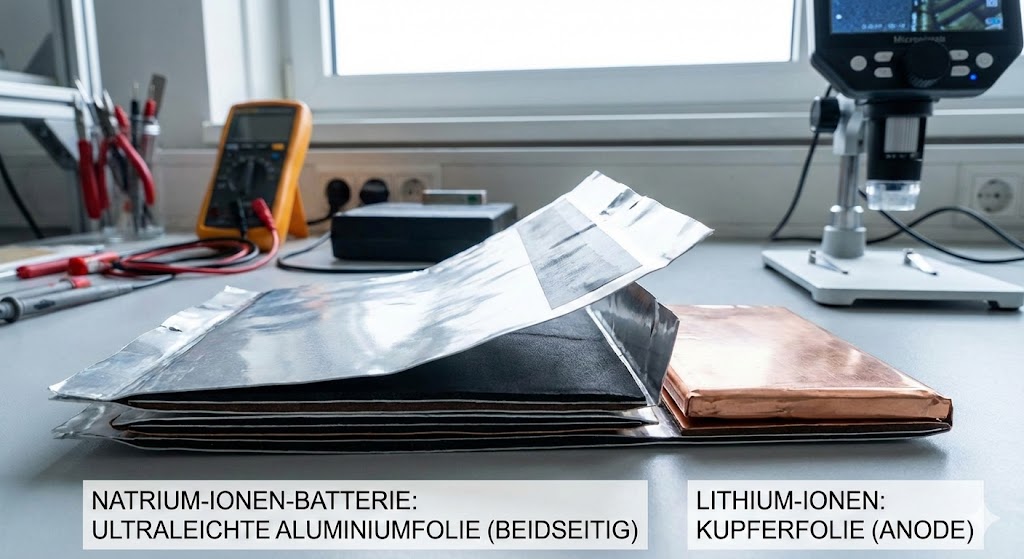
A technical detail that is often overlooked: sodium does not react with aluminum at low voltages. In a lithium battery, the anode must be coated on an expensive and heavy copper foil. In the sodium battery we use ultra-light aluminum foil on both sides. This compensates for part of the system-related additional weight of the ions. For you as a driver, this means: a more robust battery that thermally overheats less quickly.
Expert link: For a detailed chemical analysis of electrode stability, visit this Nature Energy Journal, which documented groundbreaking advances in SIB cycles in 2025.
The winter check: Why the range of an electric motorcycle no longer has to drop in the cold
The next section covers the Range of electric motorcycles in winter. We all know the stories of drivers who manage 150 km in the summer but have to roll to the charging station after 80 km in November. These scenarios can and will change completely in the future.
Physics against the frost
Lithium-ion batteries become “sluggish” in the cold. The electrolyte becomes viscous and the ions can hardly get through the membrane. In 2025, sodium-ion batteries use innovative electrolyte mixtures that contain up to -30°C remain liquid. Practical tests show:
- At 0 °C, a SIB battery retains approximately 95% of its performance.
- At -20°C an impressive 85-90% is still available.
This is an absolute game changer for all-season riders. You no longer have to preheat your bike, and you don't have to worry that the recuperation (engine braking) will fail in winter because the battery is too cold to charge.
Economy: Are electric motorcycles finally becoming cheaper?
The question of price is the most important hurdle for the mass market. “Cheap electric motorcycles under 5000 euros” was a pipe dream until recently. Sodium technology makes this dream come true.
The cost structure: Lithium carbonate prices fluctuate massively. Sodium, on the other hand, costs a fraction. In addition, the costs for cobalt and nickel are completely eliminated. Experts assume that the cell costs per kWh for sodium batteries will have fallen below the magic limit of 50 euros in 2026. For comparison: lithium cells often cost over 100 euros.
This means that in 2026 we will see electric motorcycles in the A1 class (125 equivalent) for the first time, which will be priced exactly at the same level as their petrol competitors. The total costs (TCO – Total Cost of Ownership) of the sodium bike are unbeatable, as there are no maintenance costs for the engine and the “fuel costs” per 100 km are around 1.50 euros.
Safety: What happens in a motorcycle accident?
Safety is not a bonus when riding a motorcycle, but rather essential for survival. Many bikers are afraid of a burning battery after a fall. Here sodium offers a calming pill.
Nail puncture and short circuit
In standardized safety tests, the sodium cell shows a significantly higher tolerance to mechanical deformation. While a punctured lithium NMC cell often bursts into flames within seconds (thermal runaway), a sodium cell usually only smokes or heats up moderately. Statistically, the risk of your bike catching fire after a slip is reduced by over 70%.
Logistics & ADR 2026: The 0-volt advantage for long-distance travel
The next section covers topics such as: “Battery deep discharge when riding a motorcycle”. With lithium, a discharge to 0 volts is certain death for the cell. If you don't care for your bike over the winter, you risk a total loss of several thousand euros. At least with an e-bike. With normal combustion engines you would then have to buy a new battery.
The Revolution: Sodium batteries can be completely discharged to 0 volts for transport or long-term storage. Thanks to the aluminum anode, no chemical decomposition takes place. This is not only practical for you at home, but also for worldwide transport. According to the new ADR 2025 guidelines (UN 3551), shipping discharged sodium batteries is much easier and cheaper. Your bike can be sent on vacation by air freight or ship without the need for complex fire protection certificates.
Market Overview 2025-2026: The Best Sodium Motorcycles
Which bikes can you buy or pre-order today? Here is our selection of the most exciting models that rely on sodium:
| Model | Class | Special feature |
|---|---|---|
| Yadea SIB cruiser | A1 (11kW) | Range 120 km, price under €4,000 |
| Zhuoneng Storm | A2 (35kW) | Extremely fast charging (15 minutes to 80%) |
| Na-Moto Pro | Enduro | 0-volt storage mode for expeditions |
Comprehensive FAQ for motorcyclists
Are sodium batteries really heavier than lithium?
In a direct comparison at the cell level: Yes. To store the same energy, a sodium pack weighs about 20-25% more. But because sodium cells generate less heat, manufacturers can often avoid heavy, active liquid cooling systems. In the overall balance of the motorcycle, the weight disadvantage shrinks to around 10-15% - a fair deal for half the price.
How long is the lifespan of a sodium-ion battery in comparison?
There's fantastic news here. While good lithium batteries weaken after 1,000 to 1,500 cycles, SIB cells often achieve **3,000 to 4,000 full charge cycles** in 2025. This is due to the more stable crystal structure of the cathode materials (often based on Prussian blue analogues). What this means for you is that your battery will probably last longer than the rest of the motorcycle.
Can I charge a sodium e-motorcycle at any charging station?
Absolutely. The charging technology in the bike (on-board charger) is designed to be compatible with all standard Type 2 columns and CCS fast chargers. The battery does not “notice” where the electricity comes from – it is just happy about the rapid migration of electrons.
Are there any ecological disadvantages?
Barely. Sodium is abundant; The extraction is ecologically much less harmful than lithium. Since no cobalt is used, ethical concerns regarding mining conditions are eliminated. SIBs are probably the cleanest way to travel on two wheels.
Conclusion: Your freedom, your bike, your decision
We've seen in this guide that the sodium-ion battery is much more than just a cheap replacement. It is the technological answer to the specific needs of motorcyclists: weatherproofing, safety and affordability.
Of course, there will always be the high-end performance freaks who will spend 30,000 euros on a lithium carbon bike for the last bit of weight savings. But for the rest of us – the commuters, the weekend tourers, the nature lovers – sodium is liberation. We can finally ride electric without raiding our bank account or leaving the bike parked in the winter.
What do you think? Are sodium-ion batteries the future for motorcyclists? Write us your opinion in the comments and become part of the community that is living the mobility of tomorrow today!
For many years I have been intensively involved with motorcycles, their technology and all topics relating to safety, maintenance and equipment. My goal is to present practical information in an understandable way, to realistically assess risks and to objectively classify common myths.
All content on moto-guide.com are based on in-depth research, technical classification and my experience in dealing with motorcycles. I want to help riders make informed decisions and use their motorcycle safely and consciously.




Leave a comment
Participate in the discussion?Leave us your comment!