
The ultimate guide for your motorcycle trip through Portugal

Over the last two decades, Portugal has developed from an insider tip for adventurers into one of the best developed motorcycle regions in Europe. But while the infrastructure has been modernized, the wild charm of the hinterland has been preserved. Anyone who tours Portugal by motorcycle will find a perfect symbiosis of perfectly paved curves and dusty tracks that are reminiscent of the loneliness of the North African desert.
In this comprehensive guide you will learn everything you need to know for a successful trip. We not only cover the legal basics, but also delve deep into the geography, technology and lifestyle that makes Portugal so unique for two-wheeled riders. Whether you're traveling with a heavy travel enduro, an agile naked bike or a comfortable cruiser, Portugal has the right terrain for every riding style.
Legal framework: Travel safely in Lusitania
Portuguese traffic monitoring by the GNR (Guarda Nacional Republicana) has increased in presence in recent years.
There is increased control, especially on the popular motorcycle routes. If you know the rules, you not only save money, but also nerves.
Documents and obligations to carry
In addition to the driver's license and the vehicle registration document International insurance card (IVC) your most important document. Although the license plate agreement applies within the EU, Portuguese officials often require physical (or digital) proof of insurance during checks. A point that is often underestimated is this High visibility vest. While in Germany you only have to carry it with you, in Portugal you are strictly required to carry it in the event of a breakdown. This means: As soon as you leave your motorcycle on a public road because it is no longer roadworthy, you must wear the vest. We recommend a compact vest that fits directly under the seat or in the tank bag.
Lighting and technology
The Light requirement during the day is mandatory in Portugal. This applies not only to motorways, but to all public roads. A defective lamp can already be a reason for an inspection. An interesting aspect for the tour in Portugal: The technical inspection for motorcycles (the equivalent of the TÜV) was stopped for the time being for motorcycles over 125 cm³ after much back and forth. However, this does not mean that you can drive an unsecured machine. The police pay close attention to the tread depth of the tires. Since the Portuguese asphalt - especially in the north - is often very rough and non-slip, tire wear is significantly higher than in Central Europe. Never start your trip with less than 50% remaining profile.
Speeds and “Velocidade Controlada”
Portugal uses an intelligent speed control system. The so-called “Velocidade Controlada”-Traffic lights are linked to radar sensors. If you approach the traffic light at more than the permitted speed (usually 50 km/h in urban areas), it automatically turns red. This is not a chicane, but a very effective method of calming the traffic flow in villages. If you drive through a red light here, you are committing a serious red light violation, which can be extremely expensive.
The toll system: A privilege for motorcyclists
For a long time, the Portuguese toll system was a closed book for tourists.
There are two parallel systems: the classic motorways (like the A1 between Lisbon and Porto) with toll booths and the purely electronic motorways (SCUT), which were often financed by former EU funding.
The Via Verde advantage
But the best news is the confirmation 50% toll discount for motorcycles. However, in order to receive this discount, an electronic reader (Via Verde transponder) is required. At manual ticket booths, class 1 is often charged as a flat rate. The transponder can be ordered online or rented at gas stations and post offices (CTT). It is simply attached to the cockpit or to the handlebars. The big advantage: you no longer have to stop at a barrier; Billing is carried out conveniently via your stored account or credit card.
Electronic toll (SCUT) without transponder
If you don't have a transponder, you'll need to provide your license plate number EasyGreat register. This happens at terminals directly behind the border crossings. There your credit card will be scanned and linked to your license plate number. The system is valid for 30 days and charges you every time you pass under one of the toll gantries (large metal structures with cameras).
Caution: Anyone who drives without registration risks high fines, which are now also being collected across borders.
The regions: Where the biker’s heart beats
The North: Peneda-Gerês and the Douro Valley
The north of Portugal is green, watery and mountainous. The national park Peneda-Gerês on the border with Spain offers roads that wind through ancient oak forests and past huge reservoirs. The quality of the roads here is usually excellent, as many routes have been renovated for tourism.
It's further south Douro Valley. The N222 between Peso da Régua and Pinhão is world famous. It offers 93 curves over 27 kilometers and was mathematically named the “best road in the world”. But the true connoisseur leaves the N222 and drives into the side valleys, where the roads become narrower and the views of the wine terraces become even more spectacular.
The center: Serra da Estrela and the slate villages
In the Serra da Estrela you will find a real high mountain feeling. The rise to Torre takes you to almost 2,000 meters altitude. Up here the air is thin and the landscape is reminiscent of Scotland or Norway - barren rocks, deep valleys and often cool temperatures, even in midsummer.
They are a real insider tip Aldeias do Xisto (slate villages). These hidden villages are connected by extremely winding micro-roads that are technically demanding. Anyone driving here should be able to control their machine, as bends with 180 degrees and steep gradients are not uncommon.
The Alentejo: Endless expanse and cork oaks
South of the Tejo the scenery changes dramatically. The Alentejo is the granary of Portugal. Endless wheat fields, olive groves and cork oaks dominate here. The streets here are often dead straight until they suddenly turn into rolling hills. The Alentejo is perfect for cruisers and tourers who want to enjoy relaxed “slow travel”. However, temperatures here can rise to over 45 degrees in July and August. Therefore, it is best to travel in this region in May or October.
The Algarve: More than just the beach
Most tourists only know the beaches, but the hinterland of the Algarve is a motorcycle paradise. The Serra de Monchique offers the Foia, the highest point in the Algarve. The driveway from Portimão is a complete series of curves on the finest asphalt. The west coast (Costa Vicentina), on the other hand, offers wilder roads and breathtaking cliff paths that are often not paved - a dream for every travel enduro.
FAQ: Frequently asked questions from motorcyclists
1. Do I need an international driving license? No, the normal EU driving license is completely sufficient.
2. What are the opening times of the gas stations? Highways 24/7. In the hinterland often from 8 a.m. to 8 p.m. Many gas stations have night machines, but sometimes they only accept Portuguese cards.
3. How much does a coffee (Bica) cost on the go? In the villages often only €0.70 to €1.00. It is the perfect fuel for the driver.
4. Is filtering (pushing ahead in traffic jams) allowed? It is officially tolerated and is common practice as long as you don't overdo it.
5. How secure is the supply of spare parts? In cities like Lisbon, Porto and Faro there are authorized dealers of all major brands (BMW, Honda, Yamaha, KTM). In rural areas, workshops tend to specialize in agricultural machinery.
6. Is it compulsory to carry first aid kits? Not legally required for motorcycles, but strongly recommended for long-distance travel.
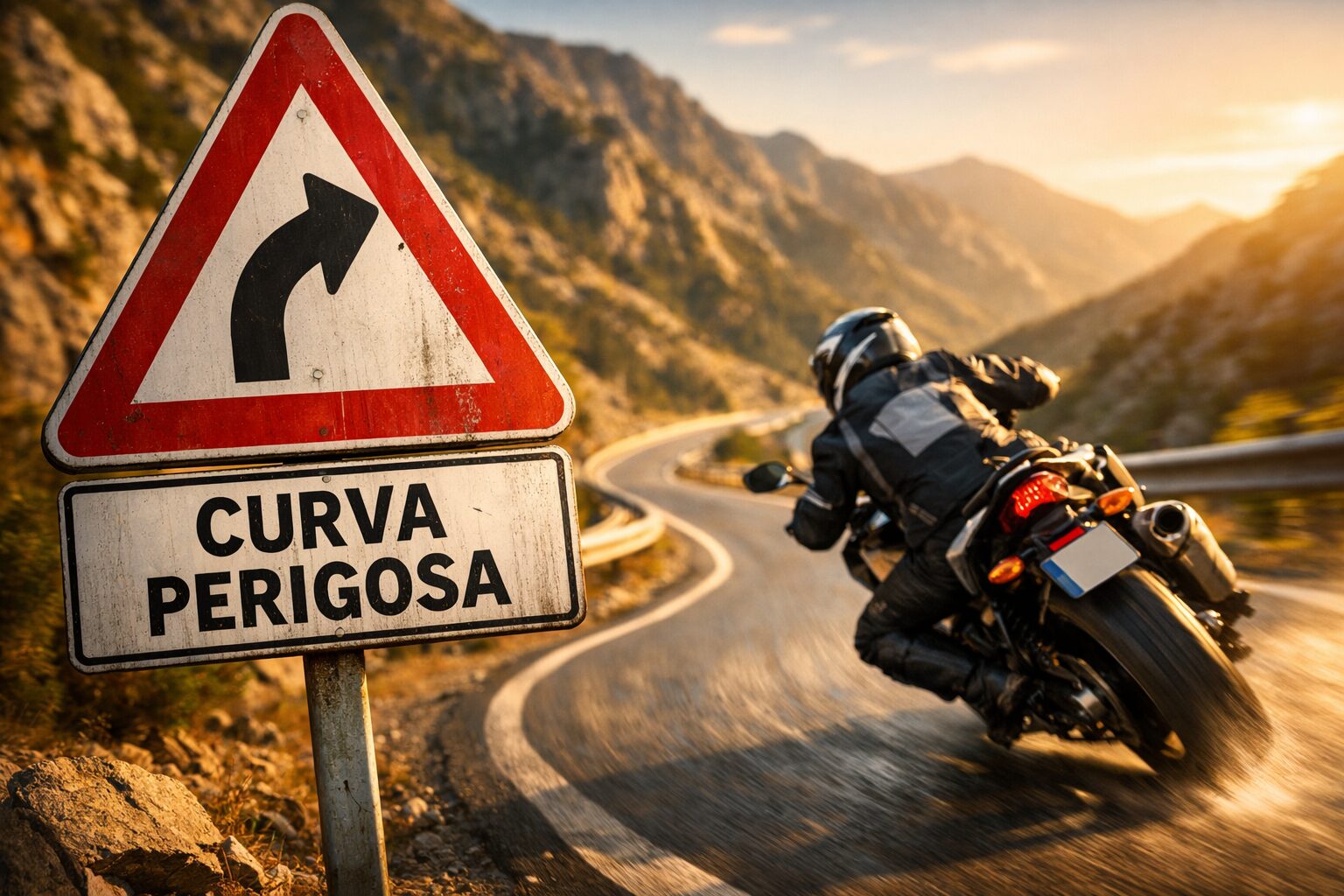
7. What does the sign 'Curva Perigosa' mean? That means 'Dangerous Curve'. In Portugal you should take this warning sign seriously as the curve often becomes tighter than expected.
8. Can I take my 125 on the highway? Yes, motorcycles with a size of 50 cm³ or more are allowed on the motorway in Portugal, provided they are designed to travel faster than 60 km/h.
9. Are the bridges in Lisbon subject to tolls? Yes, the 'Ponte 25 de Abril' and the 'Ponte Vasco da Gama' charge tolls, but only in the north direction (into the city).
10. How do I recognize unleaded gasoline? Look out for the name 'Sem Chumbo'.
11. Are there special motorcycle parking spaces? In city centers there are often marked zones only for two-wheelers. These are usually free.
12. How do the police respond to loud exhausts? Increasingly sensitive. Phon measurements are carried out particularly in national parks.
13. Is it allowed to carry reserve canisters? Yes, up to 10 liters in a tested canister are allowed.
14. Which emergency number should I call? Always 112 - English is usually spoken there.
15. Where can I find GPX data for tours? Platforms like Calimoto or Kurviger have a large community in Portugal. The official Visit Portugal website also offers motorcycle routes.
Technology check for Portugal: What your bike has to withstand
A trip to Portugal is a stress test for man and machine. Here are three things to check before you leave:
- Cooling: The heat inland is merciless. Check your cooling system and coolant levels. If your fan starts up often in city traffic at home, it will be in constant use in Portugal.
- Brakes: The long descents in the Serra da Estrela or on the Douro put a strain on the brakes. Fresh brake fluid (boiling point!) and pads with at least 60% thickness are mandatory.
- Tire compound: If you have the choice, choose a touring tire with high mileage instead of a pure sports tire. The Portuguese asphalt is like sandpaper - it offers endless grip, but literally "eats up" the rubber.
Further links on the topic of motorcycle trips in Portugal
- Início | Portugal Tolls (official website of the Portuguese customs portal)
- infraestruturasdeportugal (Portugal's official traffic overview)
Conclusion: Why Portugal should be your destination
Motorcycling in Portugal is a journey for the senses. It is the smell of eucalyptus trees in the north, the salty breeze of the Atlantic in the west and the smell of grilled fish in the fishing villages. The Portuguese have a deep passion for mechanics and engines, which is evident in the respectful way drivers usually give way when they see a motorcycle in the rearview mirror.
The combination of improved rights (bus lanes, toll discounts) and unparalleled geography makes Portugal the top destination in Europe. Anyone who has ever seen the sun set over the cliffs of Cabo de São Vicente after completing 500 kilometers of curves will come back again and again.
Are you ready for your Portugal adventure?
For many years I have been intensively involved with motorcycles, their technology and all topics relating to safety, maintenance and equipment. My goal is to present practical information in an understandable way, to realistically assess risks and to objectively classify common myths.
All content on moto-guide.com are based on in-depth research, technical classification and my experience in dealing with motorcycles. I want to help riders make informed decisions and use their motorcycle safely and consciously.




Leave a comment
Participate in the discussion?Leave us your comment!