
What is the average consumption of motorcycles really?

A comprehensive overview with real facts.
The Fuel consumption of a motorcycle is often discussed – when buying new, before a tour or simply out of interest in efficiency and costs. Unlike cars, this value for motorcycles varies greatly, depending on the type of bike, area of use and driving style. In this article we explain what realistic consumption values are, which factors have an influence and how you can estimate your own consumption - backed by real measurement and comparison figures.
What does “average consumption” mean?
The average consumption indicates how many liters of fuel a motorcycle uses per 100 kilometers. It is usually given in “liters per 100 km (l/100 km)” and is a practical value that is averaged over several trips. Manufacturer information comes from standardized test cycles and is often below the real consumption values in road use.
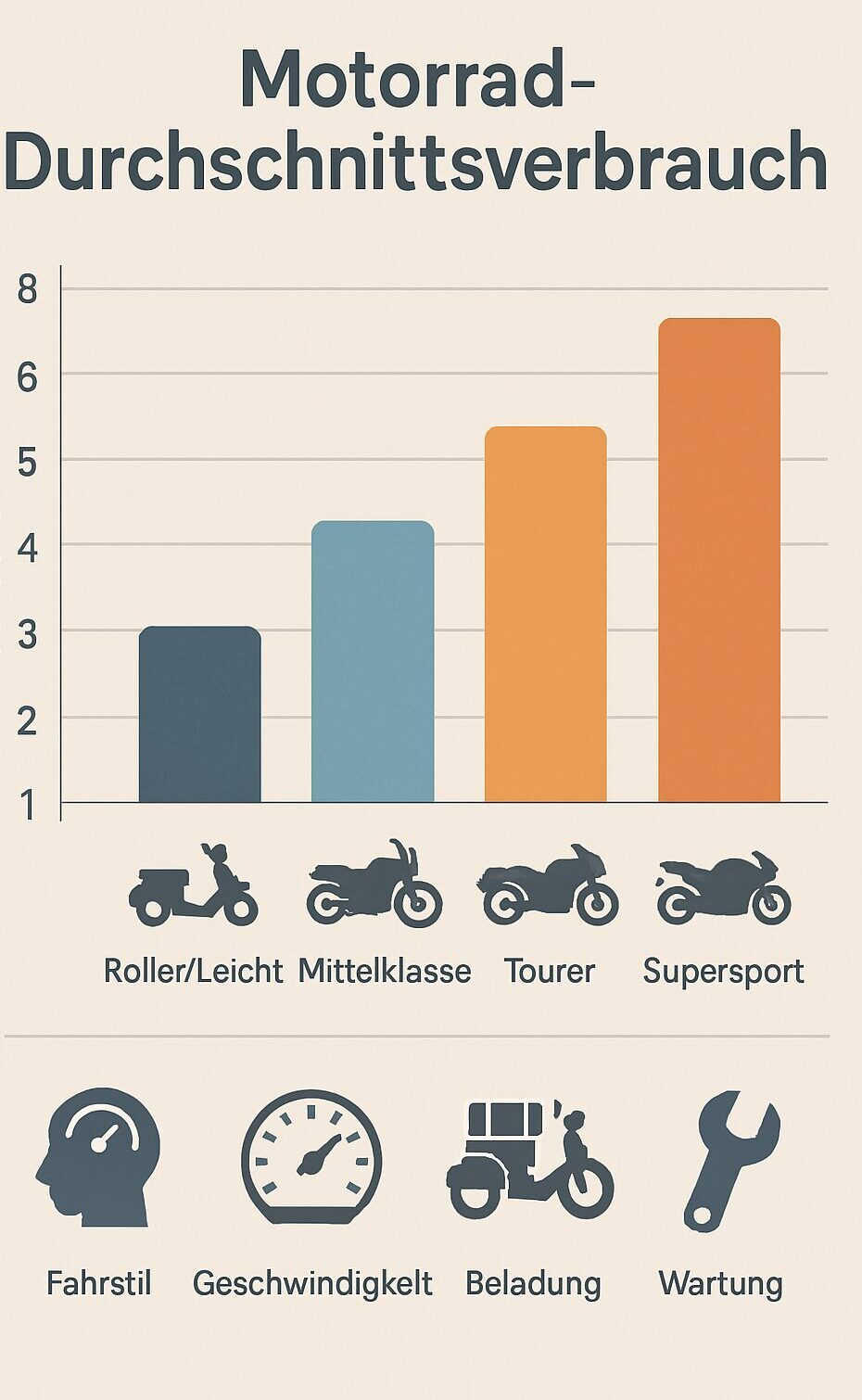
Realistic consumption values by motorcycle type
Light and small motorcycles/scooters
Small bikes with a small displacement are often very economical. Many scooters or 125cc models often fail under real everyday conditions unter 4 l/100 km, sometimes even significantly lower. Real consumption tests show that, for example, a light machine like the Honda CB 300 R on mixed country roads with approx 3,3 l/100 km comes along.
Scooters can also reach very low values at normal speeds: data from emissions and consumption tables show that some small models 1,5 – 3,5 l/100 km create – depending on design and performance.
Mid-range and all-round bikes
Many Mid-range motorcycles with 500-800 cc are typically between in everyday life 4-5 l/100 km, if they are not driven in an extremely sporty manner. High-performance models or Dragon Cruisers can be slightly higher, but in normal country roads or everyday use the values are around 4.5 l/100 km to 5 l/100 km usual.
Large tourers and high-performance machines
With large touring or super sports bikes, consumption increases noticeably. Consumption tests show that sports motorcycles like Ducati Panigale V4 S even with optimized driving style 4,7 – 8,1 l/100 km can lie, while heavy tourers often do too 5 – 6 l/100 km or more consumption – depending on speed and load.
Why does consumption vary so much?
Consumption is not a simple, fixed value. It depends on a number of interrelated factors:
1. Driving style – the biggest influencing factor
| factor | Wirkung auf Verbrauch | Tipps zur Optimierung |
|---|---|---|
| Fahrstil | Up to +2 l/100 km when driving aggressively | Drive steadily, shift up early |
| speed | Air resistance increases above 100 km/h | Moderate speed, use wind protection |
| Gewicht / Beladung | More weight → more consumption | Reduce your luggage and only take a pillion passenger if necessary |
| Technical condition | Dirty filters and incorrect tire pressure increase consumption | Service regularly, check air filters and spark plugs |
| aerodynamics | Fairing improves fuel consumption at high speeds | Make optimal use of windshields or fairings |
It's not just the technical side that decides: How you drive determines much more about fuel consumption than the pure displacement size. Violent acceleration, high engine speeds, frequent full-throttle passages and fast motorway driving cause consumption to rise quickly. Quiet, steady country road journeys, on the other hand, are usually in the lower range of the consumption scale.
2. Speed and aerodynamics
As speed increases, air resistance increases disproportionately and the engine has to work hard to maintain high speeds. Ab etwa 100km/h Consumption increases significantly faster on most bikes because air resistance increases as the square of the speed.
The shape of the motorcycle also influences consumption: Verkleidete Modelle Often have better air resistance than cruisers or naked bikes, which is noticeable on long stretches of highway.
3. Technical condition and maintenance
A well-maintained motorcycle is more efficient. Dinge wie:
-
Luftfilter sauber,
-
Richtiger Reifendruck,
-
Saubere Zündkerzen,
-
Optimal abgestimmte Einspritzung kann den Verbrauch spürbar senken. On the other hand, a lack of service or clogged components increase consumption without increasing performance.
4. Beladung und Gewicht
Additional weight caused by luggage, suitcases, pillions or accessories has a direct impact on consumption. Besonders beim Anfahren und Beschleunigen ist der Mehrbedarf an Energie spürbar.
M Motorbike vs. car – who uses less fuel?
A common point of comparison is between motorcycles and cars. According to the consumption analysis, many car models are included 7 – 8 l/100 km in the real average test, while motorcycles often do with similar use 4 – 8 l/100 km consume.
This means that motorcycles can often be more economical than cars, especially when driving moderately.
This doesn't mean that every motorcycle is more economical in every case, but motorcycles tend to have a chance of lower average consumption due to their lower weight and smaller engines - especially on country roads.
Practical examples of concrete consumption values
Here are some exemplary consumption values from measurement series that are as reputable as possible:
Light machine (CB 300 R)
-
~3,3 l/100 km on country road – driven moderately.
Sportliche Middle class
-
~4,5 l/100 km (e.g. at moderate country road speeds).
Powerful super sports bike
-
~4,7 – 8,1 l/100 km depending on driving style and route.
Scooters and 125cc scooters
-
~1,5 – 3,5 l/100 km during realistic city and country road driving.
| Motorradklasse | displacement | Realistic consumption (l/100 km) | |
|---|---|---|---|
| Leicht / Roller | bis 125 ccm | 1,5 – 3,5 | |
| Middle class | 250 – 600 ccm | 4-5 | |
| Groß / Tourer | 600 – 1000 ccm | 5 – 7 | |
| Supersport / Heavy | ab 1000 ccm | 6 – 8+ |
These values show that consumption varies greatly Machine, driving style and usage situation depends - that's exactly why there is no single "average" for all motorcycles.
How to reliably measure your own consumption
The most practical way is the classic consumption measurement over several tank fillings:
-
Tank komplett füllen and note down the mileage
-
Drive – preferably several trips over mixed routes
-
Wieder volltanken und Litermenge notieren
-
Calculation: (liters filled ÷ kilometers driven) × 100 = l/100 km
This classic method is usually more accurate than many on-board computers because sensors and displays often show fluctuations that do not reflect real consumption.
Tips for optimizing consumption
You can effectively reduce consumption without sacrificing driving pleasure:
-
Moderates Tempo halten instead of constant high speed
-
Vorausschauend Drive instead of braking/accelerating abruptly
-
Check tire pressure regularly und korrekt einstellen
-
Regelmäßig warten (air filter, spark plugs, injection)
-
Überladung vermeiden – less weight = less consumption
Conclusion – realistic, practical, easily verifiable
The Average consumption for motorcycles cannot be described with a single number. Depending on the machine and driving style, this value varies within a wide range:
-
Leichte Bikes / Roller: häufig unter 4 l/100 km
-
Mid-range motorcycles: oft zwischen 4-5 l/100 km
-
Large or very powerful bikes: rather 5 – 8 l/100 km+
This range is realistic and corresponds to several serious consumption measurements. The differences arise from speed, driving style, weight, aerodynamic factors and technical condition. Motorcycles can be more efficient in real road use than many car models, but there are also big differences between the individual classes and purposes.
Further links:
Realistic consumption values according to displacement (English)

For many years I have been intensively involved with motorcycles, their technology and all topics relating to safety, maintenance and equipment. My goal is to present practical information in an understandable way, to realistically assess risks and to objectively classify common myths.
Alle Inhalte auf moto-guide.com are based on in-depth research, technical classification and my experience in dealing with motorcycles. I want to help riders make informed decisions and use their motorcycle safely and consciously.




Leave a comment
Participate in the discussion?Leave us your comment!