Riding a motorcycle is fun, but it doesn't forgive carelessness. Modern motorcycles have cornering ABS, wheelie control and semi-active suspension. Yet two purely mechanical components are still decisive for motorcycle safety: the clutch and the tyres.
At biker meets the talk is mostly about horsepower and looks. On the road things are different. A slipping clutch or an over-aged tyre is not a minor maintenance detail but a real risk. Here you can read what is behind it technically, which dangers creep in slowly and what you can do about it.
The motorcycle clutch: more than just for changing gear
On a motorcycle the clutch is used much more finely than in a car. In a car you need it almost only for pulling away and changing gear. On a motorcycle it is part of riding stability, for example when playing with the friction point while manoeuvring at walking pace or when downshifting before a bend.
Design and function
Most motorcycles have a wet multi-plate clutch. It sits between the crankshaft and the gearbox.
The clutch pack: alternating friction plates (with lining) and steel plates.
The clutch basket: driven by the engine.
The pressure plate: strong springs press it against the plate pack. This creates the frictional connection.
The release mechanism: when you pull the lever, the pressure plate is lifted against the spring force. The plates can slide past each other and the power flow is interrupted.
What does "slipping the clutch" mean technically?
Slipping means the plates touch but don't have enough contact pressure to turn at the same speed. This is called partial friction.
Intentional slipping: you need it when pulling away to get the motorcycle moving from a standstill.
Unintentional slipping: this is a defect. The clutch slips even though you have fully released the lever. It usually happens under high load, for example when accelerating in a high gear.
Symptoms of a worn clutch
Many riders only notice the wear when the motorcycle is barely rideable. Watch out early for these warning signs:
Rubber-band effect: you open the throttle fully, the revs shoot up like on a scooter, but the speed only rises with a delay.
Notchy gearbox: if the clutch no longer disengages cleanly, the gears remain under residual tension. Finding neutral becomes a test of patience.
Grabbing and juddering: a grabbing feeling when pulling away points to warped steel plates. Usually too much heat is the cause.
Smell: burnt friction linings smell very distinctive, sulphurous and acrid. You often only notice it once the engine is off.
Why a faulty clutch is dangerous
A component that reacts unpredictably is always a problem on a motorcycle.
No engine braking: if you downshift before a hairpin, you rely on the engine slowing and stabilising the motorcycle. If the clutch slips at that moment, the bike simply keeps pushing. Right before a bend, that is really bad.
Heat damage: friction generates several hundred degrees. This heat can break down the engine oil locally, and then lubrication of the whole engine suffers. In the worst case the steel plates warp so badly that the clutch no longer disengages at all. Then the motorcycle lurches forward at the traffic lights even though you have pulled the lever.
Unsettled chassis: if the clutch slips when accelerating and then suddenly grips again, a hard jolt goes through the drivetrain. At lean, that can be enough to make the rear wheel step out.
Causes of premature wear
Wrong oil: many motorcycle clutches run in engine oil. If you accidentally fill up with car oil containing friction modifiers, the clutch will slip immediately.
Incorrectly adjusted lever: if the cable has no free play, the clutch is permanently under slight tension and slips without you noticing.
Short trips and stop-and-go: constant pulling away is hard labour for the linings.
Tyres and tread: your only contact with the road
Two contact patches, each roughly the size of a credit card, keep you on the road. There is no room for compromise.
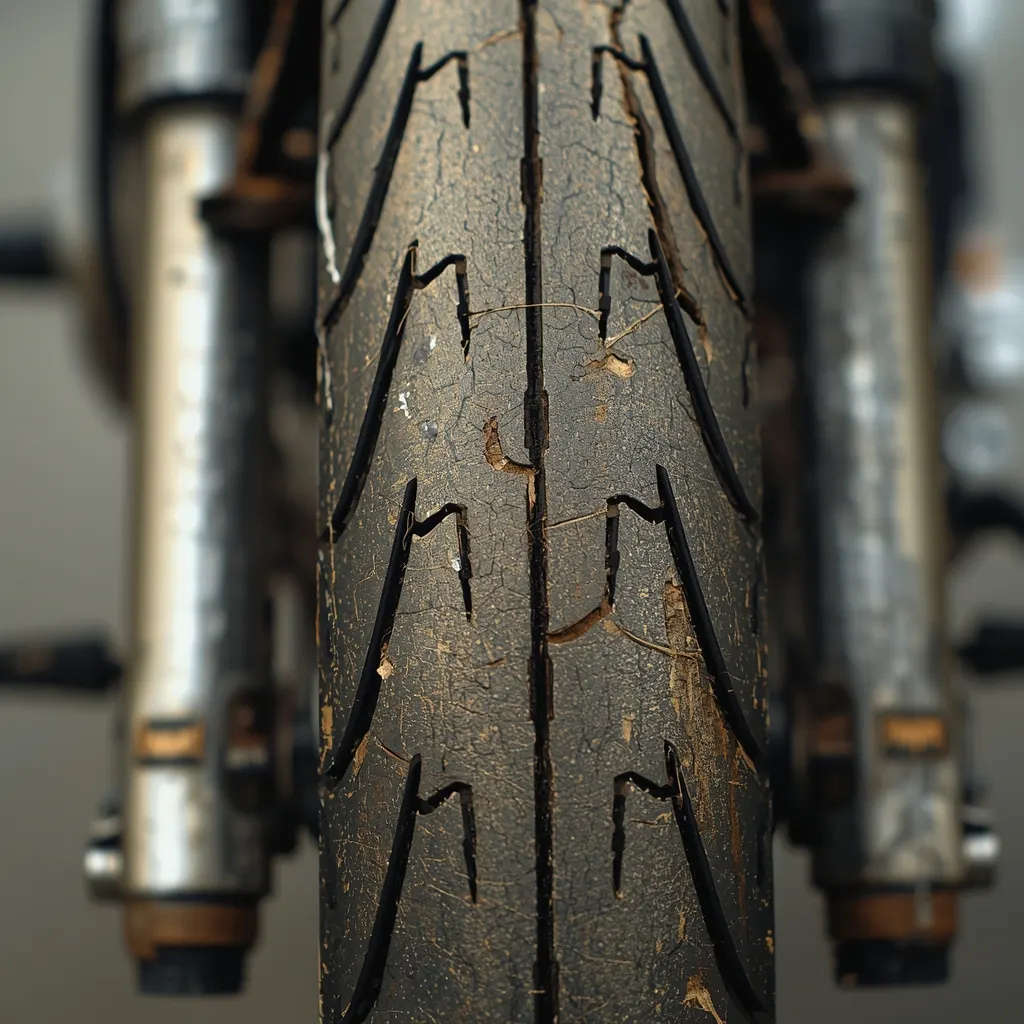
Underestimated: tyre age
A tyre is a chemical product. It consists of natural rubber, synthetic polymers, carbon black, silica and plasticisers. The plasticisers are the problem, because they evaporate over the years.
Why do tyres age even when the motorcycle is just standing?
Oxidation: oxygen reacts with the rubber molecules and makes them brittle.
UV radiation: sunlight breaks up the polymer chains.
Ozone: it causes the typical fine cracks in the sidewall.
An eight-year-old tyre can look like new and still feel like a plastic bucket. It can no longer key properly into the fine roughness of the asphalt.
Minimum tread depth: why 1.6 mm is too little
In Germany the legal minimum tread depth is 1.6 mm (in the UK it is 1 mm across the central three-quarters of the tread for bikes over 50 cc). For riders that is already borderline.
Water displacement and profile: a motorcycle tyre is round. The less tread is left, the more this shape changes and the tyre becomes "squared off". That worsens water displacement (risk of aquaplaning) and makes turning in less harmonious.
Grip: many tyres are built in layers. If the tread is badly worn, you are often already riding on a harder base compound with less grip than the soft top layer.
A small extra tip for you:
Did you know that German law distinguishes between tread depths? The familiar 1.6 mm applies to larger machines, while for light motorcycles up to 125 cc § 36 StVZO only prescribes a minimum of 1.0 mm.
But beware: legal does not mean safe. With only one millimetre of tread, a tyre can hardly displace any water in the rain, and the risk of aquaplaning rises sharply.
Our recommendation: don't go by the legal minimum. Regardless of engine size, you should consider new tyres at 2.0 mm of remaining tread at the latest. The few euros you save by delaying a tyre change are not worth it.
Reading the DOT number correctly
You should be able to read the DOT code. The last four digits, for example 4821, reveal the production date: week 48 of 2021.
From 5 years: look more closely. The rubber gets harder and the limit becomes narrower.
From 10 years: don't ride on it any more. The risk of carcass damage or a sudden loss of grip can no longer be assessed.
Typical consequences of old tyres
Longer braking distances: a hardened tyre slides earlier. The ABS intervenes more often and the braking distance becomes considerably longer.
Lowsider: in a bend the front tyre loses grip without warning because the hard rubber no longer builds up temperature.
Material fatigue: on old tyres the tread can separate at high speed on the motorway.
Clutch and tyres compared
| Factor | Slipping clutch | Old tyres |
|---|---|---|
| Main risk | Mechanical failure and loss of control | Crash from sliding away |
| Recognisable by | Sound, rev counter, feel at the lever | DOT number, visual check, hardness test |
| Type of wear | Mostly from operating errors or mileage | From ageing and abrasion |
| Cost | High (lots of labour to dismantle) | Moderate (set price approx. €250–450) |
| Typical scenario | Breaking down in a tunnel, rolling to a stop | Crash in a bend, braking distance too long |
Bottom line: a slipping clutch mainly costs you money or leaves you stranded. Old tyres, on the other hand, are directly responsible for serious crashes with injuries. If both come together, it gets really dangerous.
Checklist: check the clutch and tyres yourself
You don't have to be a mechanic to check your motorcycle. Take 15 minutes once a month.
Checking the clutch
Lever play: do you have about 10–15 mm of play at the end of the lever before you feel resistance? If not, adjust it.
Load test: ride in third gear at about 4,000 rpm and suddenly open the throttle fully. If the revs rise faster than the speed, the clutch is slipping.
Cable: is the cable frayed? Does it run smoothly? A stiff cable prevents the springs from closing the clutch completely.
Checking the tyres
Age according to DOT: is the tyre older than six years? Then plan a change soon, even if the tread still looks good.
Tread depth: measure in several places. Motorcycle tyres often wear unevenly – in the middle if you ride a lot of motorway, on the shoulders if you love bends. Recommendation: change at 2 mm.
Surface: can you see fine hairline cracks in the grooves? Then the rubber has already become brittle.
Tyre pressure: always check on a cold tyre. Incorrect pressure is the main reason for premature wear and uneven wear patterns (saw-tooth).
Is the money for clutch and tyres worth it?
Many riders are put off by the costs. A new clutch including fitting can easily cost 1,000 euros or more on complex motorcycles such as a BMW boxer or a large tourer. A set of premium tyres costs 300 to 450 euros.
But compare that:
Even a harmless tip-over usually costs 500–1,000 euros in broken fairing, levers and mirrors.
Damage to your health cannot be outweighed with money.
Documented maintenance increases your motorcycle's resale value.
Regular checks cost almost nothing. A tread depth gauge costs 5 euros, and looking at the DOT number costs nothing at all. Proper maintenance is not a luxury – it is simply part of the hobby.
Conclusion
Motorcycle safety stands on three legs: riding skill, protective clothing and technology. If the technology fails, the other two often can't make up for it.
A slipping clutch takes away precise control over engine power. Old tyres take away the grip you need to hold your line. So don't see your motorcycle only as a hobby and lifestyle object, but as a technical machine that needs looking after.
Take a look at your tyres today if you can. And next time you accelerate, listen carefully to how your engine revs. If you know your equipment and take it seriously, you will above all ride for longer.
Frequently asked questions
How can I tell that my motorcycle clutch is slipping?
The rubber-band effect is typical: when you open the throttle, the revs rise sharply but the speed only follows with a delay. A notchy gearbox, grabbing when pulling away and a burnt smell are also warning signs.
How much tread does a motorcycle tyre need?
In Germany legally 1.6 mm, for light motorcycles up to 125 cc 1.0 mm; other countries have their own limits. For your safety, you should change at 2.0 mm of remaining tread at the latest.
How old can a motorcycle tyre be?
From five years you should look more closely, from six years plan a change. You should no longer ride on tyres that are ten years old or more.
Can the wrong oil damage the clutch?
Yes. Car oil with friction modifiers lowers the coefficient of friction, and the wet clutch starts slipping immediately.