For most people it starts with a gut feeling. The sound of an engine at the traffic lights, a mountain pass on holiday or simply the urge to ride yourself instead of just watching. If you're seriously considering getting a motorcycle licence, the first question soon comes up: which motorcycle licence category suits me? Here you get the answer, honestly and step by step. The categories are the same across the EU; the details on lessons and costs refer to Germany.
Why choosing the licence category matters so much
The category determines what you can ride later, what the training costs, how quickly you learn and how safely you ride. In Germany, as in the rest of the EU, there are three categories for motorcycles: A1, A2 and A. Each has its own requirements, advantages and limits. If you know the differences, you start more safely, save money and spare yourself frustration.
Motorcycle licence categories at a glance
| Category | Minimum age | Displacement / power | Features |
|---|---|---|---|
| A1 | 16 years | up to 125 cc / 11 kW | Light motorcycles, ideal for beginners |
| A2 | 18 years | up to 35 kW | Powerful machines, easy to control |
| A | 24 years or 2 years of A2 (at 20 at the earliest) | no limit | Unrestricted category for experienced riders |
Which category suits you depends on age, experience, height and your plans. Assess the machine's power realistically and don't just look at the price or your age.
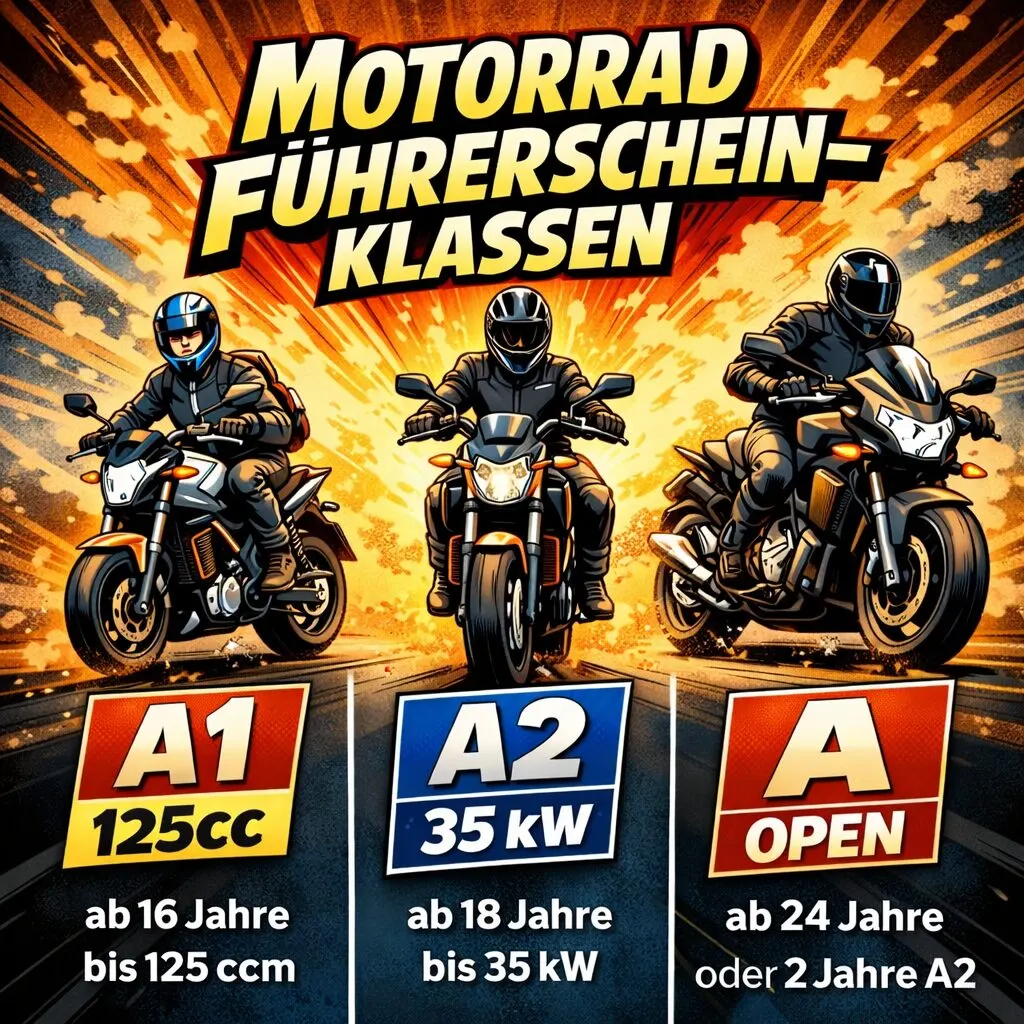
Category A1: the entry point
A1 is the entry category for young riders and beginners. From 16 you can ride motorcycles up to 125 cc and a maximum of 11 kW. The machines are light, manoeuvrable and uncomplicated. You gain first experience and get a feel for the motorcycle without being overwhelmed by too much power.
Advantages of A1
- Cheaper training and fewer lessons
- Manoeuvrable machines that are easy to control
- Well suited to young people and smaller riders
Disadvantages of A1
- Limited power, so less fun on longer tours
- If you want more power, you can hardly avoid stepping up to A2
Category A2: the best compromise for beginners
You can take A2 from 18. It allows you to ride motorcycles up to 35 kW. They are considerably more powerful than A1 machines but still easy to control. Many experienced riders consider A2 the best entry point for adults, because the category combines riding fun and safety well and you learn a lot.
Advantages of A2
- Enough power for everyday riding and touring
- Chassis, brakes and stability like on big motorcycles
- Easy for beginners to control
Disadvantages of A2
- More expensive than A1
- The machines are more demanding and require more attention
Category A: the unrestricted category for experienced riders
With category A you can ride any motorcycle, without a power limit. You get access from the age of 24 or after two years with A2 (progressive access), so at 20 at the earliest. With full power, speed and technology, you also take on more responsibility. This category is not intended for beginners without experience, because the machines are harder to control and mistakes can have serious consequences.
Advantages of A
- Free choice of machine
- Suits touring riders and professionals
- No power limit
Disadvantages of A
- High accident risk for inexperienced riders
- Higher costs for training, insurance and motorcycle
Lessons and costs per category (Germany)
| Category | Lessons (incl. special rides) | Typical total costs incl. protective clothing | Practical tip |
|---|---|---|---|
| A1 | 12–20 | €1,500–2,000 | Ideal for beginners, fast learning curve |
| A2 | 15–25 | €1,800–2,500 | Steady progress, good preparation for A |
| A | 20–30 | €2,500–3,500 | Only for experienced riders, ideally building on A2 |
Theory and practice: how the categories differ
The theory is similar for all categories, but the demands increase with the machine's power. With A1 it's mainly about basic technique, traffic rules and safe behaviour. With A2 and A, you also have to safely master higher speeds – on the motorway, at night and on country roads.
Practical tips for training
- Get the theory done early, for example in winter. You can concentrate better then.
- Practise riding slowly. That trains balance, clutch control and where you look.
- Better regular short sessions than rare long ones. You learn faster that way.
What beginners really learn in the first lessons
Many are surprised how different the first lessons are from what they expected. It's hardly about speed, but about balance, clean pulling away and a feel for the clutch. The aha moment usually comes with a small exercise, such as a clean figure of eight or smooth pulling away without jerking. This is exactly where you notice how valuable a patient instructor is.
Special rides: mandatory and rewarding
In Germany, country road, motorway and night rides are mandatory. The motorway in particular feels threatening to beginners at first. But exactly these rides give you confidence, concentration and an anticipatory riding style.
| Special ride | Category | Learning goal |
|---|---|---|
| Country roads | A1/A2/A | Bends, changing road conditions |
| Motorway | A1/A2/A | Speed, distance, dealing with wind |
| Night | A1/A2/A | Visibility, defensive riding, reaction time |
Learning continues after the test
The licence is just the beginning. The real learning happens afterwards. Riding regularly, practising technique deliberately and increasing speed slowly: that's what makes you safe in the long run. Many accidents happen in the first months because riders overestimate themselves, not because they lack technique.
Conclusion
By choosing your licence category, you decide what your entry into motorcycling looks like. A1, A2 and A each have their own pros and cons. If you honestly assess your experience, your height and your long-term plans, you'll start safely and without unnecessary costs. Learn step by step, ride at your own pace and stay alert. Then the dream of riding a motorcycle becomes a safe everyday reality.
Frequently asked questions about licence categories A1, A2 and A
Which category is suitable for beginners?
Usually A2, because the motorcycles have enough power and are still easy to control.
From what age can I start?
A1 from 16, A2 from 18, A from 24 or after 2 years of A2 experience.
Can I switch from A1 directly to A2?
Yes, shortened training is possible via progressive access.
Are the special rides the same in all categories?
In Germany, first-time applicants for A1, A2 and A all do the same number of special rides: 5 country road, 4 motorway and 3 night rides of 45 minutes each. When stepping up between categories, the special rides are dropped or reduced.
How many lessons do I need on average?
A1: 12–20, A2: 15–25, A: 20–30, each including special rides.
Is it worth going straight for category A?
Only for experienced riders. As a beginner, you're better off choosing A2 first.
Which motorcycle is ideal for A2?
Manoeuvrable, stable, maximum 35 kW and with a good chassis.
Is motorcycling dangerous?
The risk can be controlled well: with defensive riding, regular practice and a motorcycle that suits you.
What protective clothing do I need?
Helmet, jacket, trousers, gloves and sturdy boots. Good quality brings more safety and a better riding feel.
Can I reduce the costs?
Yes. Regular practice and good preparation reduce the number of lessons.
Once you've chosen your category, it's on to riding lessons. Tips for a successful test can be found here: Getting your motorcycle licence: guide and tips from an instructor.