It's frosty outside and the roads are covered in grit salt. And that very salt contains a substance that could shape the future of the electric motorcycle. The sodium-ion battery promises riders real advantages, but also has drawbacks. Here's what the technology can do, what it costs and what it means for your everyday riding.
Why salt is suddenly so interesting
Remember when an electric motorcycle was either unaffordable luxury or a feeble plastic scooter? That time could be coming to an end. The buzzword now being discussed in garages and at bike meets: the sodium-ion battery (SIB).
While everyone was discussing scarce lithium, cobalt and nickel, researchers and engineers brought a surprisingly simple solution to series production. In 2025 CATL announced series production with the Naxtra cell. Sodium is a component of table salt and exists in huge quantities on every continent. For us riders it mainly means independence: from shaky supply chains and from batteries that weaken significantly in frost.
So we're not just looking at advertising promises, but at the physical basics, the costs and practice on the road. It gets a little technical, but it's worth it.
How the sodium-ion battery works
To answer the question "Are sodium batteries worse than lithium batteries?", you have to look at the molecular level. Yes, sodium ions are larger and heavier than lithium ions. For years that was the deal-breaker. But there are solutions now.
Hard carbon anodes
Lithium batteries use graphite. Sodium cells use special carbons that can be made from renewable raw materials such as coconut shells or wood waste. This hard carbon has larger gaps in which the bulky sodium ions fit comfortably. That makes the cell very stable during charging and discharging.
Aluminium instead of copper: a hidden weight advantage
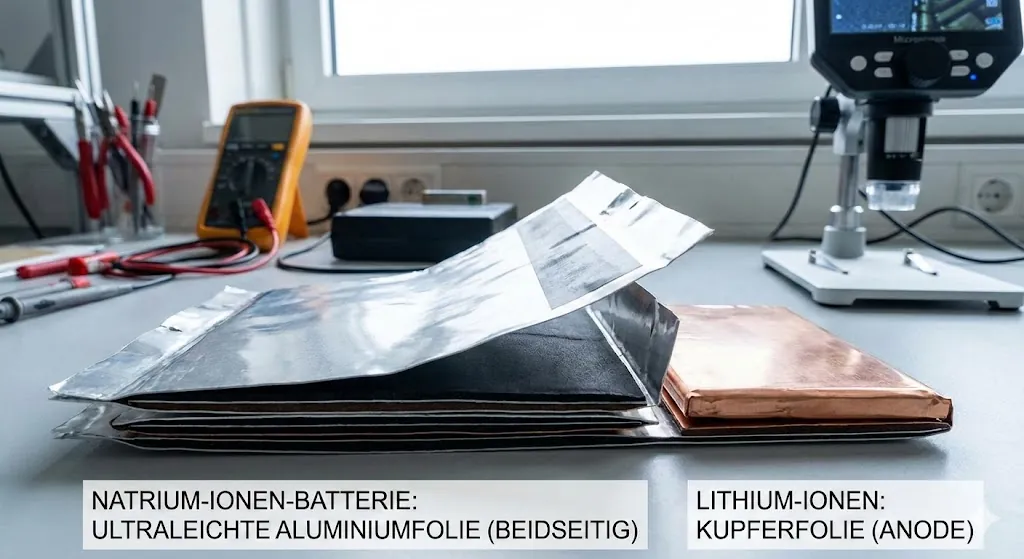
A detail that often gets overlooked: sodium doesn't react with aluminium at low voltages. In a lithium battery the anode has to be applied to an expensive and heavy copper foil. In a sodium battery, light and cheap aluminium foil can be used on both sides. That offsets a small part of the extra weight and saves costs.
Further reading: if you want the chemical details, the Nature Energy journal has papers on electrode stability, including the progress on SIB cell cycle life from 2025.
Winter range: the sodium-ion battery's advantage
Now to the winter range of electric motorcycles. Everyone knows the stories of riders who manage 150 km in summer and have to find a charger after just 80 km in November. That could change fundamentally with sodium.
Physics against frost
Lithium-ion batteries become sluggish in the cold. The electrolyte thickens and the ions hardly get through the membrane. Sodium-ion batteries cope with cold much better. Manufacturer figures using the example of CATL Naxtra:
- Operating range according to CATL from -40 °C to +70 °C.
- At -40 °C around 90% of usable power should still be available.
These are lab values from one manufacturer, independent real-world tests on motorcycles are still lacking. If they're confirmed, it would be a big step for year-round riders: no more preheating and less worry that regeneration (the electric engine brake) is limited in winter because the battery is too cold to charge.
Cost: will electric motorcycles finally be affordable?
Price is the biggest hurdle for the mass market. "Cheap electric motorcycles under 5,000 euros" were wishful thinking until recently. Sodium technology could change that.
The costs in detail: the price of lithium carbonate fluctuates a lot. Sodium is much cheaper to extract, and cobalt and nickel are eliminated completely. Manufacturers therefore expect sodium cells to become cheaper than lithium cells in large quantities. How big the price advantage will be in the end is still open, there are no reliable figures yet.
That could bring A1-class electric motorcycles (comparable to a 125) closer to petrol bikes in price. In total cost of ownership (TCO), an electric motorcycle would have advantages anyway, because combustion engine maintenance is eliminated and electricity for 100 km usually costs only a few euros depending on consumption and tariff.
Safety: what happens in a crash?
Safety isn't a nice extra in motorcycling. Many fear the battery will catch fire after a crash. Sodium has advantages here, but isn't completely unproblematic.
Nail test and short circuit
Sodium cells are considered more thermally stable than lithium cells. A punctured lithium NMC cell can quickly burst into flames (thermal runaway). Manufacturers such as CATL advertise that their sodium cells survive such tests much more benignly. But the organic electrolyte is still flammable, so a sodium battery burns less easily, not not at all. There are no reliable statistics yet on how much the fire risk after a crash falls.
Storage and transport under ADR 2025: the 0-volt advantage
An important topic is deep discharge of the motorcycle battery. With lithium, deep discharge damages the cell, which is often unusable afterwards. If you don't look after your electric motorcycle over winter, you risk damage worth several thousand euros. With a combustion bike, only a new starter battery would be needed in such a case.
The big difference: sodium batteries can be completely discharged to 0 volts for transport or long storage. Because aluminium instead of copper is used as the current collector, nothing decomposes. That's practical for your garage at home, but also for shipping. Since ADR 2025, sodium-ion batteries have their own UN numbers in European road transport of dangerous goods (UN 3551 and UN 3552). A special provision (SP 400) eases the rules for batteries in a discharged state. For you as a private rider that's more of a footnote, but it helps dealers and workshops with shipping.
Market overview 2025–2026: motorcycles with sodium batteries
What can you already buy? The first production vehicles with sodium batteries are light electric scooters from China. Yadea presented four models there in early 2025:
| Model | Class | Special feature |
|---|---|---|
| Yadea Q1, DE3, G30 Lite | Electric scooter (China) | 3,299 to 3,699 yuan, according to Yadea 80% in 15 min |
| Yadea Guanneng Q50 | Electric scooter (China) | 4,299 yuan, sodium battery with hard carbon anode |
| A1/A2 motorcycles | Europe | As of September 2026 we know of no production models with sodium batteries |
Frequently asked questions
Are sodium batteries really heavier than lithium batteries?
Usually yes. Most sodium cells store less energy per kilogram than lithium cells. But the best cells are catching up: CATL states 175 Wh/kg for Naxtra, which according to the manufacturer is on a par with lithium iron phosphate (LFP) cells. Compared to high-performance NMC batteries there's still a weight disadvantage.
How long does a sodium-ion battery last in comparison?
This looks good. Depending on the cell, manufacturers state several thousand full charge cycles, CATL even over 10,000 cycles for the Naxtra cell. One reason is the stable crystal structure of some cathode materials, such as Prussian blue analogues. Long-term experience still has to show how that works in everyday motorcycle use.
Can I charge a sodium electric motorcycle at any charging point?
In principle yes. Which chargers work doesn't depend on the cell chemistry, but on your motorcycle's charging socket and on-board charger. Type 2 is common, but by no means all electric motorcycles have a CCS fast-charging connector.
Are there environmental downsides?
Fewer than with lithium batteries containing cobalt and nickel. Sodium is plentiful, and because no cobalt is used, ethical concerns about mining conditions disappear. But a sodium battery isn't free of environmental impact either: production and recycling also cost energy and raw materials.
Summary
The sodium-ion battery is more than a cheap substitute for lithium. It fits pretty much what riders need: it's said to tolerate cold better, is considered safer and should become cheaper. The downside is the usually higher weight, and for motorcycles the technology isn't yet on sale in Europe.
Of course there'll still be people who spend 30,000 euros on a lithium motorcycle with carbon parts to save the last gram. But for most of us, commuters, weekend tourers and leisure riders, sodium could be a real relief: riding electric without emptying your bank account or leaving the bike parked in winter.
What do you think? Is the sodium-ion battery the future for motorcyclists? Send us your opinion, all the ways to do so are on the community page.
We're keeping an eye on developments and will update this article as soon as sodium batteries for motorcycles are available in Europe. Ride safe.
Sources
- Naxtra Battery Breakthrough (CATL)
- Yadea released first electric scooters with sodium-ion batteries (CarNewsChina)
- New ADR rule for lithium and sodium-ion batteries (Haufe, German)
- ADR 2025: UN 3551 sodium-ion batteries (gefahrgutbrumme.de, German)
- UN 3551 and UN 3552: clarification by BAM (gefahrgut.de, German)
- Nature Energy (journal)
Last checked: September 2026. Manufacturer information and availability can change.