There is a lot of talk about a motorcycle's fuel consumption: when buying new, before a tour or simply because you want to know what the kilometres cost. Unlike cars, the average consumption of motorcycles varies greatly depending on the type of motorcycle, how it's used and riding style. Here you will find out which consumption figures are realistic, what influences them and how to determine your own consumption – backed by real measured and comparative values.
What does "average consumption" mean?
Average consumption tells you how many litres of fuel a motorcycle uses per 100 kilometres. It is given in litres per 100 km (l/100 km), averaged over several rides. (For reference: 5 l/100 km is about 56 mpg in UK gallons or 47 mpg in US gallons.) Manufacturer figures come from standardised test cycles and are often lower than what actually goes through the tank in real-world riding.
Realistic average consumption by motorcycle type
Light and small motorcycles, scooters
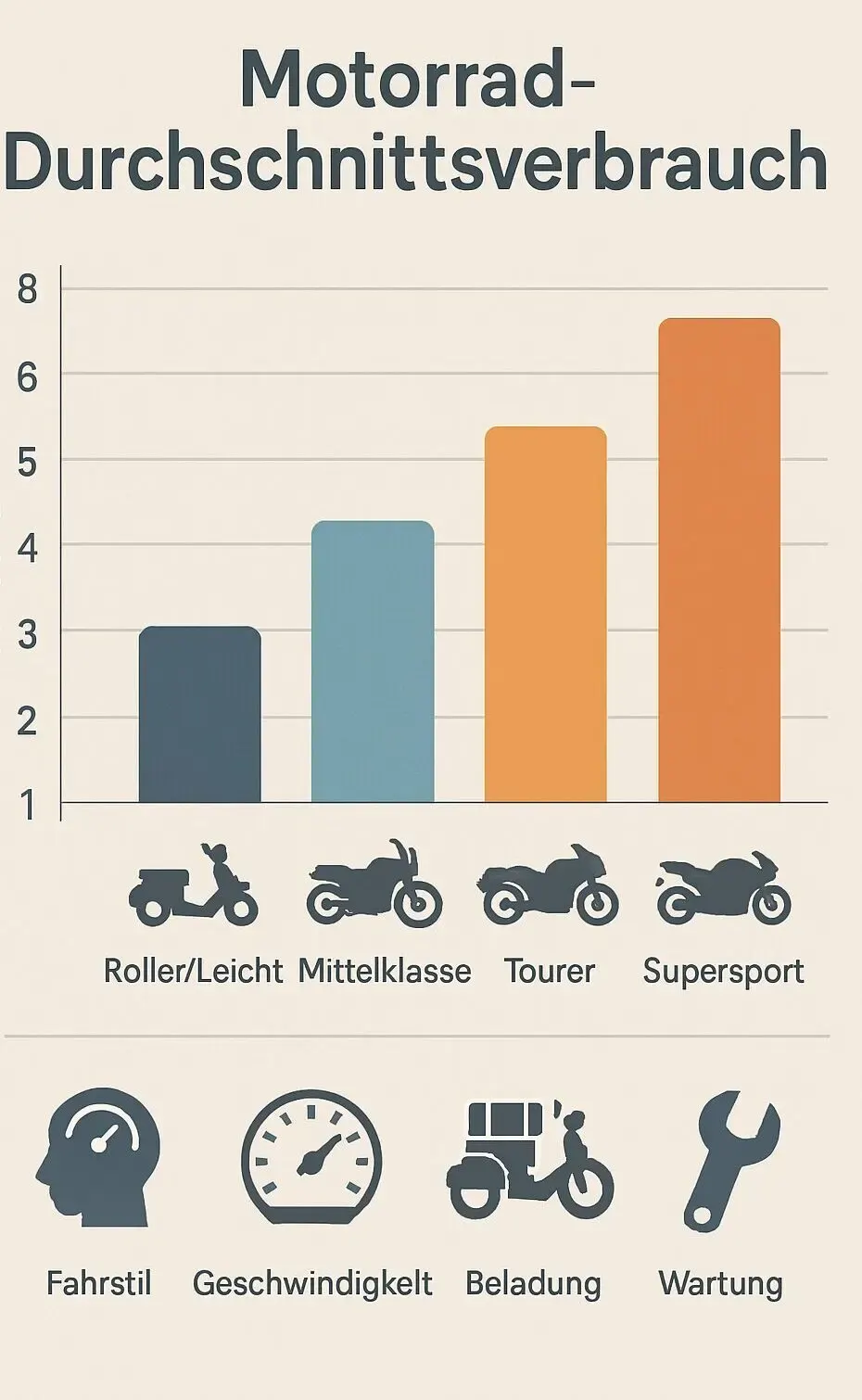
Small motorcycles with small engines are often very economical. Many scooters and 125s manage under 4 l/100 km in everyday use, sometimes considerably less. Consumption tests show, for example, that a light machine such as the Honda CB 300 R manages about 3.3 l/100 km on mixed country roads.
Scooters also achieve very low figures at normal speeds. According to emission and consumption tables, some small models reach 1.5–3.5 l/100 km, depending on design and power.
Mid-range and all-rounders
Many mid-range motorcycles of 250–600 cc use 4–5 l/100 km in everyday use, as long as you don't ride them extremely sportily. Powerful models or large cruisers can be above this. On country roads and in everyday use, however, figures of around 4.5 to 5 l/100 km are typical.
Large tourers and high-performance machines
Consumption rises noticeably with large tourers and superbikes. Tests show that sports bikes such as the Ducati Panigale V4 S can use 4.7–8.1 l/100 km even when ridden economically. Heavy tourers also often need 5–6 l/100 km or more, depending on speed and load.
Why consumption varies so much
Consumption is not a fixed value. It depends on several interlocking factors.
1. Riding style: the biggest lever
| Factor | Effect on consumption | How to optimise |
|---|---|---|
| Riding style | Up to +2 l/100 km with aggressive riding | Ride smoothly, shift up early |
| Speed | Air resistance rises sharply above 100 km/h | Moderate speed, use wind protection |
| Weight / load | More weight → higher consumption | Reduce luggage, pillion only when necessary |
| Technical condition | Dirty filters, wrong tyre pressure increase consumption | Service regularly, check air filter & spark plugs |
| Aerodynamics | A fairing lowers consumption at high speed | Use a windscreen or fairing sensibly |
Technology is only part of it. How you ride influences consumption much more than engine size alone. Hard acceleration, high revs, frequent full throttle and fast motorway stages quickly drive consumption up. Calm, steady country road riding, on the other hand, usually ends up at the lower end.
2. Speed and aerodynamics
As speed increases, air resistance grows disproportionately, and the engine has to work hard to maintain speed. From about 100 km/h, consumption rises much faster on most motorcycles, because air resistance increases with the square of speed.
The design also counts: faired models are often more streamlined than cruisers or naked bikes. You notice this especially on long motorway stretches.
3. Technical condition and maintenance
A well-maintained motorcycle rides more economically. This includes:
a clean air filter,
the right tyre pressure,
clean spark plugs,
well-tuned fuel injection. All of this can noticeably reduce consumption. A missed service or clogged components, on the other hand, increase it without giving you more power.
4. Load and weight
Additional weight from luggage, panniers, a pillion or accessories has a direct effect on consumption. You need noticeably more fuel, especially when pulling away and accelerating.
 Motorcycle or car: which uses less fuel?
The comparison with the car is obvious. According to consumption analyses, many cars average 7–8 l/100 km in real use, while motorcycles with similar use often reach 4–8 l/100 km.
So especially with moderate riding, the motorcycle is often more economical than the car.
That doesn't mean every motorcycle always uses less. But thanks to their lower weight and smaller engines, motorcycles have a good chance of lower average consumption, especially on country roads.
Practical examples: specific consumption figures
Here are a few example values from measurement series that are as reliable as possible:
Light machine (CB 300 R)
approx. 3.3 l/100 km on country roads, ridden moderately.
Sporty mid-range
approx. 4.5 l/100 km, e.g. at moderate country road speeds.
Powerful superbike
approx. 4.7–8.1 l/100 km, depending on riding style and route.
Scooters and 125s
approx. 1.5–3.5 l/100 km on normal rides in town and in the countryside.
| Motorcycle class | Displacement | Realistic consumption (l/100 km) |
|---|---|---|
| Light / scooter | up to 125 cc | 1.5–3.5 |
| Mid-range | 250–600 cc | 4–5 |
| Large / tourer | 600–1000 cc | 5–7 |
| Superbike / heavy | from 1000 cc | 6–8+ |
The figures show that consumption depends heavily on machine, riding style and use. That's exactly why there is no single average for all motorcycles.
How to measure your own consumption reliably
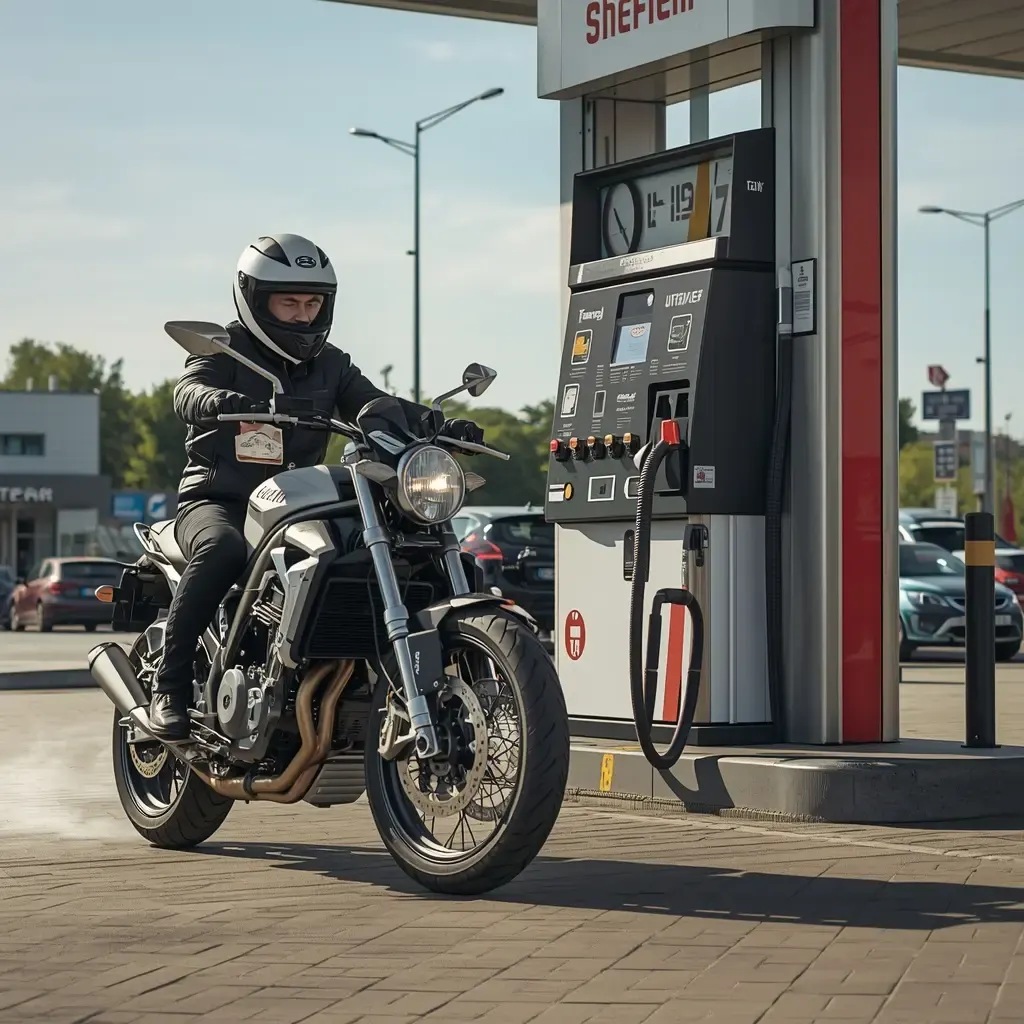
The easiest way is the classic measurement over several tank fills:
Fill the tank completely and note the mileage.
Ride, ideally several rides on mixed routes.
Fill up again and note the number of litres.
Calculate: (litres filled ÷ kilometres ridden) × 100 = l/100 km
This method is usually more accurate than many on-board computers, whose display often fluctuates and doesn't always reflect actual consumption.
Tips: how to reduce your motorcycle's consumption
You can ride more economically without sacrificing riding fun:
Keep a moderate speed instead of riding fast all the time
Ride with anticipation instead of braking and accelerating abruptly
Check tyre pressure regularly and set it correctly
Service regularly (air filter, spark plugs, injection)
Avoid overloading: less weight, less consumption
In a nutshell
Average motorcycle fuel consumption can't be described with a single number. Depending on the machine and riding style, it covers a wide range:
Light motorcycles / scooters: often under 4 l/100 km
Mid-range motorcycles: often 4–5 l/100 km
Large or very powerful motorcycles: rather 5–8 l/100 km and more
This range matches several reliable consumption measurements. The differences come from speed, riding style, weight, aerodynamics and technical condition. In everyday use, motorcycles can be more economical than many cars, but the differences between classes and uses are large.
Frequently asked questions
How much fuel does a motorcycle use on average?
It depends on the type: light motorcycles and scooters are often under 4 l/100 km, mid-range bikes often 4–5 l/100 km, large or very powerful motorcycles rather 5–8 l/100 km and more.
Why does my motorcycle use more than the manufacturer states?
Manufacturer figures come from standardised test cycles and are often lower than real consumption. Riding style, speed, load and maintenance condition push the value up in everyday use.
Is a motorcycle more economical than a car?
Often, yes. Many cars actually use 7–8 l/100 km, motorcycles with similar use often 4–8 l/100 km. Especially with moderate riding on country roads, the motorcycle usually has the advantage.
How do I calculate my motorcycle's consumption?
Fill up, note the mileage, ride, fill up again and calculate: (litres filled ÷ kilometres ridden) × 100 gives the consumption in l/100 km.