Almost everything you do on a motorcycle goes through your hands: throttle, clutch, brake, steering inputs in bends. At the same time, they're among the most sensitive parts of your body. Yet many people buy their motorcycle gloves based on looks, price or gut feeling. That's a mistake, and an expensive one.
In a crash, your hands almost always hit the asphalt first. Abrasions, broken fingers, torn palms or lasting restrictions of movement are common. And even without an accident you'll notice the wrong gloves: little grip, cold fingers, no feel for the lever, hands that tire quickly. That's more dangerous than it sounds.
Good motorcycle gloves protect you, and they improve your control and your feel for the motorcycle. For that you don't need the most expensive model, but the right one for how you ride.
This article covers:
- which protectors on fingers, knuckles and palms really matter
- how winter and summer gloves fundamentally differ
- why grip, ventilation and touchscreen compatibility have to do with safety
- how to find the gloves that suit you, your motorcycle and your riding style
Why motorcycle gloves are more than compulsory equipment
Many underestimate how strongly gloves affect riding. They constantly influence three things:
- Power transmission
Every movement of your hands goes to the motorcycle. If the gloves slip or fit badly, only part of it arrives cleanly. - Feedback
Brake pressure, the clutch's biting point, vibrations: you feel all of this through your hands. Gloves that are too thick or poorly cut swallow this information. - Reaction
Cold or tired hands react more slowly. Exactly when it matters.
Then there's a reflex: anyone who falls instinctively catches themselves with their hands. Without proper protection, serious injuries are then almost inevitable. That's why gloves aren't a comfort item but a central piece of protective equipment.
Protectors: where motorcycle gloves must protect
Not all gloves are equal. What matters is where protectors sit, what they're made of and how they're positioned.
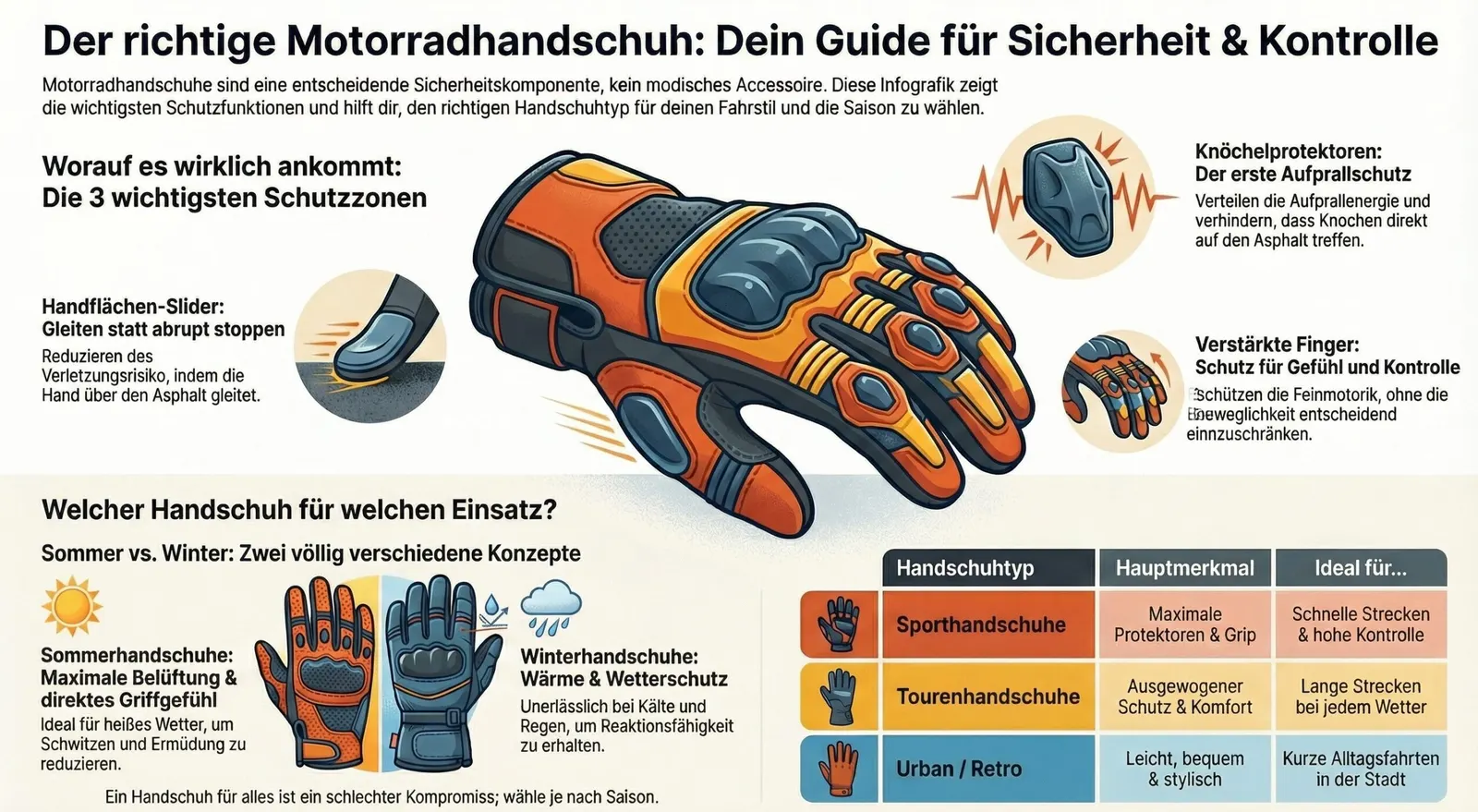
Knuckle protectors: the most visible protection
Knuckles are injured particularly often in motorcycle accidents. Hard knuckle protectors distribute the impact energy so the bone doesn't hit the asphalt directly.
Common materials:
- carbon
- TPU (thermoplastic polyurethane)
- hard plastic with a damping layer
Sports and touring gloves almost always have strong knuckle protectors. On urban or retro models they're often more discreet or only softly padded.
Important: the knuckle protector must neither press nor slip. It only helps in an emergency if it stays in the right place.
Palm protectors: often underestimated
The palm is highly exposed in a crash. If it hits the asphalt unprotected, you risk abrasions and also rotational injuries where the wrist twists.
Good motorcycle gloves rely on:
- additional layers of leather
- Kevlar or aramid fibres
- sliders made of plastic or ceramic
That way your hand slides over the asphalt instead of catching abruptly. That's exactly what significantly reduces the risk of injury.
Good to know: many cheap gloves save money exactly here. You often can't see it from the outside.
Finger protectors: protection for feel and control
Fingers are delicate, but you need them for every fine movement on the handlebars. Even a small injury can restrict you for months.
Look out for:
- reinforced finger edges
- extra padding on the outer sides
- pre-curved fingers for a relaxed position
Good finger protectors protect without restricting you. If a glove feels stiff or clumsy, fine motor skills usually suffer.

Winter gloves or summer gloves: two different concepts
One pair for everything sounds practical but is almost always a compromise. Winter and summer gloves are meant to do very different things.
Summer gloves: cooling, feel, control
Summer gloves dissipate heat and keep sweat in check. They give you maximum contact with the motorcycle.
Typical features:
- perforated leather or mesh inserts
- short cuffs
- thin lining or none at all
- lots of airflow
Advantages:
- very direct feel on the grips
- less fatigue in the heat
- good for town, country roads and sporty riding
Disadvantages:
- hardly any protection from cold
- little insulation in the rain
- quickly get cold on long motorway stages
Good to know: summer gloves suit you if you mainly ride in warm, dry weather.
Winter gloves: warmth, wind and weather protection
Winter gloves have several jobs at once: keep you warm, keep out wind and wet and still leave enough feel for the levers.
Typical features:
- thermal lining
- windproof and waterproof membranes (e.g. Gore-Tex)
- long cuffs
- thicker materials
Advantages:
- warm hands even at low temperatures
- protection from rain and airflow
- good for all-year riders and commuters
Disadvantages:
- less direct feel
- more weight
- more effort on clutch and brake
Good to know: if you regularly ride below 10 °C, you can't do without good winter gloves.
Grip: why slippery gloves are dangerous
Grip is one of the most important points with motorcycle gloves, and yet hardly anyone looks at it. At the latest when your hands sweat or it rains, the good separate from the bad here.
Look out for:
- non-slip material on the palm
- silicone or rubber inserts
- high-quality leather with special surface treatment
Poor grip means, for example, imprecise throttle control and less control at the levers.
Good to know: good gloves feel like part of your hand and not like a layer in between.
Touchscreen gloves: comfort that also brings safety
Sat nav, music, a call in an emergency: these days the smartphone almost always comes along. Touchscreen-compatible gloves are therefore more than a nice extra.
What to look for:
- touch material on thumb and index finger
- precise operation, even when wet
- a coating that lasts
The advantage: you don't have to keep stopping or taking your gloves off, so you're less distracted.
Ventilation: when heat slows your reactions
Overheated hands lose feeling. Sweat makes the grips slippery, muscles tire faster and concentration drops.
You can recognise good ventilation by:
- specifically placed mesh zones
- ventilation channels in the protectors
- perforated leather on the fingers and back of the hand
So ventilation isn't just comfort. It helps determine how long you can ride with concentration and precision.
Fit: what matters most with motorcycle gloves
A glove can have as many protectors as you like. If it doesn't fit, it's dangerous.
A well-fitting motorcycle glove:
- fits snugly without constricting
- doesn't wrinkle in the palm
- doesn't slip when braking
- has no pressing seams
When trying them on, it's best to test:
- full steering lock movements
- pulling hard on clutch and brake
- making a fist and opening it again
Good to know: if you forget you're wearing gloves after a few minutes, they fit.
Which glove suits your riding profile?
Commuters and everyday riders
- weatherproof materials
- good insulation
- touchscreen compatibility
- comfortable even after hours
Touring riders
- balanced protection
- long cuffs
- mix of ventilation and weather protection
Sporty riders
- maximum protectors
- tight, precise fit
- very good grip
- direct feedback
Occasional riders
- easy entry level
- high comfort
- uncomplicated in everyday use
Glove types at a glance
The table shows the common glove types, what they're intended for and how well they protect.
| Glove type | Use / season | Protection | Grip & ventilation | Extras / features |
|---|---|---|---|---|
| Summer gloves | Town, country roads, warm weather | Knuckles: medium, palm: slightly reinforced, fingers: minimal | Grip: high, ventilation: very good, perforated / mesh | Light, direct feedback, high comfort |
| Winter gloves | Commuting, long distances, cold weather | Knuckles: medium to strong, palm: reinforced, fingers: medium | Grip: medium, ventilation: low, focus on warmth | Windproof and waterproof, long cuffs |
| Touring gloves | Long distances, all-round | Knuckles: strong, palm: reinforced, fingers: medium | Grip: high, ventilation: good | Comfortable, touchscreen, protection + weatherproofing |
| Sports / racing gloves | Fast roads, bends | Knuckles: very strong, palm: sliders, fingers: strong | Grip: very high, ventilation: targeted | Maximum protectors, direct feedback |
| Urban / retro | Town, short distances | Knuckles: minimal to medium, palm: light, fingers: minimal | Grip: medium, ventilation: medium | Stylish, light, comfortable |
| All-round gloves | All kinds of riders, occasional use | Knuckles: medium, palm: medium, fingers: medium | Grip & ventilation: medium | Mix of protection, comfort and weatherproofing |
| Off-road / enduro | Off-road, trail | Knuckles: strong, palm: reinforced, fingers: strong | Grip: high, ventilation: good | Robust, flexible, extra protection |
| Textile gloves | Town, everyday | Knuckles: minimal, palm: medium, fingers: minimal | Grip: medium, ventilation: very good | Light, easy care, often waterproof |
| Premium leather gloves | Touring, sport, everyday | Knuckles: strong, palm: reinforced, fingers: medium to strong | Grip: high, ventilation: medium | Durable, high protection, classic look |
| All-weather gloves | All year, rain, snow | Knuckles: medium, palm: medium, fingers: medium | Grip: medium, ventilation: medium to good | Weatherproof, comfortable, universal |
Frequently asked questions about motorcycle gloves
1. Why are motorcycle gloves so important?
They protect your hands from injury, cold, wind and abrasion. Without gloves you risk serious abrasions or fractures in a crash. They also improve grip, control and comfort.
2. Which protectors are crucial in gloves?
The most important protection zones:
- Knuckles: hard shell or TPU
- Palm: leather, Kevlar or sliders
- Fingers: reinforced, pre-curved and padded
3. Do summer and winter gloves only differ in thickness?
No. Summer gloves are light, ventilated and give a lot of feel. Winter gloves insulate, are windproof and waterproof and usually have longer cuffs. Each type is built for different conditions.
4. How can I tell whether a glove fits properly?
It fits snugly, doesn't press, lets your fingers move freely, and you can make a fist without problems. Not slipping is crucial for safety.
5. Are touchscreen-compatible gloves worthwhile?
Yes. You can operate sat nav, music or an emergency call without taking your gloves off. That's less distracting.
6. Which gloves are suitable for sporty riding?
Those with a tight fit, maximum protectors, very good grip, pre-curved fingers and light material for direct feedback. Made for fast bends and longer sporty rides.
7. What makes touring gloves special?
They offer balanced protection, ventilation, long cuffs and often touchscreen function. Comfort and safety for long distances in one.
8. How do I care for my motorcycle gloves properly?
- Leather gloves: only wipe with a damp cloth, treat regularly with leather care
- Textile gloves: wash or reproof according to the manufacturer's instructions
- Check the protectors regularly
9. How often should motorcycle gloves be replaced?
When the leather cracks, protectors are loose or seams come apart. You should also replace them after a crash or after several years of intensive use.
10. Are expensive gloves automatically safer?
Not necessarily. A higher price often stands for better material or a well-known name. What matters are protectors, fit and intended use.
11. How important is grip in gloves?
Very important. Good grip ensures precise control and less fatigue and prevents your hands from slipping in wet or hot conditions.
12. What distinguishes urban from sporty gloves?
- Urban: comfortable, simple protectors, often stylish
- Sporty: hard protectors, tight cut, lots of grip, direct feedback
13. Do gloves help you keep control in the rain?
Yes. Models with a waterproof membrane or non-slip inner material keep your hands dry and the grip stable. Without a membrane, wet gloves can become slippery.
14. Are finger protectors really necessary?
Yes. Fingers are easily injured. Reinforced finger protectors reduce the risk of fractures and abrasions, especially in sideways falls.
15. How do I choose gloves for my riding profile?
Think about:
- riding style (sporty, touring, everyday)
- season and weather
- comfort or protection: which matters more to you?
- extras (touchscreen, ventilation)
That's how you find the gloves that suit you.
Conclusion
Motorcycle gloves aren't a fashion accessory. They're among the most important protective equipment and determine every day how well you have your motorcycle under control.
If you choose your gloves according to riding style, intended use and season, you protect your hands and ride more relaxed as well. If you only buy by looks or price, you're taking an unnecessary risk.
In the end it's quite simple: without healthy hands, motorcycling is over.