You've finally found the right leather jacket, but another manufacturer's trousers fit your build much better? Or you ride in Kevlar jeans and want to connect them to your touring jacket?
Sooner or later almost every rider asks: does my motorcycle clothing have to come entirely from one manufacturer, or can I combine different brands safely and sensibly?
The honest answer: yes, combining works – but only with a system.
Here you'll see step by step how to combine motorcycle clothing from different manufacturers without compromising safety, comfort or function. It's about connecting zips, safety standards and adapters, so you can pick the best from every manufacturer.
Why mix motorcycle clothing at all?
Hardly any manufacturer leads in every area. A few situations almost everyone knows:
The jacket fits, the trousers don't: your shoulders need XL, but your legs can't cope with the Italian cut of size L trousers.
Good protectors, poor ventilation: you like the safety of your sports jacket but need airy mesh trousers in summer.
The glove convinces, the boot doesn't: hands and feet place completely different demands on ergonomics and brand.
Specialisation: one manufacturer is strong in touring and value for money, other brands focus entirely on the track.
There are also very practical reasons: different body proportions, changing seasons, a limited budget or simply your taste. Many experienced riders today deliberately combine instead of tying themselves to complete sets.
Basic rules for combining
Before we go into detail, five basic rules you shouldn't compromise on:
Safety before looks: a cool look is no use if the seam tears in an emergency.
Fit before brand: a well-fitting mix protects you better than a badly fitting complete set.
Check the standards: make sure the CE certifications (EN 17092) match. What exactly this standard covers can be read on the official page (German).
Layer system: think modular: base layer, protective layer, weather protection.
Practical test: your mix has to work in the riding position on your motorcycle, not just in front of the mirror.
Connecting jacket and trousers from different brands
The biggest stumbling block when mixing is the connecting zip. It is extremely important because it stops the jacket riding up in a fall and your back scraping across the asphalt.
Typical zip problems
If you want to zip trousers to another manufacturer's jacket, you usually run into one of these problems:
Different lengths: short zips (approx. 20 cm) don't match full-circumference zips.
Different systems: the teeth are too coarse or too fine (e.g. YKK vs Opti).
Different positions: the zip sits too high on the jacket or too low on the trousers.
Practical solutions
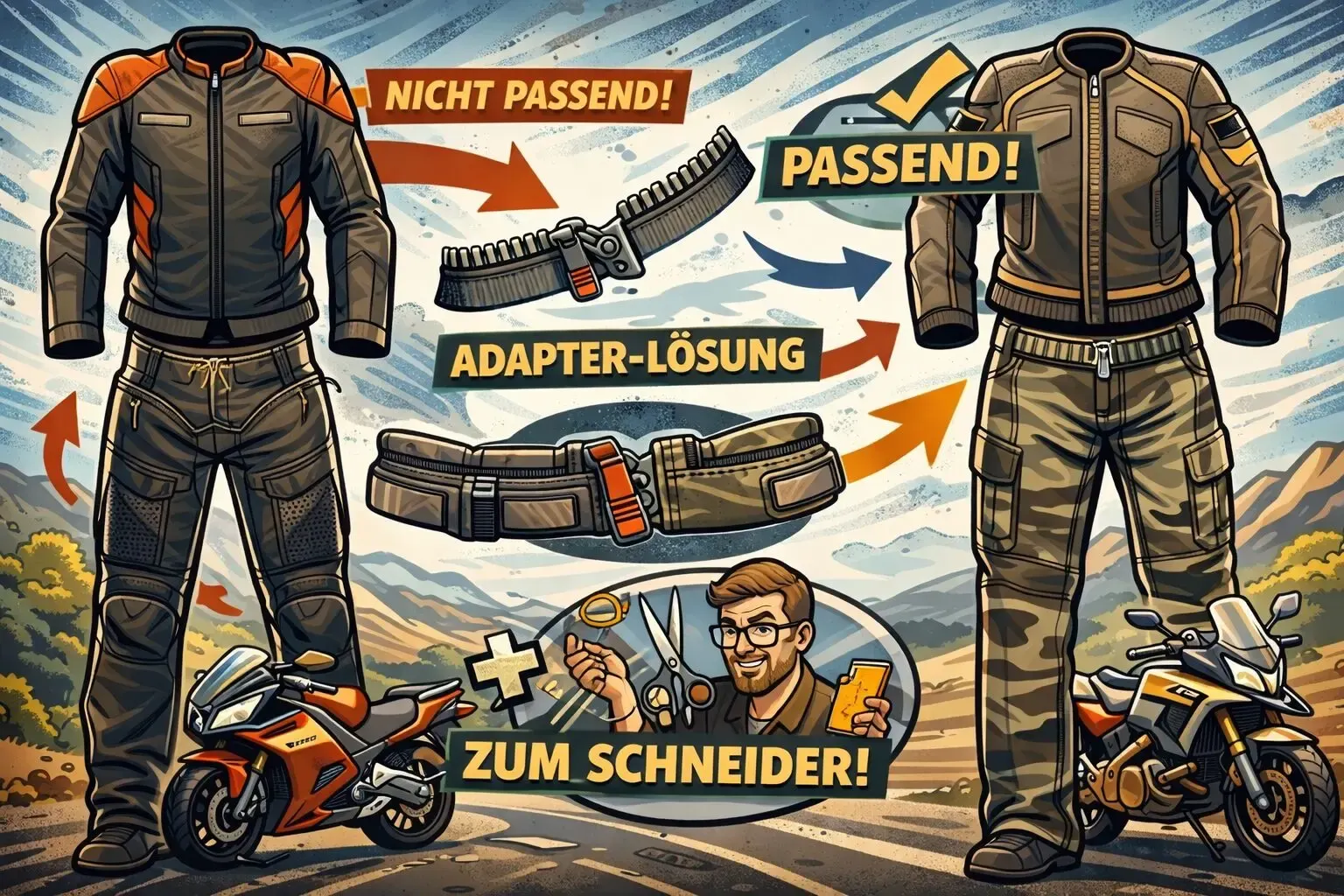
Option 1: adapter zip. Many manufacturers now offer adapters. Belt adapters are particularly handy for motorcycle jeans: you thread your belt through the adapter and zip the jacket straight onto it.
Option 2: have a zip sewn in. This is the cleanest solution. Almost every jacket and pair of trousers comes with the matching counterpart of the zip, usually in a small plastic bag attached to the label. If it's missing, ask the manufacturer and hope for goodwill. Some even send you the zip for free.
Go to a tailor who can sew leather and textile.
Have the jacket's counterpart sewn onto the trousers (or vice versa).
Advantage: you have a secure connection that works just like an original set.
Option 3: not connecting at all. Why that is risky: without a connection you get unpleasant draughts and, above all, a considerably higher risk of injury. For touring and sporty riding, a firm connection between jacket and trousers really should be standard.
Sizes: why a mix often fits better
Why do so many riders swear by mixing brands? Because manufacturers cut differently:
Italian: very slim and sporty, often made for slim, wiry riders.
German: rather generous, with realistic sizes that fit sturdier riders or people with a perfectly normal build.
American: often very wide and designed for comfort (boxy fit).
Only by mixing do you often get the right sleeve length, the right leg length and a good fit of the protectors at knee and shoulder. If Italian trousers are too tight on your calves, German trousers may be the solution while the Italian jacket fits like a glove up top.
Combining protectors correctly
Not every CE protector fits every pocket. If you mix brands or upgrade protectors, pay attention to the following:
CE level: Level 1 is basic protection, Level 2 the recommended standard for road and touring, because it absorbs considerably more energy.
Shape: a back protector from brand A is often wider or narrower than the pocket in brand B's jacket. It must neither kink nor slip.
Position: check while sitting on the motorcycle whether the knee protector really sits on the kneecap or slips to the side.
Tip: swap cheap, hard foam protectors for high-quality brand-independent protectors. These viscoelastic materials are soft, adapt to your body and only become hard on impact. That is allowed and often a big safety plus. If you want to know more about CE protectors and abrasion-resistant materials, read our article on it.
Combining materials: leather, textile and mesh
Leather and textile
A common and practical combination for everyday use is a leather jacket with textile trousers (or vice versa).
Important: leather holds its shape, textile is more flexible. When connecting, make sure the heavier leather jacket doesn't pull the lighter textile trousers down.
Mesh with textile or leather
Ideal for summer, but be careful: mesh itself offers hardly any abrasion protection. Only combine mesh items if they are reinforced with robust Cordura or leather at the typical impact points (shoulder, elbow, knee).
Weather protection across brands
If you have a jacket from manufacturer A and trousers from manufacturer B, the membranes often work differently.
The problem: in heavy rain, water penetrates more easily at the junction between two systems.
The solution: take a separate one-piece rain suit to pull over. It is often more watertight and flexible than any expensive membrane mix.
Typical mistakes when combining
Looks before function: the jacket looks great but is so short that it no longer protects you when you lean forward.
Wrong protector size: you stuff a protector that is too big into a pocket that is too small. That leads to pressure points and material fatigue.
Mixing areas of use: combining a very sporty leather jacket with flapping urban cargo trousers can cause dangerous weaving at high speed.
In a nutshell
Combining motorcycle clothing from different manufacturers is not a compromise. Often it's even the best solution for your build. If you proceed systematically, know the standards and make sure of a firm connection, you get:
More comfort thanks to a better fit.
More safety, because the protectors sit where they belong.
Lower costs in the long run, because you only replace the items that really need replacing.
What matters is not the logo on your chest, but that your gear works together as a system.
Your next step
Take a look at your current gear. Do jacket and trousers have different zips? Then measure the length and look online for a suitable adapter or for a tailor near you.
Frequently asked questions
Can I connect jacket and trousers from different manufacturers?
Yes. Either with an adapter zip or, most cleanly, by having a tailor sew the matching counterpart onto the trousers or jacket.
What do I do if my motorcycle jeans have no zip?
There are belt adapters for this. You thread your belt through the adapter and zip the jacket onto it.
Which protector level should I choose?
Level 2 is the recommended standard for road and touring because it absorbs considerably more energy than Level 1.
Will I stay dry in a combination of two brands?
In heavy rain, water can penetrate more easily at the junction between two membrane systems. A one-piece rain suit to pull over is often the more watertight solution.