
Motorcycle gloves: This is how you protect your hands optimally

Your hands are the link between you and your motorcycle. You use it to control the gas, clutch and brake, hold the line in the curve and react to every situation on the road. At the same time, they are one of the most vulnerable parts of the body when riding a motorcycle. Nevertheless, motorcycle gloves are still viewed as an afterthought by many riders. Bought based on looks, price or gut feeling. A fatal mistake!
In the event of a fall, it is almost always the hands that touch the asphalt first. Abrasions, broken fingers, destroyed palms or long-term restrictions on movement are not uncommon. But even without an accident, the wrong gloves influence your driving behavior: a lack of grip, cold fingers, a lack of feeling or rapid fatigue can be more dangerous than you realize.
Good motorcycle gloves not only protect, but also actively improve your control, feedback and security. What is important is not the most expensive model, but that right model for your usage profile.
In this article you will learn:
-
which protectors on fingers, knuckles and palms are really crucial
-
how winter and summer gloves fundamentally differ
-
why grip, ventilation and touchscreen capability are important to safety
-
and how to find exactly the gloves that suit you, your motorcycle and your riding style
Why motorcycle gloves are much more than mandatory equipment
Many motorcyclists underestimate how much gloves influence riding behavior. They have a permanent impact on three safety-relevant areas:
-
Power transmission
Your hands transfer every movement to the motorcycle. Slippery or ill-fitting gloves distort this power transmission. -
Return message
The feeling for brake pressure, clutch slip point and vibrations comes through your hands. Gloves that are too thick or incorrectly cut take away important information. -
Responsiveness
Cold or tired hands react more slowly, especially in critical situations.
In addition, when you fall, your body instinctively tries to catch itself with your hands.
Without adequate protection, serious injuries are almost inevitable. Good motorcycle gloves are therefore not just comfort; central security element.
Protectors: Where motorcycle gloves really need to protect
Not every glove provides equal protection. What is crucial is where protectors are installed, what material they are made of and how they are positioned.
Ankle protectors – the most obvious protection
The ankles are one of the most commonly injured areas in motorcycle accidents. Hard ankle protectors distribute the impact energy and prevent bones from hitting the asphalt directly.
Common materials:
-
Carbon
-
TPU (thermoplastic polyurethane)
-
Hard plastic with cushioning layer
Sports and touring gloves almost always have pronounced knuckle protectors.
In urban or retro-inspired models, they are often more subtle or only softly padded.
Important: An ankle protector must not press, but must not slip either. Only then can it be effective in an emergency.
Palm protectors – the underestimated lifesaver
The palm of the hand is extremely vulnerable in a fall. If it hits the asphalt unprotected, there is a risk of not only abrasions, but also so-called rotational injuries, in which the wrist twists.
Modern motorcycle gloves are based here:
-
additional leather layers
-
Kevlar or aramid fibers
-
Sliders made of plastic or ceramic
These ensure that your hand glides over the asphalt, instead of stopping abruptly. This is exactly what significantly reduces the risk of injury.
Additional info
Many cheap gloves save money right here. A risk that is often not visible from the outside.
Finger protectors – protection for fine motor skills and control
Fingers are delicate but crucial for control and feeling. Even small injuries can limit your health for months.
Pay attention to:
-
reinforced finger edges
-
additional padding on the outside
-
Pre-curved finger shape for relaxed posture
Good finger protectors protect without restricting mobility. If a glove feels stiff or bulky, fine motor skills usually suffer.

Winter vs. summer gloves: Two completely different concepts
A pair of gloves for everything sounds practical - but it's almost always a compromise. Winter and summer gloves pursue fundamentally different goals.
Summer gloves: cooling, feel, control
Summer gloves are designed to dissipate heat and reduce sweating. They allow maximum contact with the motorcycle.
Typical properties:
-
perforated leather or mesh inserts
-
short cuffs
-
thin lining or none
-
high air flow
Advantages:
-
very direct grip feeling
-
less fatigue in the heat
-
ideal for city traffic, country roads and sporty driving
Disadvantages:
-
hardly any protection from the cold
-
little insulation in the rain
-
Cools down quickly on long stretches of motorway
Additional info
Ideal for riders who ride primarily in warm, dry weather.
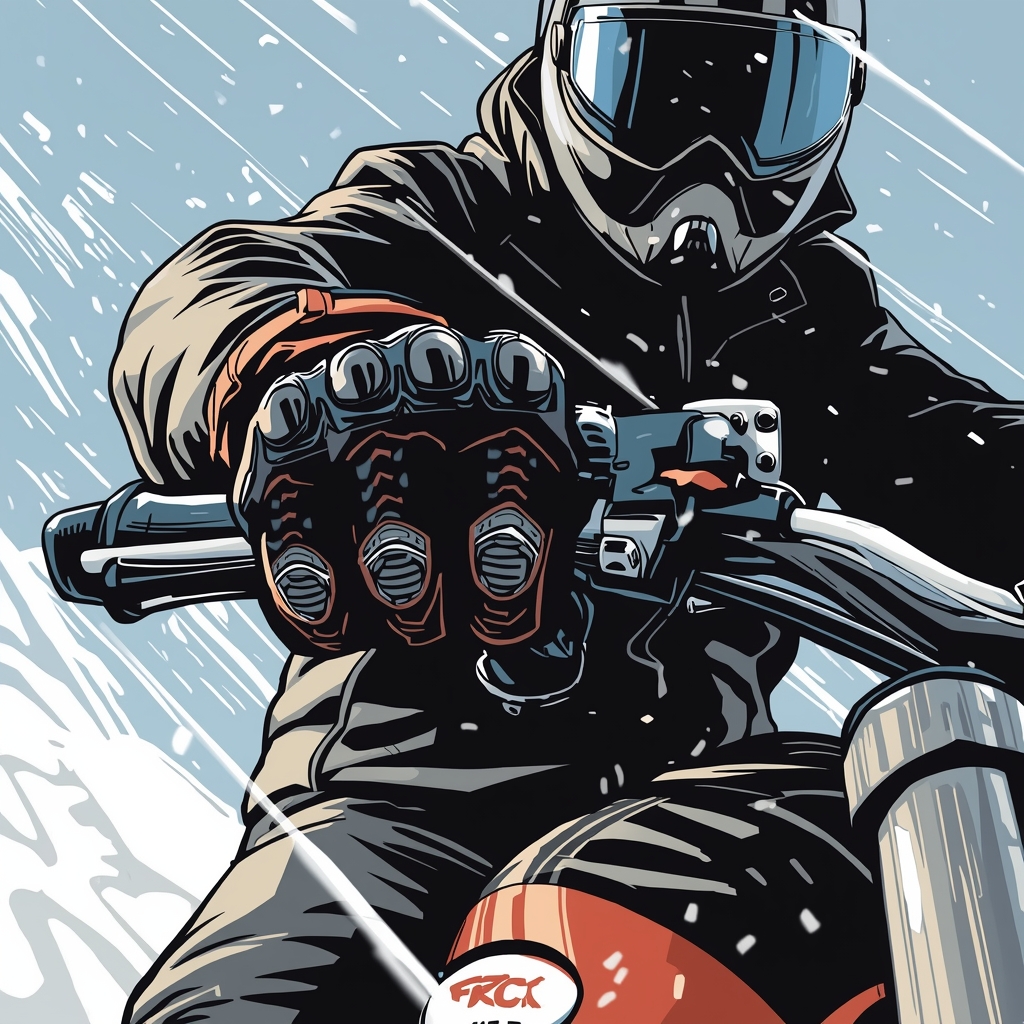
Winter gloves: warmth, wind and weather protection
Winter gloves have to fulfill several tasks: They keep you warm, protect against wind and moisture and should still remain controllable.
Typical features:
-
Thermal lining
-
windproof and waterproof membranes (e.g. Gore-Tex)
-
long cuffs
-
thicker materials
Advantages:
-
warm hands even at low temperatures
-
Protection from rain and wind
-
ideal for all-season drivers and commuters
Disadvantages:
-
less direct feeling
-
higher weight
-
more effort on the clutch and brake
Additional info
If you regularly ride below 10 °C, you can't ignore good winter gloves.
Grip: Why slippery gloves are more dangerous than you think
Grip is one of the most important but least considered factors in motorcycle gloves. As soon as your hands sweat or it rains, the difference between good and bad models becomes clear.
Pay attention to:
-
Non-slip materials in the palm
-
Silicone or rubber inserts
-
high-quality leather with special surface treatment
Poor grip means:
-
imprecise Gasan
Additional info
Good gloves feel like they're part of your hand - not like a layer in between.
Touchscreen Compatibility: Convenience that increases security
Navigation, music control or emergency calls – smartphones have long been part of everyday motorcycle life. Touchscreen-enabled gloves are therefore more than just a nice extra.
What you should pay attention to:
-
Touch material on thumb and index finger
-
precise operation, even when wet
-
durable coating
The safety gain is that you don't have to constantly stop or take off gloves - and that's it less distracted are.
Ventilation: When heat reduces your responsiveness
Overheated hands lose feeling. Sweat makes handles slippery, muscles tire more quickly and concentration drops.
You recognize good ventilation by:
-
strategically placed mesh zones
-
Ventilation channels in protectors
-
perforated leather on fingers and back of hand
Ventilation is not a comfort issue - it directly influences how long you can ride with concentration and control.
Fit: The decisive factor for safety
No matter how many protectors a glove has, if it doesn't fit, it's dangerous.
A well-fitting motorcycle glove:
-
fits snugly without constricting
-
does not crease in the palm
-
does not slip when braking
-
has no pressing seams
Test when trying on:
-
full steering angles
-
pulling hard on the clutch and brake
-
Close and open your fist
Additional info
If you forget you're wearing gloves after a few minutes, they'll fit.
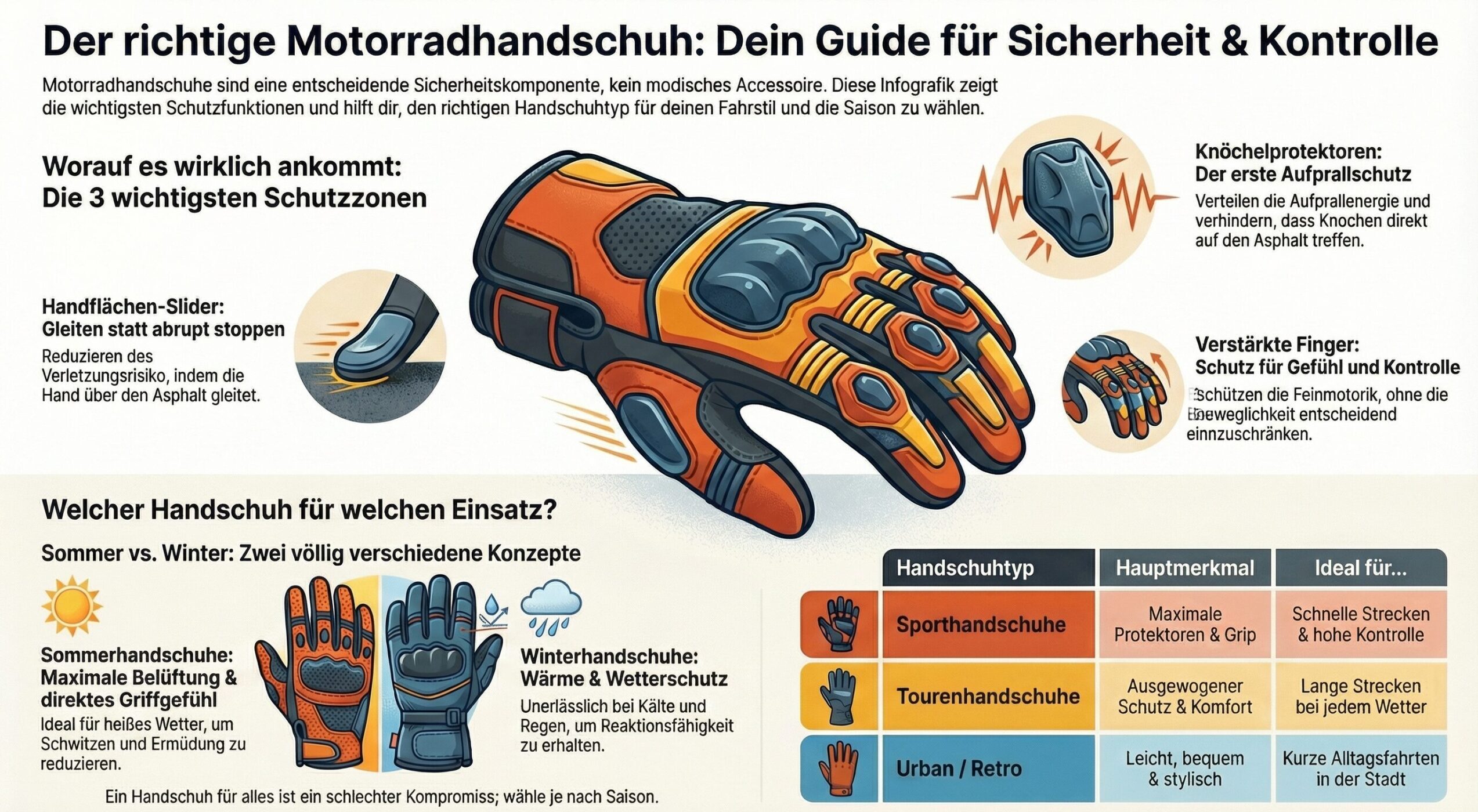
Which glove suits your usage profile?
Commuter and everyday driver
-
weatherproof materials
-
good insulation
-
Touchscreen capability
-
high long-term comfort
touring rider
-
balanced protection
-
long cuffs
-
Combination of ventilation and weather protection
Sporty drivers
-
maximum protectors
-
tight, precise fit
-
extremely good grip
-
direct feedback
Occasional driver
-
easy entry
-
high comfort
-
uncomplicated handling
In the following overview you will find the different types of gloves and the special features that are characteristic and safety-related for these types of gloves.
| Glove type | Area of application / season | Protection | Grip & ventilation | Extras / special features |
|---|---|---|---|---|
| Summer gloves | City, country road, warm weather | Knuckle: medium, palm: slightly reinforced, fingers: minimal | Grip: high, ventilation: very good, perforated / mesh | Light, direct feedback, high comfort |
| Winter gloves | Commuting, long distances, cold weather | Knuckle: medium-strong, palm: reinforced, fingers: medium | Grip: medium, ventilation: low, focus heat | Wind and waterproof, long cuffs |
| Touring gloves | Long distances, all-round | Knuckle: strong, palm: reinforced, fingers: medium | Grip: high, ventilation: good | Comfortable, touchscreen, protection + weatherproof |
| Sports gloves / racing | Fast routes, curves | Knuckle: very strong, palm: slider, fingers: strong | Grip: very high, ventilation: targeted | Maximum protectors, direct feedback |
| Urban/retro | City, short distances | Knuckles: minimal-medium, Palm: light, Fingers: minimal | Grip: medium, ventilation: medium | Stylish, light, comfortable |
| All-round gloves | All-rounder, occasionally | Knuckles: medium, palm: medium, fingers: medium | Grip & ventilation: medium | Combination of protection, comfort and weather resistance |
| Offroad/Enduro | Terrain, trail | Knuckles: strong, palm: reinforced, fingers: strong | Grip: high, ventilation: good | Robust, flexible, extra protection |
| Textile gloves | City, everyday life | Knuckles: minimal, palm: medium, fingers: minimal | Grip: medium, ventilation: very good | Lightweight, easy to care for, often waterproof |
| Premium leather gloves | Touring, sport, everyday life | Knuckles: strong, palm: reinforced, fingers: medium-strong | Grip: high, ventilation: medium | Durable, high protection, classic look |
| All-weather protective gloves | All year round, rain, snow | Knuckles: medium, palm: medium, fingers: medium | Grip: medium, ventilation: medium to good | Weatherproof, comfortable, universally applicable |
FAQ: Motorcycle gloves – answers to the most important questions
1. Why are motorcycle gloves so important?
Motorcycle gloves protect your hands from injuries, cold, wind and abrasion. Without it, you risk serious abrasions or broken bones if you fall. At the same time they improve grip, control and comfort.
2. Which protectors are crucial for gloves?
The most important areas of protection are:
-
ankle: hard shell or TPU
-
palm: Leather, Kevlar or Slider
-
finger: reinforced, pre-curved and padded
3. Do summer and winter gloves only differ in thickness?
No. Summer gloves are light, ventilated and offer a lot of grip. Winter gloves insulate, are windproof and waterproof and are often cut longer. Each model is optimized for different conditions.
4. How do I know if a glove fits properly?
A glove fits properly if it fits snugly, does not pinch, the fingers can move freely and the fist can be closed easily. Non-slip fit is crucial for safety.
5. Are touchscreen-enabled gloves useful?
Yes. They enable navigation, music control or emergency calls without taking off the gloves. This reduces distraction and increases safety.
6. Which gloves are suitable for sporty driving?
Tight fit, maximum protectors, very good grip, pre-curved fingers and light material for direct feedback. Perfect for fast corners and longer sporty rides.
7. What makes touring gloves special?
Touring gloves offer balanced protection, ventilation, long cuffs and often touchscreen functionality. They combine comfort with safety for long distances.
8. How do I properly care for my motorcycle gloves?
-
Leather gloves: only wipe with a damp cloth, leather care regularly
-
Textile gloves: wash or impregnate according to the manufacturer's instructions
-
Check protectors regularly
9. How often should you replace gloves?
If the leather becomes cracked, protectors are loose or seams are damaged. You should also replace them after falls or after a few years of intensive use.
10. Are expensive gloves automatically safer?
Not necessarily. More expensive often means high quality material or brand name. are crucial Protectors, fit and area of use, not just the price.
11. How important is grip in gloves?
Very important. Good grip provides precise control, reduces fatigue and prevents uncontrolled slipping in wet or hot conditions.
12. What are the differences between urban and sports gloves?
-
Urban: rather comfortable, minimalist protectors, often stylish
-
Sporty: hard protectors, tight cut, high grip, direct feedback
13. Can gloves improve control in the rain?
Yes, gloves with a waterproof membrane or non-slip inner material keep your hands dry and maintain grip. Without a special membrane, wet gloves can become slippery.
14. Are finger protectors really necessary?
Yes. Fingers are very susceptible to injury. Reinforced finger protectors reduce the risk of breaks and abrasions, especially in sideways falls.
15. How do I choose gloves according to my usage profile?
Consider:
-
Driving style (sporty, tour, everyday life)
-
Season/weather
-
Comfort vs. protection
-
Extras (touchscreen, ventilation)
This way you can find exactly the gloves that suit you.
Conclusion: Your hands determine safety and control
Motorcycle gloves are not a fashion accessory. They are a crucial part of your safety equipment - and they influence how well you control your motorcycle every day.
Choosing your gloves based on your riding style, usage and season will not only protect your hands, but improve your overall riding experience. On the other hand, if you only decide based on appearance or price, you are taking unnecessary risks.
Because one thing is certain:
Without healthy, functioning hands, motorcycling is over.
You can also listen to this article version as audio - ideal for on the go or on long motorcycle tours. Simply click on the player below to listen directly.
For many years I have been intensively involved with motorcycles, their technology and all topics relating to safety, maintenance and equipment. My goal is to present practical information in an understandable way, to realistically assess risks and to objectively classify common myths.
All content on MOTO-guide.com are based on in-depth research, technical classification and my experience in dealing with motorcycles. I want to help riders make informed decisions and use their motorcycle safely and consciously.




Leave a comment
Participate in the discussion?Leave us your comment!