
Why you shouldn't neglect the clutch & the tire tread!

Motorcycling is the purest form of transportation, but it doesn't forgive negligence. While modern bikes shine with lean angle ABS, wheelie control and semi-active chassis, fundamental safety is still determined by two mechanical components: the clutch and the tires.
In the daily shop talk at the biker meeting, the focus is often on horsepower numbers or design. But the harsh reality on the street looks different. A slipping clutch or an outdated tire isn't just a maintenance detail - it's a ticking time bomb. This guide analyzes the physical background, the creeping dangers and the vital measures that every biker should know.
Part 1 – The clutch: The misunderstood precision instrument
The clutch on a motorcycle is much more complex to use than that on a car. While in a car the clutch is usually only used for starting and changing gears, on a bike it is an active element of driving stability - think of playing with the rocker arm in a curve or slowly maneuvering at walking pace.
Structure and technical function in detail
Most motorcycles use a so-called Multi-plate oil bath clutch. It sits between the crankshaft and the gearbox.
-
The clutch package: It consists of an interplay of friction disks (with lining) and steel disks.
-
The clutch basket: It is powered by the engine.
-
The printing plate: It is pressed against the disc pack by strong springs to create a frictional connection.
-
The release mechanism: As soon as you pull the lever, the pressure plate is lifted against the spring force. The discs now have space to slide past each other - the flow of force is interrupted.
What does “clutch grinding” really mean technically?
When we talk about “grinding” we mean the state of partial friction. The discs touch each other, but do not have enough contact pressure to rotate synchronously.
-
Intentional grinding: When starting off, this is necessary to overcome the vehicle's inertia.
-
Unintentional grinding: There is a defect here. The clutch slips even though the lever has been completely released. This often happens under high load (e.g. when accelerating in high gear).
Symptoms: The language of your motorcycle
Many riders only notice wear and tear when the bike is almost unrideable. Watch out for these subtle warning signs:
-
The “rubber band effect”: You give full throttle, the engine speed shoots up like on a scooter, but the speedometer needle only moves with a time delay.
-
Sluggish gearbox: If the clutch no longer separates cleanly, the transmission gears are under residual tension. Putting the car in neutral is a test of patience.
-
Vibrations and jerks: A “judging” feeling when starting up indicates warped steel discs, usually a result of extreme heat.
-
The smell test: Burnt friction linings have a very specific, sulphurous, acrid smell that is often only noticeable after the engine has been switched off.
The dangers: Why a defect is life-threatening
A technical component that reacts unpredictably is always dangerous on a motorcycle.
-
Loss of engine brake: Anyone who downshifts before a serpentine relies on the engine to stabilize the load. If the clutch slips here, the motorcycle continues to push without braking - a catastrophe before the curve.
-
Thermal destruction: The friction creates temperatures of several hundred degrees. This heat can locally “crack” the engine oil, which endangers the lubricating properties of the entire engine. In the worst case, the steel discs warp so much that the clutch suddenly no longer disengages - the bike jumps forward at the traffic lights even though you pull the lever.
-
Hectic in the chassis: If the clutch slips during acceleration and then suddenly engages again, it sends a hard shock through the drive train. When leaning, this impulse can be enough to cause the rear tire to break away.
Causes of premature wear
-
Wrong oil: Many motorcycle clutches run in engine oil. If you incorrectly use car oils with low-friction additives (friction reducers), the clutch will immediately begin to slip.
-
Incorrect lever setting: If there is no play in the cable, the clutch is constantly under minimal tension - it drags unnoticed.
-
Short-haul and stop-and-go: Constant starting is hard work for the pads.
Part 2 – Tires: Your only support when leaning
When you consider that two rubber surfaces the size of a credit card protect your life, it becomes clear: There is no room for compromise here.
The underestimated danger: tire age
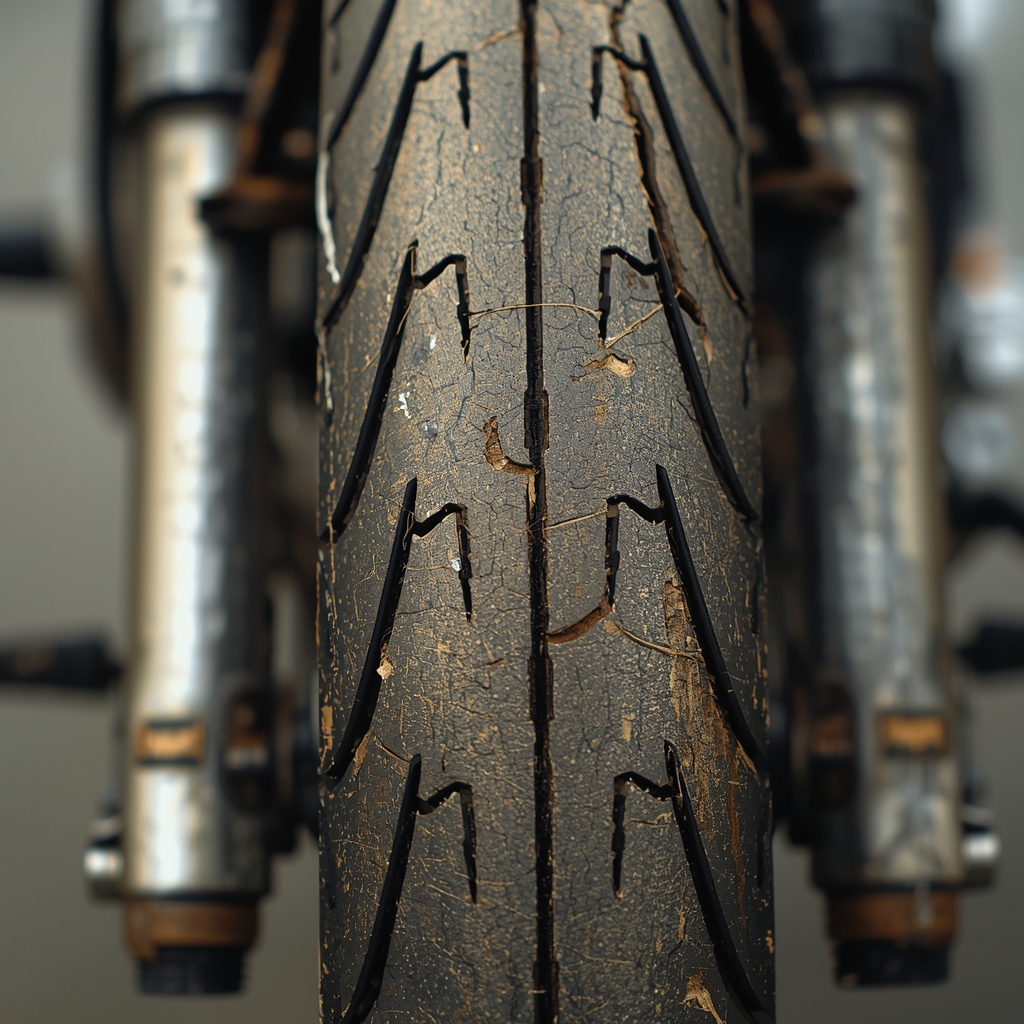
Tires are living chemistry. They consist of natural rubber, synthetic polymers, carbon black, silica and plasticizers. The latter are the problem: they evaporate over the years.
Why do tires age even when standing?
-
Oxidation: Oxygen reacts with the rubber molecules and makes them brittle.
-
UV radiation: Sunlight breaks the polymer chains.
-
Ozone: Creates the typical small cracks in the tire sidewall.
A tire that is 8 years old can still look “like new” but has the tactile properties of a plastic bucket. It can no longer mesh with the micro-roughness of the asphalt.
The “tread depth” myth
In Germany the legal minimum of 1.6 mm applies. But for a motorcyclist, this value is almost negligent.
-
Water displacement: A motorcycle tire has a round contour. This shape changes as the profile decreases (it is driven “square”). This not only affects water displacement (danger of aquaplaning), but also destroys the homogeneous steering behavior.
-
Grip level: The rubber mixture is often built up in layers. When the tread is low, you're often riding on a harder base compound that offers less grip than the soft top layer.
A little additional tip for you:
Did you know that the law makes differences when it comes to tread depth? While for large machines the well-known ones 1.6mm apply, writes § 36 StVZO for light motorcycles (up to 125 cc) only a minimum depth of 1.0mm before.
But be careful: Just because it's legal doesn't mean it's safe! A tire with only one millimeter of tread can hardly displace water when it rains. The risk of aquaplaning increases massively.
Our recommendation: Ignore the legal minimum. For your safety in the saddle, you should - no matter what displacement class - at the latest 2.0 mm remaining profile think about a change. Your life is worth more than the few euros you save on a delayed tire change.
The DOT number: your life insurance
Every biker must be able to read the DOT code. The four numbers (e.g. 4821) say it all: 48th week in 2021.
-
From 5 years: Increased attention. The rubber becomes harder and the border area narrows.
-
From 10 years: Absolute driving ban. The risk of casing damage or a sudden loss of grip is incalculable.
Typical consequential damage and hazards
-
Longer braking distances: A hardened tire slips sooner. The ABS regulates more often and dramatically increases the braking distance.
-
Low-siders: When cornering, the front tire loses grip without warning because the cold, hard rubber no longer builds up temperature.
-
Material fatigue: Old tires are prone to tread separation at high speeds on the highway.
Part 3 – The direct comparison: clutch vs. tires
| factor | Grind clutch | Old tires |
| Primary risk | Mechanical failure & loss of control | Immediate fall due to slipping |
| Recognizability | Hearing, tachometer, feeling in the finger | DOT number, visual inspection, “hardness test” |
| Type of wear | Mostly due to operating errors/mileage | Through time (aging) and abrasion |
| Cost factor | High (time required for disassembly) | Moderate (set prices approx. 250-450 €) |
| Danger scenario | Stopping in the tunnel / coasting | Departure in the curve / brake failure |
Conclusion of the comparison: While a slipping clutch often means financial ruin or a technical breakdown, the old tire is the direct cause of serious personal injury. Both together are a life-threatening combination.
Part 4 – Practical Garage Inspection Checklist
You don't have to be a professional mechanic to check your bike. Take 15 minutes once a month.
Clutch checkup
-
Leverage game: Do you have about 10-15 mm of play at the end of the lever before you feel any resistance? If not: adjust!
-
Stress test: Drive in third gear at around 4,000 rpm and suddenly give full throttle. If the speed increases faster than the speedometer, the clutch will slip.
-
Cable pull test: Is the train frayed? Does it move smoothly? A stiff pull prevents the springs from completely closing the clutch.
Tire checkup
-
DOT age: Is the tire older than 6 years? If so, plan a change as soon as possible, even if your profile is good.
-
Tread depth: Fair in several places. Motorcycle tires often wear unevenly (in the middle when driving on the highway, on the sides when cornering). Recommendation: change from 2 mm.
-
Surface structure: Do you see small cracks (“hairline cracks”) in the tread grooves? This is a sign of lateness.
-
Air pressure: Check him always on cold tires. Incorrect pressure is the main reason for premature aging and poor running pattern (sawtooth).
Part 5 – Investing in security: Is it worth it?
Many people are put off by the costs. A new clutch including installation can quickly cost 1,000 euros or more for complex bikes (e.g. BMW boxers or large tourers). A set of premium tires costs between 300 and 450 euros.
But let's look at the opposite calculation:
-
Damage caused by a fall (even a harmless “fall”) usually costs 500-1,000 euros due to broken panels, levers and mirrors.
-
Damage to health is priceless.
-
The value of the motorcycle increases through verifiable maintenance.
Regular checks cost almost nothing. A tread depth gauge costs 5 euros; Viewing the DOT number is free. Professional maintenance is not a luxury, but the basis of your hobby.
Final conclusion: Your life depends on the material
Safety when riding a motorcycle is a three-legged bank: Driving skills, protective clothing and technology. If one leg of the technology breaks away, the other two can often no longer compensate.
Slipping clutches rob you of precision and control over engine performance. Old tires rob you of the physical ability to stay on track. Treat your motorcycle not just as a lifestyle item, but as the high-performance machine it is.
Check your tires today. Next time you hear your engine revving, listen carefully. If you know and respect your material, you will not only ride faster, but above all, longer.
Your safety starts in your head and ends on the asphalt. Make sure the connection lasts.
For many years I have been intensively involved with motorcycles, their technology and all topics relating to safety, maintenance and equipment. My goal is to present practical information in an understandable way, to realistically assess risks and to objectively classify common myths.
All content on moto-guide.com are based on in-depth research, technical classification and my experience in dealing with motorcycles. I want to help riders make informed decisions and use their motorcycle safely and consciously.




Leave a comment
Participate in the discussion?Leave us your comment!