Sound familiar? The bend flowed perfectly, the view from the pass is magnificent, and you want to tell your riding buddies straight away. Or you're on an 800-kilometre stage and the silence in your helmet is starting to drag. A modern motorcycle communication system (intercom) today is far more than a two-way radio. It gives you directions, plays your music and calls for help in an emergency.
But the market is full of jargon. So that you don't spend a few hundred euros on technology you switch off in annoyance after two tours, we'll approach it thoroughly: from the acoustics in the helmet to the little tricks that make the difference in everyday use.
Bluetooth or mesh: which is better for your group
Imagine you're out with five friends. One needs to fill up, one gets stuck at the lights. With classic Bluetooth, that was the moment the connection broke down. The reason: Bluetooth works like a string of fairy lights. If one link fails, the rest stay dark.
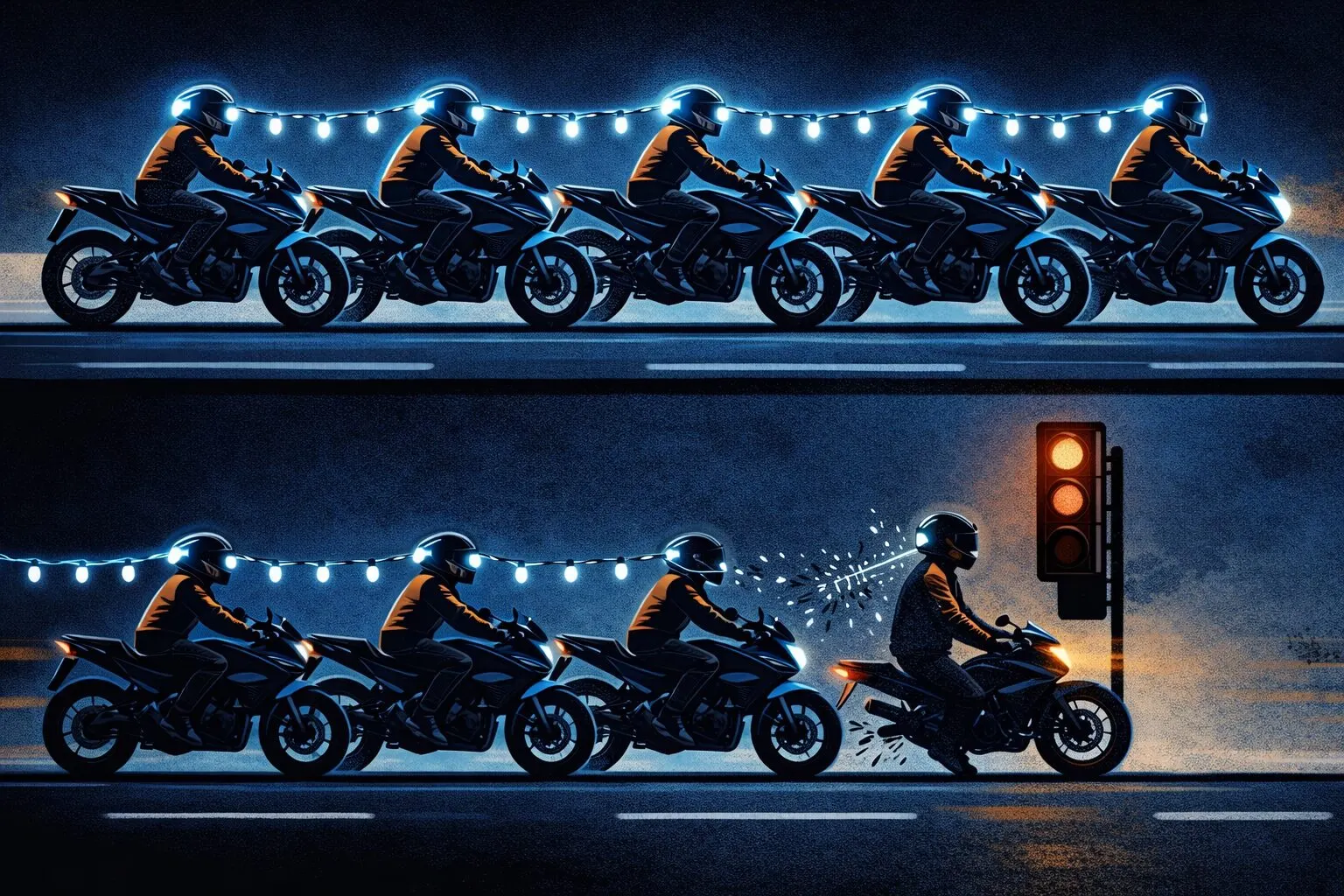
Mesh: the group stays connected
Mesh technology (especially the newer generations 2.0 and 3.0) has fundamentally changed group communication. All participants are networked with each other every which way. If one drops out, the others still aren't left in silence. In practice this means:
The advantage: if rider C gets stuck at the lights, A, B, D and E simply keep talking. As soon as C catches up, they're automatically back in the group. No button pressing, no swearing.
Why you often can't understand anything in the helmet
The biggest problem on a motorcycle isn't the technology but physics. Above a certain speed, air turbulence creates noise that masks almost all frequencies. If you want to learn more about choosing the right motorcycle helmet, read our article on it.
Digital signal processing (DSP) and noise reduction
A good system distinguishes between engine noise and voice. Modern algorithms filter out the low hum of a V-twin and the high whistle of the wind.
What to look for: check the "side tone" function in the shop (or in test reports). It lets you hear your own voice quietly in the speaker. That way you don't start shouting in your helmet, which annoys your fellow riders and tires your voice.
Speaker position is what counts
You can have the most expensive system in the world. If the speaker sits 5 mm off your ear canal, it still sounds like an old pocket radio.
Centre: the speaker must sit exactly over your ear canal.
Distance: use spacer pads. There should be hardly any air between ear and padding, without it pressing. The closer the speaker is to your ear, the fuller the bass sounds and the quieter you can set it. That protects your hearing.
Universal or integrated system?
Opinions differ here. It's the question: tidy looks or technical flexibility.
The integrated solution (OEM)
Many helmet manufacturers work with electronics specialists. The system then disappears completely into the helmet shell.
Pro: no wind noise from the device, good weight distribution, sleek looks.
Con: you buy a helmet from another brand in three years? Then the expensive system is useless. The batteries are also often built in and hard to replace.
The universal system (external)
The classic module clamped to the side of the helmet.
Pro: you take it from helmet to helmet. The buttons are usually much larger and easier to operate with gloves.
Con: it looks less elegant and can create one-sided wind noise on fast motorcycles, especially naked bikes.
Features to look out for when buying
Some features are only printed in small letters on the box, but after the first tour they decide whether you love or hate the device.
Audio multitasking
Cheap chipsets can only do one thing at a time. When the sat nav speaks, the music stops. When you talk to your pillion, the sat nav goes silent.
You don't want that. You need a system with two Bluetooth chips (or modern mesh management) that handles audio overlay. Your music gets quieter when your mate talks, but doesn't stop. That keeps the flow going.
Charging while riding
A point many only think of too late. Many devices switch off as soon as a USB cable is plugged in. If you have a 12-hour stage ahead of you, you might want to recharge from a power bank in your tank bag. So check beforehand whether the device supports "charge while riding".
Installing an intercom: step by step
A sloppily installed system is a permanent annoyance. Take 60 minutes, a soft cloth and a good lamp.
Remove the padding: carefully take out the cheek pads.
Route the cables: never cross cables and never route them where the mechanism of a flip-up helmet could crush them. Fix them with tape in the recesses of the EPS shell.
Position the microphone: in a full-face helmet, stick the flat microphone slightly to the side of your mouth – that prevents breathing noise. In a flip-up helmet, the boom must sit so that it doesn't get trapped when the chin bar is closed.
Glasses test: if you wear glasses, put them on after the speakers are in. Nothing is worse than a speaker pressing the arm of your glasses against your temple.
Frequently asked questions about motorcycle communication
Why is the range in the mountains so much worse than stated?
The manufacturer's figures apply to clear line of sight on flat land. In the Alps, rock faces reflect the signal but also block it heavily. Mesh has the advantage here because the group acts as a relay. If rider B is in the middle, they can pass the signal from A to C around the corner.
Do I still need earplugs?
Yes. The opposite is a widespread misconception. The noise in the helmet comes from the wind and permanently damages your hearing. Good filter earplugs reduce ambient noise but let your speakers' frequencies through. With earplugs you often understand conversations even better than without.
Can I pair my system with my motorcycle's TFT display?
Yes, but be careful not to create pairing chaos. It usually runs most stably if you pair both the phone and the headset with the motorcycle. The motorcycle is then the hub. Direct connections between all three devices often cause protocol confusion.
Which system suits you?
To find the right system, be honest with yourself:
Solo riders: an inexpensive Bluetooth system with really good speakers for music and navigation is perfectly adequate.
Touring couples: two Bluetooth devices in a set. Mesh is often overkill here, unless you regularly ride in larger groups.
Group leaders: nothing works without mesh here. Being able to manage five or more participants easily is worth every cent.
Another important point: look at what your friends use. If your whole circle of friends uses the same manufacturer, pairing is child's play. Cross-brand pairing mostly works today too (universal intercom), but often with compromises in range and extra functions.
When buying, also look for IP67 certification so your system survives heavy rain in the Alps. And know the legal rules on impaired hearing while riding – in Germany, for example, § 23 StVO. Which rules and laws apply to motorcyclists in different countries can be found in our rules section.
Checklist for buying your intercom
Use this list as a cheat sheet in the shop or when getting advice.
Motorcycle communication checklist:
Mesh support: indispensable if you ride with more than one other person.
Bluetooth 5.2: standard for a stable connection to phone and sat nav.
Audio multitasking: can you listen to music and talk at the same time? (Cheap chips often block each other.)
HD speakers: does the system have high-quality drivers that sound clear even at 100 km/h and above?
Digital noise reduction (DSP): does the system actively filter wind noise for your fellow riders?
Battery life & charging: does the device last 10 hours? Can it be charged from a power bank while riding?
Feel: can you find the buttons blind with your thickest gloves?
Helmet compatibility: does the module fit your helmet shell, or are there annoying edges?
App connection: can you handle settings and updates conveniently via smartphone?
With this you're well prepared to find the right setup for your tours.