Whether you're chasing 200 hp around the Nordschleife, exploring the Balkans on an adventure bike or cruising relaxed to the ice-cream parlour: in every case your motorcycle tyres are your only connection to the asphalt. Per tyre, this contact patch is hardly bigger than a credit card. On these few square centimetres, it's decided how much fun you have, how long your braking distance is and, in extreme cases, whether you arrive in one piece.
Tyre development has taken a big leap in recent years. Rubber compounds are developed with the help of artificial intelligence, and adaptive tread patterns are appearing. At the same time, however, the bureaucracy has grown. Here you'll get an overview of technology, tyre types, the legal situation and care.
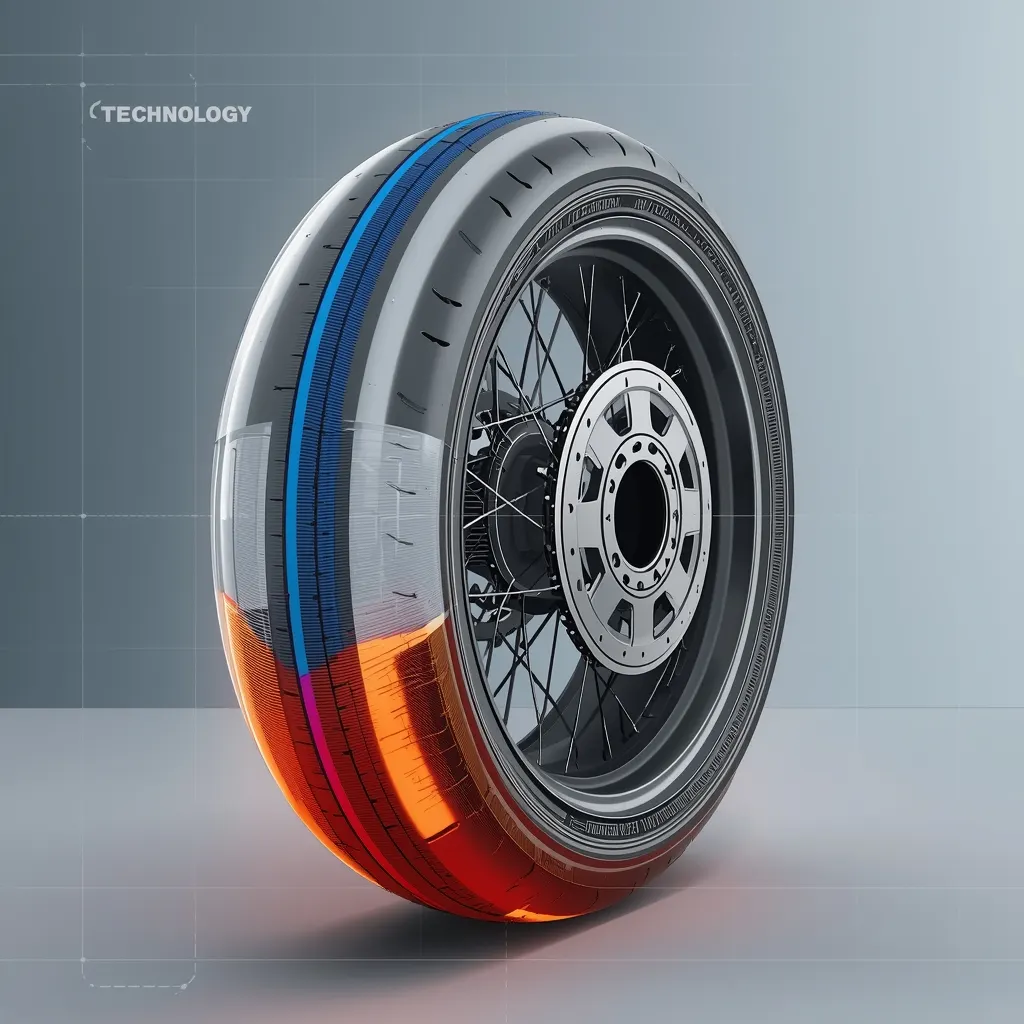
How a modern motorcycle tyre is built
A current motorcycle tyre consists of up to 25 different components. To understand why it sticks at 10 degrees in the rain and doesn't melt at 40 degrees, it's worth looking beneath the surface.
The carcass: the supporting framework
The carcass gives the tyre its shape and stability. Today there are mainly two designs:
Bias-ply tyres (B): today you find this design almost only on heavy cruisers or classic retro bikes. The fabric plies cross diagonally. Bias-ply tyres are very robust and carry a lot, but deform at high speed due to centrifugal force.
Radial tyres (R): the standard for sports bikes and tourers. The carcass cords run radially, i.e. at right angles to the direction of travel. This allows a softer sidewall for more grip in bends and a more stable tread.
The zero-degree steel belt
Above the carcass, almost all modern performance tyres have a steel belt wound in the direction of travel (0 degrees). It prevents the tyre from ballooning at 300 km/h. Manufacturers such as Metzeler or Bridgestone often work with variable winding density today: tighter in the middle (stable straight-line running), looser at the shoulders (more damping and feedback at lean).
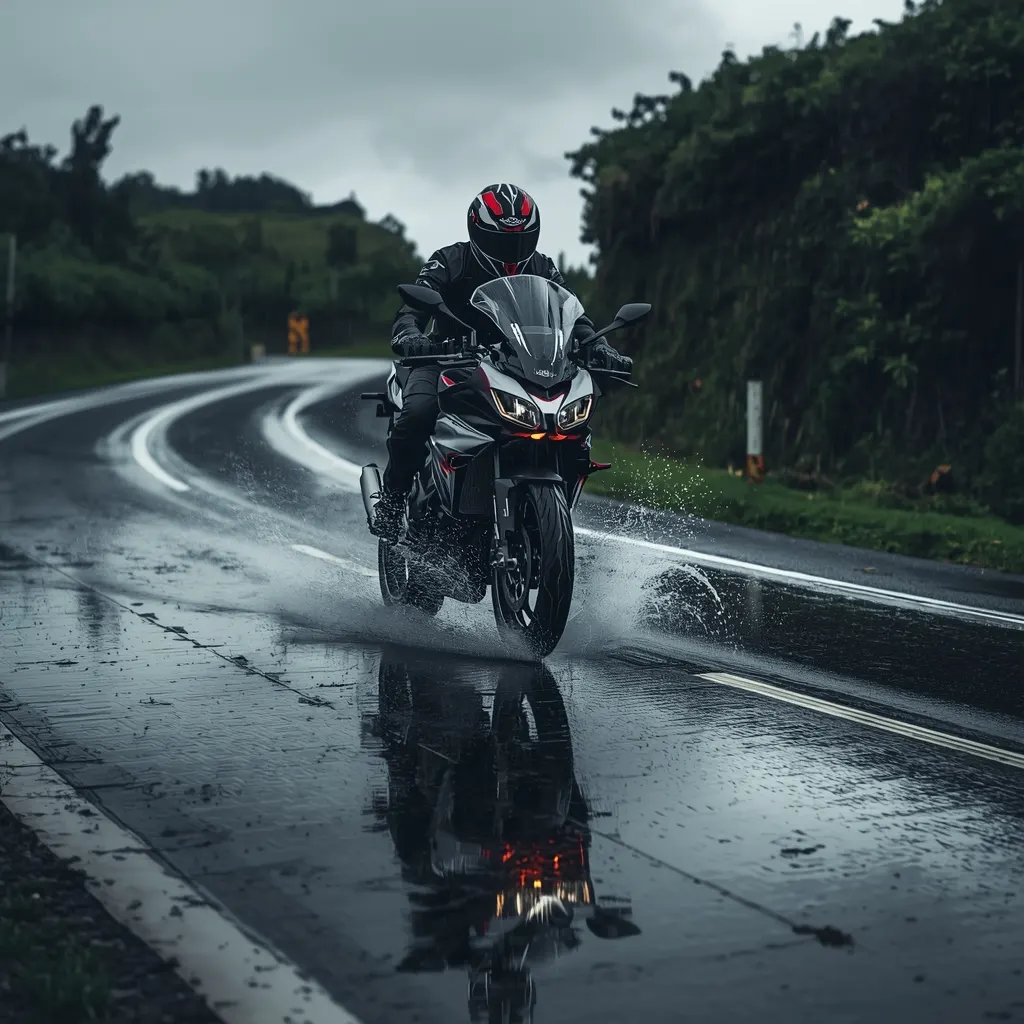
The rubber compound: where grip is created
This is where a tyre shows what it can do. The two most important ingredients:
Silica: provides a chemical interlock with the asphalt in wet and cold conditions. Modern sport-touring tyres therefore rely on a high silica content in the tread.
Carbon black: found mainly in race tyres or on the shoulders of hypersport tyres. At high temperatures it provides maximum grip; in cold and wet conditions it fails.
Motorcycle tyre types: which suits you?
The choice has never been greater. Crossover products increasingly blur the boundaries between categories.
| Category | Typical models | Mileage | Focus |
| Hypersport | Pirelli Diablo Rosso IV Corsa, Bridgestone Battlax RS11 | 2,500–4,500 km | Maximum grip, cornering stability |
| Sport-touring | Michelin Road 6, Continental ContiRoadAttack 4 | 8,000–12,000 km | Wet grip, everyday use, high mileage |
| Adventure (80/20) | Metzeler Tourance Next 2, Dunlop Trailmax Meridian | 7,000–11,000 km | Stability at speed, light gravel |
| Off-road (50/50) | Continental TKC 80, Heidenau K60 Ranger | 4,000–7,000 km | Self-cleaning, traction in the dirt |
| Custom/cruiser | Metzeler Cruisetec, Michelin Commander III | 12,000–18,000 km | High load, linear turn-in |
The trend: adaptive tread patterns
Some manufacturers rely on adaptive tread designs. At low speeds or in the rain, the grooves actively channel water away. Under high load and at lean, they close almost completely due to deformation, and the tyre becomes almost a slick. More rubber on the asphalt means more grip.
The legal situation in Germany: the end of tyre approvals
Motorcyclists in Germany have had to adjust. Simply downloading the tyre manufacturer's PDF approval and carrying it with you is definitely over.
What applies today?
Since 1 January 2025, the transition period for old tyres (produced before 2020) has expired. In 2026 the situation is clear but strict:
Vehicles with EU type approval (roughly from 2000): you may use any tyre that has exactly the size, load index and speed index stated in your registration certificate. Legally there is no longer any brand restriction, even if one is listed on the certificate.
Different sizes: if, for example, you want to run a 190 instead of a 180 at the rear, you absolutely need an individual inspection under § 19 (2) StVZO. The tyre manufacturer's document then only serves as a basis for the TÜV or DEKRA inspector.
Classic bikes and vehicles with national approval: this is the trickiest area. Any change of tyre type not intended by the factory (e.g. from bias-ply to radial) must be registered.
The physics of grip: why your tyre holds (or doesn't)
Why do you slide off in the rain? Why do tyres get greasy in high summer? That's pure physics.
The friction circle
A tyre can only transmit a limited total force. It is divided into longitudinal forces (braking and accelerating) and lateral forces (cornering).
If you brake hard at full lean, nothing is left for lateral grip. The tyre slides away.
Cornering ABS uses exactly this principle and regulates brake pressure so that some lateral grip always remains.
Slip: the invisible helper
A tyre doesn't have the most grip at 0% slip, but usually at around 10% to 15%. So the rear wheel turns minimally faster than the motorcycle is moving. In this range the rubber interlocks best with the fine irregularities of the asphalt.
Practical tips for the road
What do the red and yellow dots mean?
Have you ever noticed a small coloured dot on the sidewall?
The red dot marks the point of greatest radial force variation (often interpreted as the lightest point).
The yellow dot marks the lightest point of the tyre. During fitting it usually goes next to the valve.
Warming up: weaving doesn't help
You see it all the time: people weaving wildly to warm up their tyres. Don't. It does almost nothing and is dangerous.
Tyres warm up from the inside through flexing. The most effective method is strong acceleration and moderate braking on the straight. This stretches and compresses the carcass, and the heat moves from the inside out.
What the "chicken strips" really say
A wide unused edge on the rear tyre often says less about your ability than many think. It depends heavily on the tyre profile. You'll hardly ride a pointed sports tyre to the edge without your knee scraping the ground. A flat touring tyre, on the other hand, is already at the edge at 35 degrees of lean.
Maintenance and care: how to make your tyres last longer
The right pressure
The most common mistake of all. Too much pressure reduces the contact patch and you have less grip. Too little pressure makes the tyre overheat and the handling vague.
Solo on country roads: 2.3–2.5 bar front / 2.5–2.8 bar rear.
Motorway or with luggage: up to 2.9 bar at the rear (follow the manufacturer's specification).
Track: here the pressure is reduced considerably (cold sometimes to 1.5 bar at the rear), because it rises sharply with heat during riding. Caution: this only applies to special race tyres.
Storage
Tyres age through UV light and oxygen. If you store your motorcycle over winter:
Store dark, cool and dry.
Tyre shine or silicone spray looks good but is fatal for grip. If at all, only treat the sidewall, never the tread.
Saw-tooth wear
If the tread blocks wear unevenly and look like a saw, it's often due to incorrectly set rebound damping or braking too hard into bends. That's not a manufacturing defect, but a sign that the suspension is overwhelmed.
Frequently asked questions about motorcycle tyres
How old can a "new" tyre be when you buy it?
With proper storage, a tyre up to 3 years old is considered "factory new" and up to 5 years old "new" (German practice). The DOT number on the sidewall tells you the age (e.g. 1226 = week 12 of 2026).
What is the difference between "ZR" and "W"?
"ZR" denotes a design (radial tyres for over 240 km/h). The "W" after the load index, e.g. (73W), gives the exact maximum speed (W = up to 270 km/h, (W) = over 270 km/h).
Do I still need to run in new tyres for 100 km?
Tyres used to have a greasy release layer from the mould. Modern tyres hardly have this any more. You should still ride carefully for the first 50 km so the smooth surface is roughened mechanically.
Can I run a sports tyre at the front and a touring tyre at the rear?
With the same size it's often legal, but technically usually a bodge. The profiles don't match, and the motorcycle can weave unstably or suddenly tip in bends. Always run a matched pair of the same model.
Which tyre is right for you?
The technology today is at a level that was unthinkable ten years ago. The modern sport-touring tyre is something like a Swiss army knife. It copes with rain, cold and heat and can even handle the odd track day.
Our recommendation: unless you're chasing the last tenth of a second, choose a sport-tourer. It lasts twice as long as a sports tyre, and at 15 degrees on a wet country road it's vastly superior.