Many people dream about it for a long time before they dare: getting started with motorcycling. As soon as it gets concrete, though, the doubts come. When it comes to motorcycling for beginners, the same questions and fears come up again and again, and the good news is: there's a practical solution for each of them.
Four topics concern beginners in particular. First, the fear that the motorcycle is too heavy and you'll drop it. Second, uncertainty about the right motorcycle protective clothing for beginners. Third, unclear costs for insurance, workshop and running. And fourth, the question of how to find a trustworthy riding school.
Here you'll get clear, practical answers on each point. And you'll see step by step how to overcome your fears and learn to ride safely. The costs are based on Germany, but the principles apply everywhere.
1. Fear of the weight: is the motorcycle too heavy for beginners?
Why this fear is so common when learning to ride
The first worry of many beginners is control over the motorcycle. At first glance such a machine looks massive and intimidating: 150 to 250 kilograms that you seemingly have to keep in balance all the time. The idea that the motorcycle is too heavy or will tip over when stopping holds back many people who could actually become really good riders.
There's usually a misunderstanding behind this. Riding a motorcycle isn't a question of muscle power but of technique, balance and body feel. The weight isn't the real problem; lack of confidence in your own technique and too little training are.
The right machine for beginners: this is where the solution begins
The most important first step for beginners is a beginner-friendly motorcycle. Machines in a moderate weight class are particularly well suited for new riders.
Among 125 cc motorcycles for beginners in particular there are very light, easy-to-handle models:
| Model | Weight | Power | Seat height | Price |
|---|---|---|---|---|
| Honda CB 125 F | 117 kg | 11 hp | 790 mm | from €2,500 |
| Suzuki GSX-R 125 | 134 kg | 15 hp | 800 mm | approx. €4,700 |
| Aprilia SX 125 | 134 kg | 15 hp | 830 mm | approx. €4,500 |
| KTM 125 Duke | 153 kg | 15 hp | 820 mm | approx. €4,850 |
Most of these motorcycles weigh less than 140 kilograms, much less than many beginners expect. You don't need the strength of a bear, just clean technique and regular practice.
Where and how to practise as a beginner
Almost every good riding school starts with exercises in an empty car park or on a closed practice area. That's exactly where you learn to control your motorcycle safely.
Typical exercises for beginners are:
- Balance training at low speed: riding slow figure-eights or tight turns to train your balance.
- Manoeuvring exercises: pushing, turning and manoeuvring the motorcycle so you get a real feel for its weight and dimensions.
- Riding at walking pace: control and balance without momentum.
- Cornering and lean: increasing speed and lean angle step by step.
That sounds trivial at first, but it's crucial. With every practice session, the feeling of having the motorcycle under control grows. And the fear of the weight gets smaller and smaller.
Mental training: underestimated help for beginners
What's often overlooked when learning to ride without fear is mental training. Organisations such as the German automobile club ADAC recommend playing through difficult riding situations in your head beforehand.
The reason: the brain processes mental and physical training in a very similar way.
Example: are you afraid of leaning? Then consciously imagine calmly steering into the bend, shifting your weight and riding the motorcycle steadily through the bend. Repeat this a few times. That's how you program your brain for success.
2. Protective clothing for beginners: what matters
Which motorcycle protective clothing is really safe?
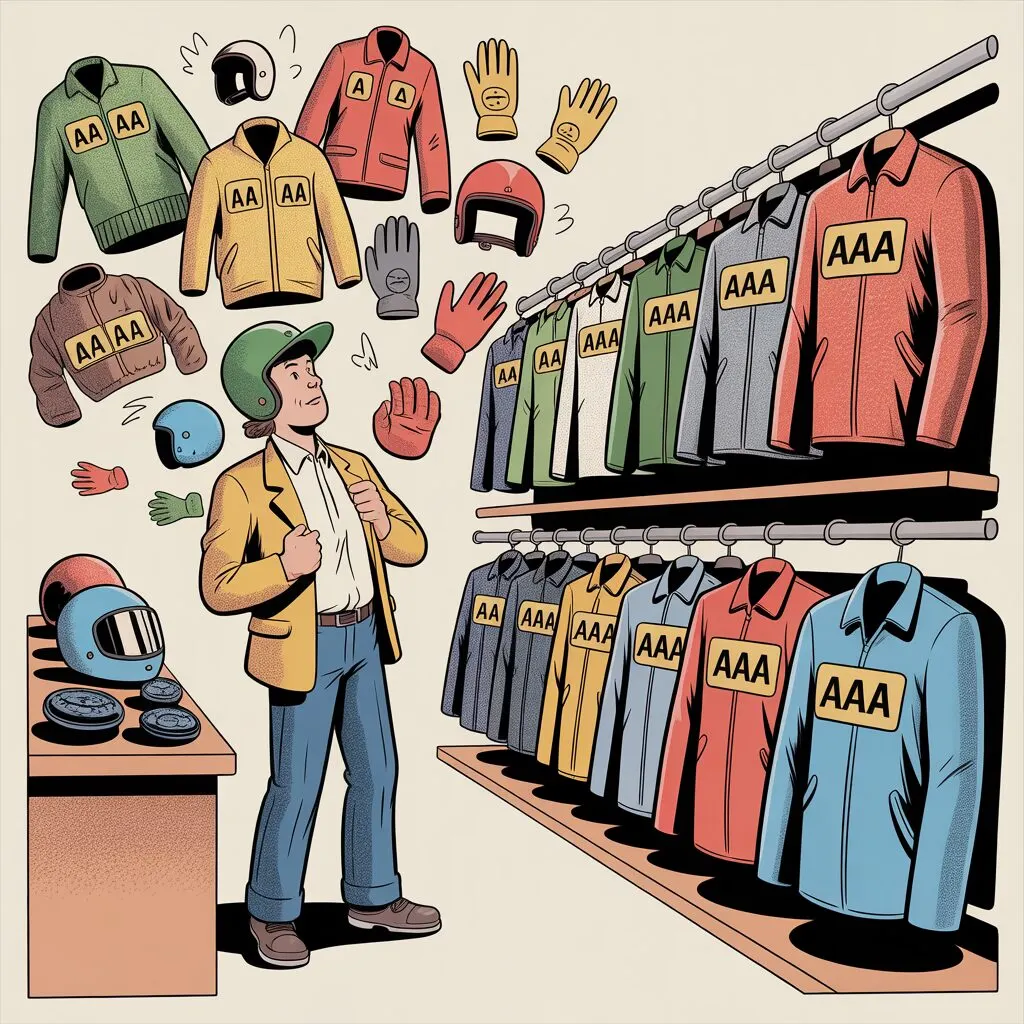
Choosing the right protective clothing unsettles many beginners. The market is huge, and many products look safe but only offer limited protection.
What matters is the European standard EN 17092:2020, which has been binding since 2020. It defines five protection classes for motorcycle clothing. A common mistake: many think a simple CE mark is already real proof of protection. That's not quite true.
Protection classes for motorcycle clothing explained
| Class | Protection level | Suitable for |
|---|---|---|
| AAA | Highest protection | Sporty riding, track |
| AA | High protection | Touring, everyday |
| A | Basic protection | City traffic |
| B | Abrasion protection only | Summer clothing |
| C | Protectors only | Supplementary products |
As a beginner you're best off with class A or AA.
Material and fit
Many beginners only look at the certification and forget about material and fit.
- Material: leather offers the best abrasion protection. But modern textiles with aramid or Cordura are almost as good and often more weatherproof, so a very good choice for beginners.
- Fit: protectors must sit exactly right. A jacket that's too big is dangerous, because the protectors can shift in a crash.
Gloves and boots: often underestimated, but important
In crashes, hands and feet are among the most frequently injured parts of the body. Good motorcycle gloves and sturdy motorcycle boots are therefore a must.
- Good gloves: €80–150
- Good boots: €150–300
The money is well spent.
3. Planning the costs of motorcycling realistically
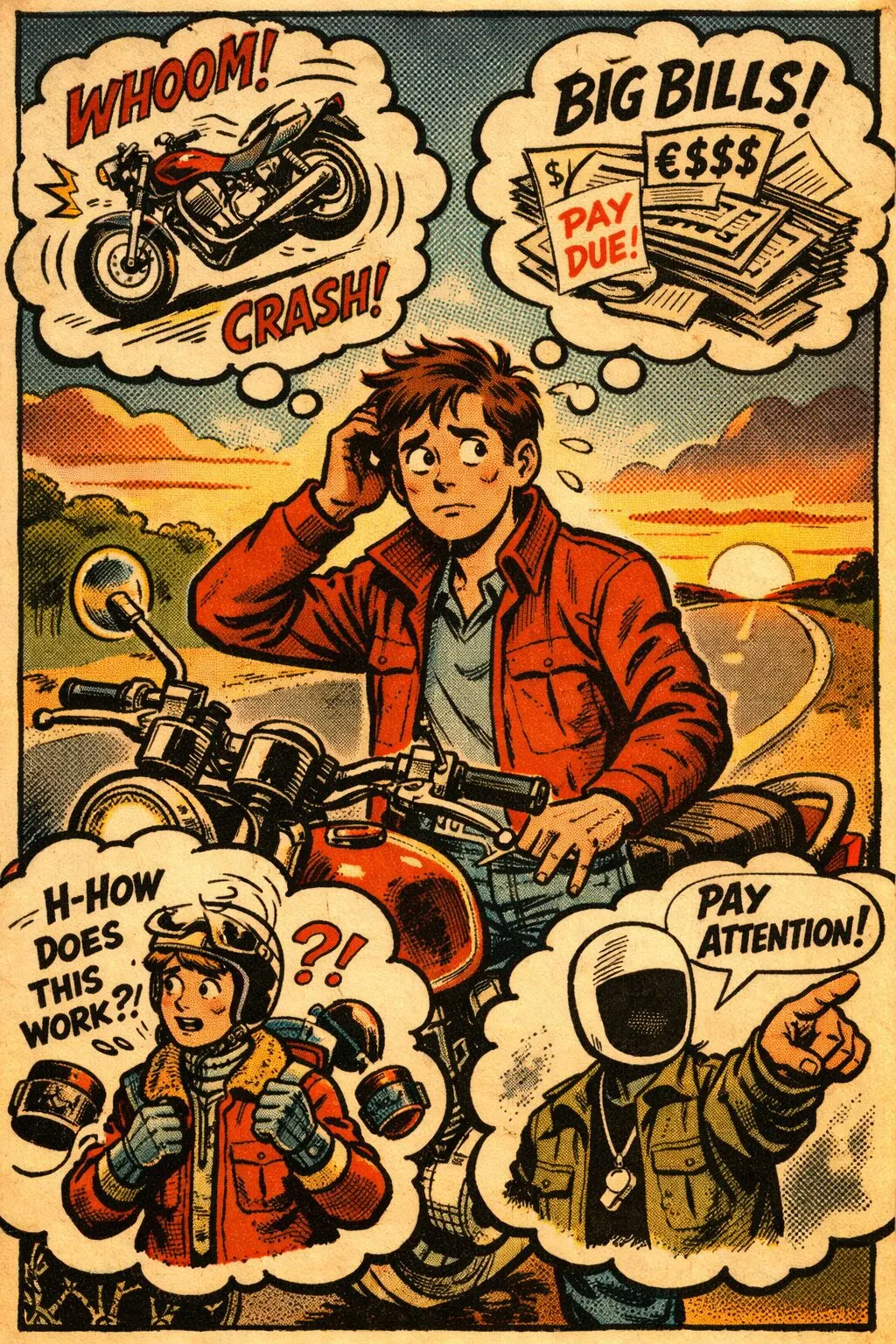
Is motorcycling expensive?
Many beginners think motorcycling is extremely expensive. It's not quite that simple: there are costs, but you can plan them well.
Insurance costs for beginners
| Type of insurance | Annual cost in Germany (with a good no-claims discount) |
|---|---|
| Third-party liability | €43–65 |
| Liability + partial cover | €80–100 |
| Fully comprehensive | €200–250 |
Total annual costs of motorcycling
At about 5,000 km a year you can expect these guide values. Insurance here is calculated for new riders without a discount, which is why it's higher than in the table above:
| Category | Min | Max |
|---|---|---|
| Insurance | €350 | €1,150 |
| Fuel | €340 | €510 |
| Maintenance & wear | €225 | €420 |
| Roadworthiness test (TÜV) | €45 | €50 |
| Total | ~€1,085 | ~€2,415 |
4. Finding a good riding school
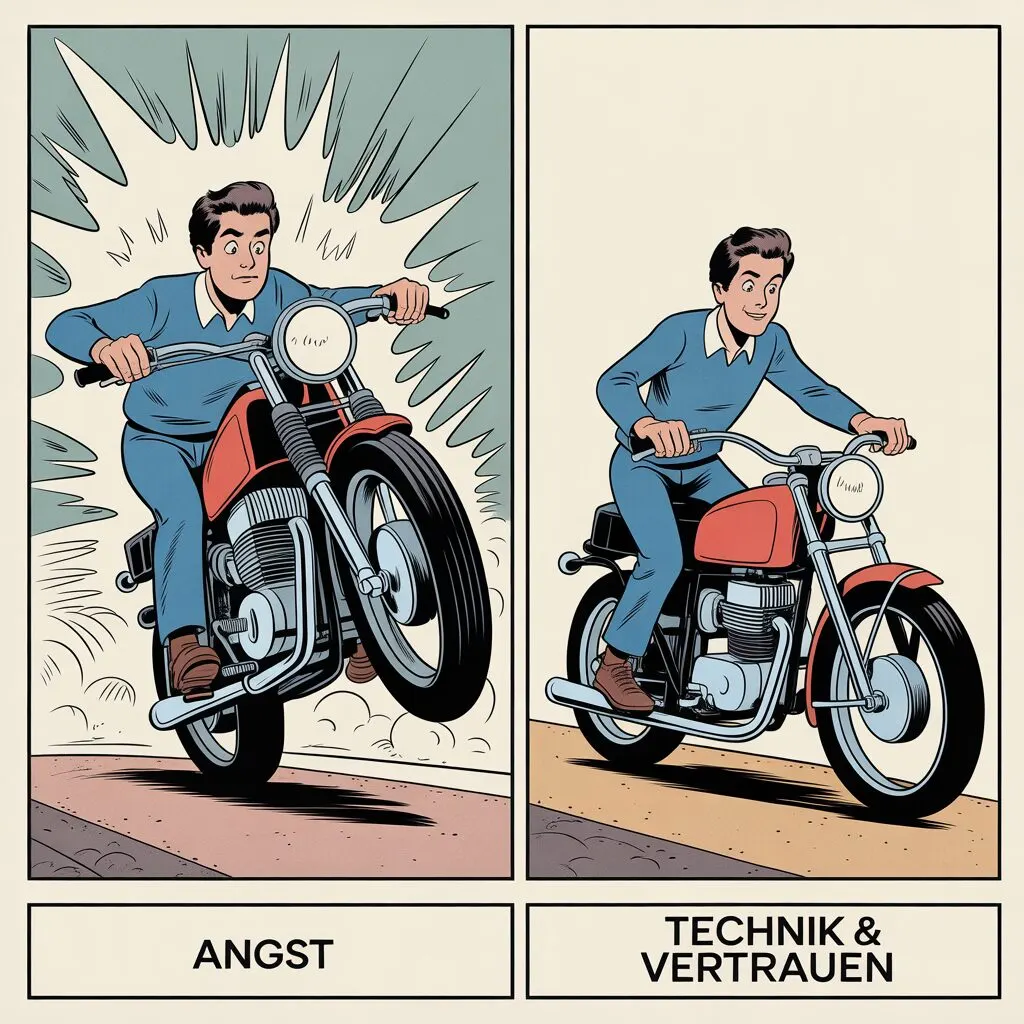
The riding school lays the foundation for everything that follows. In Germany, good training costs between €2,000 and €2,800. That's a lot of money, but you're investing it in safety and self-confidence.
Why a good riding school is so important
Choosing a riding school isn't a formality. It's one of the most important safety decisions when you start. Good training saves you money, time and above all accident risk in the long run. Here are the most important reasons:
- Mistakes are spotted early, before they become dangerous. Beginners quickly pick up bad habits without noticing: wrong gaze, tense posture, incorrect braking or jerky throttle. A good riding school sees this immediately and corrects it before it becomes ingrained and later leads to crashes.
- Technique replaces strength. Good instructors show you early on that riding is not a question of strength but of technique, balance and timing. That's exactly what helps you overcome the fear of weight, lean and slow manoeuvres and develop real control.
- Realistic risk assessment instead of false security. Poor training often creates deceptive self-confidence. Good schools teach you anticipatory riding, hazard recognition and defensive strategies. In traffic, that can be a matter of life and death.
- You learn faster without stress. A professional riding school provides a calm, structured learning environment. You learn without time pressure, without being shown up and without fear of mistakes. That gets you further faster and reduces test stress.
- Practice instead of pure test preparation. A good riding school trains you for real traffic, not just for the test. Emergency braking, gaze control in bends and riding in rain or on poor asphalt are an integral part.
- Fewer accidents in the first years. The accident risk is particularly high in the first 12–24 months after getting your licence. Good training significantly reduces this risk because it lays clean foundations on which your experience can build safely.
- Cheaper in the long run than "cheap" training. What looks cheap often turns out expensive. Crashes, damaged motorcycles, repairs, excesses and injuries quickly cost many times the saved school fees. A good riding school is therefore economically sensible, not expensive.
- Confidence comes from ability, not courage. Real safety on a motorcycle doesn't come from forcing yourself but from being able to do it. A good riding school explains why something works, not just how. The result: calm, controlled riding, even when things get difficult.
5. Riding without fear: the psychological side
For beginners, fear isn't actually the real problem. The problem is a lack of knowledge. Knowledge, practice and a clear plan make you competent.
With every successful lesson the fear becomes noticeably smaller, because trust grows.
Conclusion
Motorcycling isn't just for the particularly strong or rich. It's for everyone who's willing to prepare, learn and take their fears seriously.
The way in is clear: choose a beginner-friendly motorcycle, find a good riding school, buy tested protective clothing and ride consciously.
The rest comes with time.
Frequently asked questions
Which motorcycle is suitable for beginners?
Light, easy-to-handle models such as 125s. The Honda CB 125 F, for example, weighs only 117 kg, and many other 125s are under 140 kg.
Which protection class should my motorcycle clothing have?
For beginners, class A or AA according to EN 17092 is the most sensible choice. A simple CE mark alone says nothing about the level of protection.
What does motorcycling cost per year?
At around 5,000 km a year you'll pay roughly between €1,085 and €2,415 for insurance, fuel, maintenance and roadworthiness tests (German figures).
What does a motorcycle licence cost at a good riding school?
In Germany, expect €2,000 to €2,800. The money is worth it, because good training significantly reduces the accident risk in the first years.