
Wash and care for motorcycle clothing correctly – all questions finally answered!

Motorcycle clothing is not a fashion accessory or a lifestyle product that can be replaced or neglected at will. It is a highly developed, safety-relevant protection system that consists of precisely coordinated components. Abrasion-resistant outer materials, shock-absorbing protectors, load-bearing safety seams and waterproof and breathable membranes together form a functional unit. In an emergency, this interaction determines whether the skin, joints and bones remain protected or whether serious injuries are at risk.
Despite this central importance, motorcycle clothing is mistreated by many riders. Some people are too careless with their own equipment and wear unwashed jackets and trousers for months. Others clean their protective clothing like everyday clothing, using aggressive detergents, high temperatures or fabric softeners. Both extremes lead to significant loss of function in the long term.
Unwashed motorcycle clothing gradually loses its protective effect. Sweat and skin oils get stuck in the material, membranes become clogged, textiles harden, leather dries out and seams are chemically attacked. At the same time, incorrect washing can permanently destroy precisely these safety-relevant properties. The damage is often not immediately visible, but becomes noticeable at the crucial moment.
This guide shows you in detail, practically and comprehensibly how to properly wash and care for motorcycle clothing. The focus is on textile clothing, membrane systems, leather suits and protectors. You will learn why care is an active safety factor, what mistakes you must avoid and how you can keep your equipment functional, comfortable and protective for many years.
Why motorcycle clothing needs to be washed regularly

Many motorcyclists underestimate how much stress their protective clothing is subjected to in everyday life. After just a few trips, residues are deposited in the material that are neither visible nor immediately smellable, but have significant technical consequences. Motorcycle clothing is constantly exposed to wind, heat, moisture and dirt while riding. At the same time, body heat and movement create a warm, humid microclimate inside.
Typical exposures include sweat and skin oils, fine dust, brake dust, road abrasion, insect residue and oil and fuel particles. In addition, there are salt residues from sweat or driving in the cooler season. These substances attack materials from the inside and outside. Sweat is particularly critical because it contains salts and fatty acids that chemically damage seams, coatings and membranes.
The result is a gradual loss of function. The clothing still looks intact on the outside, but feels heavier, breathes more poorly and gets soaked more quickly when it rains. The insulation effect decreases, the feeling of cold increases and material aging accelerates significantly.
Regular, correct washing is therefore not a question of appearance or hygiene, but rather an elementary part of safety precautions. Anyone who cares for their motorcycle clothing not only maintains the comfort but also the protective effect for which it was developed.
Basic rule before every wash: pay attention to the care label and manufacturer's instructions
Motorcycle clothing is technically highly complex. Depending on the manufacturer, price range and intended use, different materials, membranes and coatings are used. Accordingly, the care requirements also differ considerably.
Therefore, without exception, the care label must be read before each wash. The values stated there are not to be understood as recommendations, but rather as a binding part of the product design. They provide information about the maximum permissible washing temperature, suitable washing programs, permitted spin speeds, drying options and recommended washing and waterproofing agents.
Anyone who ignores this information risks permanent damage to membranes, seams and outer materials. If in doubt, it makes sense to also consult the manufacturer's website or contact them directly. Reputable motorcycle clothing manufacturers provide detailed care instructions.
How to wash motorcycle textile clothing correctly – explained step by step
Preparation before washing
Thorough preparation is crucial to avoid damage during the washing process. Before washing, all protectors must be removed from the jacket and trousers. These include shoulder, elbow, back, hip and knee protectors. Bags must be completely emptied and checked several times, as forgotten items can damage zippers or drums.
All zippers should be closed, as should all Velcro fasteners. Open Velcro surfaces act like sandpaper and damage other textiles as well as your own material. Coarse dirt such as mud or insect remains should be removed in advance with a damp cloth to avoid unnecessary mechanical stress in the washing machine.
The right detergent for motorcycle clothing
The choice of detergent is crucial for the functionality of modern motorcycle clothing. Heavy-duty detergents, color detergents, fabric softeners and bleach are generally unsuitable. They contain surfactants and additives that clog membranes, attack coatings and permanently impair breathability.
Special detergents for functional or motorcycle clothing are recommended. Alternatively, a mild, fragrance-free detergent can be used. In any case, fabric softener is taboo. It covers the fibers like a film and destroys the micropores of the membrane, often irreversibly.
Washing program, temperature and spin
In most cases, a washing temperature of 30 degrees Celsius is optimal. Only if the manufacturer expressly allows it can it be increased to 40 degrees. Gentle or delicate wash cycles are suitable as a program as they are less mechanically stressful.
The spin speed should be between 600 and a maximum of 800 revolutions per minute. Higher speeds can weaken seams, peel membranes, destroy coatings and deform protector pockets. An additional rinse cycle is recommended, as detergent residues have a greater impact on the function of climate membranes than dirt.
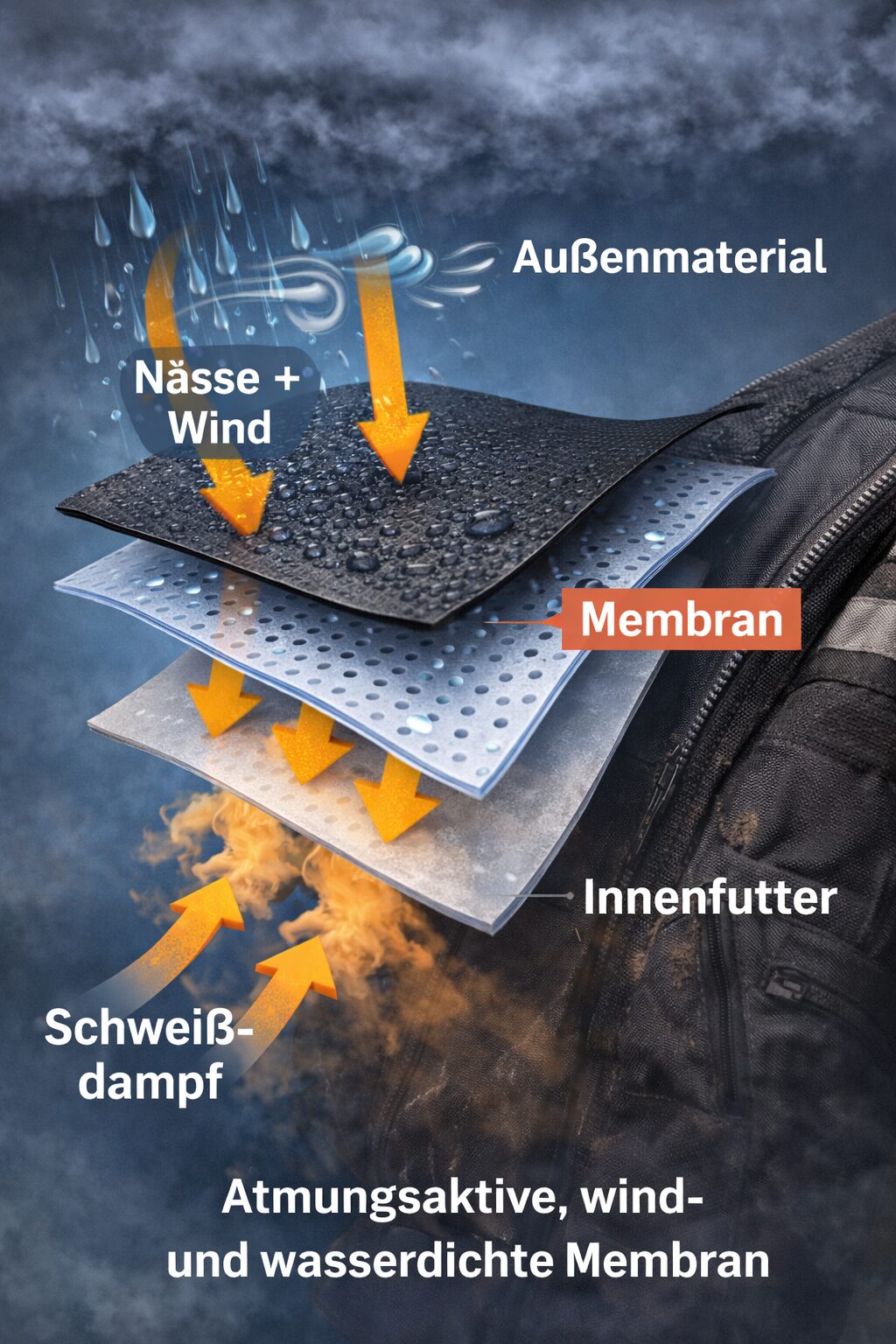
Properly care for motorcycle clothing with a membrane
A common misconception is that membranes should not be washed. In fact, regular washing is necessary to maintain their function. Membranes are made up of microscopic pores that allow water vapor to escape but block liquid water.
Sweat grease and dirt clog these pores. The consequences are reduced breathability, clammy wearing comfort and the impression that the clothing is leaking. Regular washing restores its original function.
Many membranes also benefit from moderate heat to reactivate the water-repellent outer layer. This can be done with short tumble dryer cycles at a low temperature or gentle ironing with a cloth - but only if the manufacturer allows this. Too much heat permanently destroys the membrane and coating.
Clean and care for motorcycle leather clothing
Leather is a natural material with excellent abrasion resistance, but is sensitive to incorrect care. Leather clothing should never be machine washed or completely soaked. Household cleaners, aggressive chemicals or direct heat sources are also taboo.
For cleaning, coarse dirt is brushed off with a dry brush. The surface can then be wiped with a slightly damp cloth. If the leather is more dirty, special leather cleaners are used, which are used sparingly. Drying always takes place at room temperature, away from heating or direct sun.
Once completely dry, leather needs care to stay supple. Leather balm or wax-based products are suitable. Too much grease softens the leather and reduces its abrasion resistance. The same applies here: less is more.
Clean, check and replace protectors
Protectors usually consist of viscoelastic plastics or special foams that harden in the event of an impact and absorb energy. They must not be cleaned in the washing machine. Cleaning is done by hand washing with lukewarm water and mild detergent.
After cleaning, protectors must dry completely. Direct heat, dryers or radiators should be avoided. In addition, protectors should be checked regularly. Cracks, hardening or deformation are clear signs that the protective effect is no longer present and replacement is necessary.
Impregnation – why it remains indispensable
The impregnation ensures that water rolls off the outer fabric instead of soaking into the material. Even if the membrane is tight, a lack of impregnation has significant disadvantages. The outer material gets soaked; The clothing becomes heavy, cools down and loses its breathability.
A new impregnation is necessary if water no longer rolls off but instead soaks into the fabric. As a rule, impregnation should be carried out after every second to third wash. Spray or washing impregnations that are applied evenly to clean, damp clothing are suitable. Activation occurs, if permitted, with moderate heat.
Conclusion: Proper care is active self-protection
Motorcycle clothing is high-performance technology. Only clean, well-maintained materials offer the protection for which they were designed. Proper washing and regular care maintain abrasion resistance, breathability, weatherproofing, fit and protection.
Anyone who takes their equipment seriously cares for it consistently. This pays off – through more comfort, longer durability and, above all, through a higher level of safety on the motorcycle.
How often should you really wash motorcycle clothing?
Motorcycle clothing should not be washed until it is visibly dirty or smells unpleasant. Sweat, skin oils and fine salt residues in particular attack materials from the inside. If you use it regularly, we recommend washing it about every five to ten days of travel. After driving in the rain, summer heat or long tours, it makes sense to wash it earlier in order to maintain the protective function over the long term.
Can motorcycle clothing be put in the washing machine?
Yes, modern textile motorcycle clothing is specifically designed to be machine washed. It is important that all protectors are removed in advance and a gentle or delicate washing program is selected. If the clothes are washed according to the manufacturer's instructions, the washing machine will not cause any harm - on the contrary: it will maintain the function of the membranes and materials.
At what temperature should motorcycle clothing be washed?
In most cases, 30 degrees Celsius is ideal. This temperature is enough to remove sweat, dirt and residue without damaging membranes or coatings. Only if the manufacturer expressly allows it can it be increased to 40 degrees. Higher temperatures should always be avoided.
Which detergent is suitable for motorcycle clothing?
Special detergents are best suited for motorcycle or functional clothing. Alternatively, a mild, fragrance-free detergent can be used. Heavy-duty detergents, bleach and fabric softeners are taboo as they can clog membranes and permanently destroy breathability.
Why is fabric softener so dangerous for motorcycle clothing?
Fabric softener forms a film over the fibers and clogs the microscopic pores of modern climate membranes. This means that water vapor can no longer escape, the clothing feels clammy and loses its function. This damage is often irreversible - even after several washes.
Do protectors need to be removed before washing?
Yes, protectors always have to be removed. In the washing machine they can deform, lose their shock-absorbing properties or damage protector pockets. Removing it also prevents water and detergent from building up in the upholstery.
How strong can motorcycle clothing be thrown?
A low spin speed of around 600 to a maximum of 800 revolutions per minute is ideal. Higher speeds place unnecessary strain on seams, membranes and coatings and can significantly shorten the lifespan of clothing.
Can motorcycle clothing be put in the dryer?
That depends on the manufacturer. Some membranes benefit from low, controlled heat to reactivate the water-repellent surface. However, temperatures that are too high can cause massive damage. That's why the following applies: only dry if it is expressly permitted - and then only at the lowest setting.
What is the best way to dry motorcycle clothing?
The safest option is to air dry at room temperature. Clothing should be hung well ventilated, without direct sunlight or heating. Patience pays off here, as drying too quickly damages materials and coatings.
How do you properly clean motorcycle leather clothing?
Leather clothing should never be put in the washing machine. Coarse dirt is removed dry and the surface can then be cleaned with a slightly damp cloth. If necessary, special leather cleaners can be used. After drying at room temperature, economical leather care is important to keep the material supple.
Does motorcycle clothing need to be waterproofed regularly?
Yes, waterproofing is crucial for comfort and function. It ensures that water rolls off the outer fabric. Without it, clothing becomes saturated, becomes heavy and loses breathability - even if the membrane is still tight.
How do you know that new waterproofing is necessary?
If rainwater no longer rolls off but instead soaks into the fabric, the impregnation has been used up. It should be replaced after two to three washes at the latest to restore full functionality.
How do you clean protectors correctly?
Protectors are cleaned by hand with lukewarm water and mild detergent. Then they must dry completely, without exposure to heat. Dryers, heating or direct sun are taboo.
When should protectors be replaced?
If protectors are cracked, hardened or have lost their shape, they should be replaced. Even very old protectors can lose their protective effect, even if they still appear intact on the outside.
Does frequent washing damage motorcycle clothing?
No. Correct washing that is appropriate for the material extends its lifespan. Dirt, sweat and salt attack materials much more than proper cleaning. Those who maintain their vehicle regularly will drive more safely in the long term.
For many years I have been intensively involved with motorcycles, their technology and all topics relating to safety, maintenance and equipment. My goal is to present practical information in an understandable way, to realistically assess risks and to objectively classify common myths.
All content on moto-guide.com are based on in-depth research, technical classification and my experience in dealing with motorcycles. I want to help riders make informed decisions and use their motorcycle safely and consciously.




Leave a comment
Participate in the discussion?Leave us your comment!