Your heart is pounding, the lights turn red, and you feel for the ground with the tips of your toes. If your motorcycle is too tall, it's not just about comfort but about your safety. Many tip-overs happen when stationary or manoeuvring slowly because the rider can no longer hold the bike.
The good news for everyone under 1.75 m: your height is not an obstacle but a question of the right setup. Here we show you how to safely handle even a taller motorcycle with suspension adjustments, ergonomic tricks and the right technique. We draw on information from the German motoring club ADAC, technical advice from the testing organisation DEKRA and the experience of many riders.
Seat height isn't everything
When buying a motorcycle, most people look at the seat height in the data sheet first. But 830 mm on a slim enduro feels completely different from 830 mm on a wide tourer.
The inseam arc is decisive
More important than the vertical distance from the ground to the seat is the inseam arc: the distance from one foot over the seat to the other foot.
Width matters: a wide seat pushes your legs into a bow shape. That effectively costs you leg length.
How to measure: stand barefoot against a wall and clamp a book as high as possible between your legs. The distance from the floor to the top edge of the book, times two plus the seat width, is your guide value.
Tip: the ADAC has a detailed list of the seat heights of current models (German), which is a good starting point for your search.
Lowering a motorcycle: what happens to the suspension
If ergonomics aren't enough, the technology has to be adapted. That means intervening directly in the chassis geometry.
Lowering kits (linkage)
Most commonly, the linkage arms on the rear shock are replaced, often called "dog bones". This lowers the rear.
Cost and effort: a kit costs between €80 and €150; fitting at a workshop costs about €100.
Important: as DEKRA explains on suspension tuning, in Germany you need a general type approval (ABE) or a parts certificate with inspection for the component, otherwise your motorcycle's approval lapses. Other countries have their own rules for modifications – check them before fitting.
Sliding the fork through: keeping the balance
If you only lower the rear, the steering head angle changes. The motorcycle then runs more stably in a straight line but turns in more sluggishly in bends. To compensate, the fork is "slid through" at the front: the fork tubes are pushed a little further up through the triple clamp.
Caution: if you slide the fork through too far, the front wheel can hit the radiator or mudguard under hard braking. Stick exactly to the manufacturer's specifications. It's safest to have a workshop do it.
Sitting lower without modifications: ergonomic tricks
Before you put a few hundred euros into technology, use the options you already have: your gear and the settings on the motorcycle.
Set up the suspension correctly
Incorrectly adjusted suspension often sits unnecessarily high. Many riders use too much spring preload.
Sag: your body weight alone should compress the motorcycle by about 25% to 30% of the total suspension travel. If the spring is preloaded too much, the motorcycle "stays up".
Tip: use suspension setup guides to adjust your motorcycle's ride height correctly via the spring preload.
The invisible lowering: boots
Some good motorcycle boots have internal sole lifts of up to 6 cm. In our gear section we take a closer look at different motorcycle boots.
Advantage: you gain height without the motorcycle losing ground clearance.
Typical mistakes when lowering
The same dangerous mistakes happen again and again with DIY work:
Cutting springs: never cut the original spring. This changes the spring rate unpredictably and can lead to breakage.
Too little ground clearance: always keep at least 80 mm of ground clearance so you don't get caught on kerbs or bumps.
Forgetting the headlight: after any lowering, especially if only the rear has been lowered, you must readjust the headlight. Otherwise you dazzle oncoming traffic.
In a nutshell: how to stand securely
Measure first: determine your inseam arc and look for suitable models in seat-height lists such as the ADAC catalogue.
Adjust ergonomics: set up your suspension correctly and try a narrower seat.
Retrofit selectively: boots with a lift or a tested, approved lowering kit.
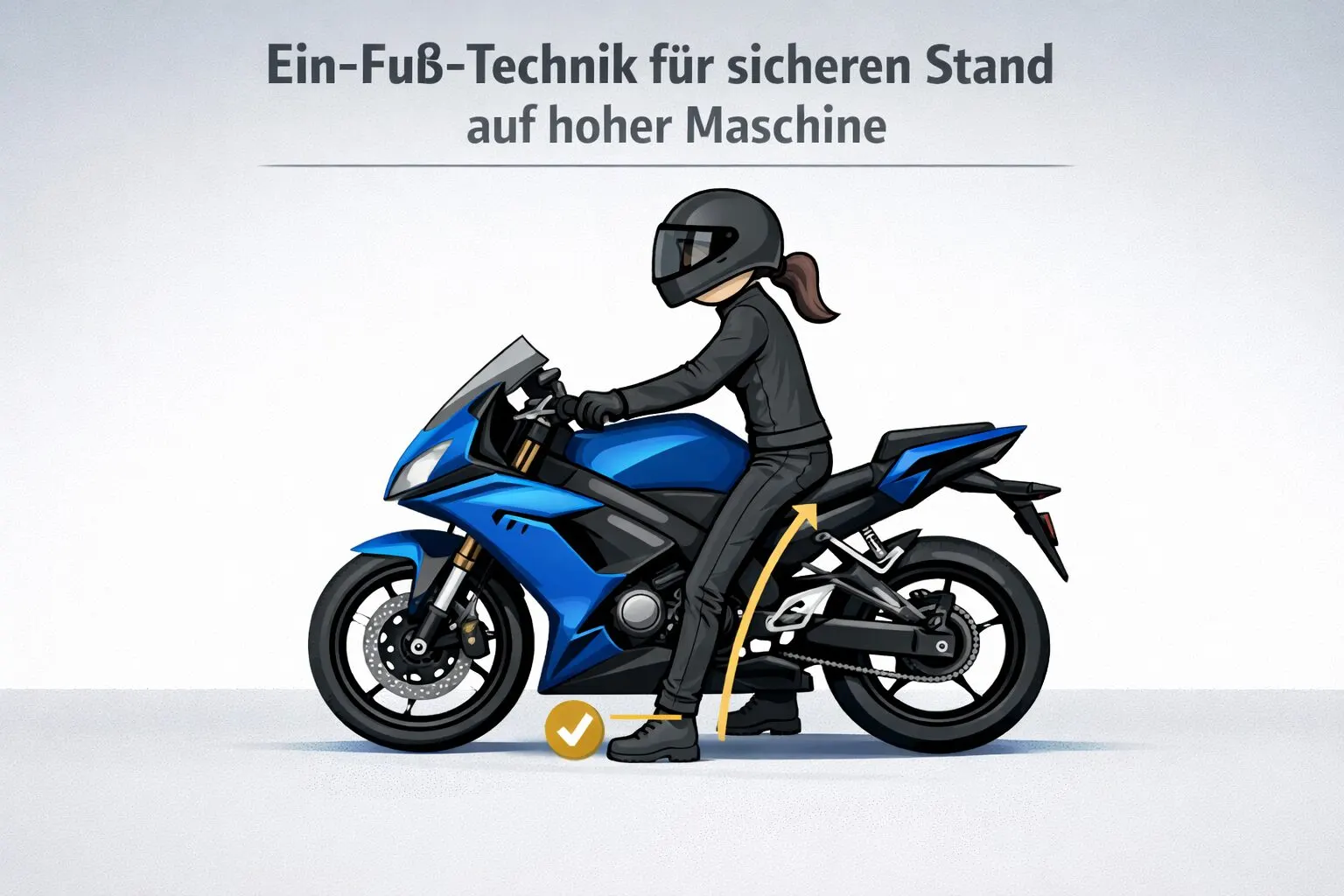
Practise technique: get used to putting down only one foot at the lights. One secure, flat foot is better than two wobbly tiptoes.
We're not about quick tips, but about helping you understand the technology behind them. A motorcycle that is well adapted to you makes riding safer and more relaxed in the long run. We wish you many more good and safe rides.
Frequently asked questions: motorcycle too tall and lowering
Does lowering change the handling?
Yes, usually a little. Lowering reduces the available lean angle, and footpegs or the centre stand touch down earlier in bends. A good approved kit keeps this effect small, but you will need to adapt your riding style slightly.
Can I reduce the padding of my seat myself?
In theory yes, in practice an upholsterer is the better choice. They can cut the seat narrower at the sides ("wasp waist"). That often helps more than just reducing the height.
Do I need to shorten the side stand after lowering?
Usually yes. If the motorcycle sits lower, it stands too upright on the original side stand and can tip over to the right in wind or on uneven ground.
How does lowering affect riding with a pillion?
Critically. Because there is less suspension travel available, the suspension bottoms out more quickly two-up. So increase the rear spring preload or consider a special replacement shock.
What does registering the modification cost?
In Germany, with a general type approval (ABE) nothing – you just carry it with you. With a parts certificate, the inspection costs about €40 to €60. An individual inspection is more expensive (from €120). Costs differ in other countries.
Are there electronic lowering systems?
Yes. Motorcycles such as the Harley-Davidson Pan America or the BMW R 1300 GS offer adaptive ride height. The motorcycle lowers itself when stationary and rises again while riding for more ground clearance.
Are sole add-ons a good solution?
For many riders, yes. These are rubber add-ons that you strap over your boots. They take some getting used to visually but are practical for learner riders or test rides.
Will I lose the manufacturer's warranty by lowering?
With the manufacturer's original accessories the warranty remains. With third-party parts the manufacturer may refuse warranty claims for suspension damage.
Can I back off the spring preload completely to sit lower?
No. The preload adapts the motorcycle to your weight. If you back it off too far, you lack the necessary suspension travel and the motorcycle becomes unstable and dangerous.
Which motorcycle has the lowest seat height for beginners?
At the top are the Honda Rebel 500 (690 mm) and the Kawasaki Vulcan S. Among naked bikes, the BMW G 310 R is very accessible at 785 mm.