The tour was really good, the bends flowed nicely, and on the way home it starts. First a slight pull, then a burning in your neck that radiates into your shoulders. Many of us think neck pain when riding a motorcycle is normal. Honestly, though, it takes quite a lot of the fun out of riding.
What's often dismissed as simple tension is, medically speaking, an interplay of biomechanics, aerodynamics and ergonomics. Riding a motorcycle isn't passive sitting. For your musculoskeletal system it's sport, especially for your cervical spine. Here you'll read what happens in your body when you open the throttle, and how targeted training and a few technical adjustments keep you pain-free.
1. Anatomy: your cervical spine under constant load
Before we get to solutions, a quick look at the structure. Your cervical spine consists of seven vertebrae (C1 to C7). They're stabilised by a fine system of ligaments, tendons and muscles. This construction carries your head, which weighs about 5 kilograms on average.
Static and dynamic load
A helmet adds about 1.3 to 1.7 kilograms. Sounds like little. But while riding there's also the dynamic load from the airflow. Your neck muscles have to hold this whole package steady while vibrations and centrifugal forces act on you at the same time.
Neck pain typically develops when the muscles are statically tensed for a long time. This static holding work compresses the fine blood vessels in the muscle. The result is reduced blood flow (ischaemia). The muscles get too little oxygen, and metabolic products such as lactate aren't carried away. That irritates the pain receptors, and you feel the typical tension pain.
2. Muscular imbalance: who is really working here
When riding, two muscles in particular are challenged: the trapezius and the levator scapulae.
The "vulture neck": forward head posture (FHP)
Especially on sporty machines, you often unconsciously push your head forward to see the road beneath the edge of the helmet. Experts call this forward head posture.
In this position the levator scapulae is under heavy tension, because it has to compensate for the torque of the head leaning forward. Studies show that this poor posture shortens the neck muscles over time, while the deep neck flexors, the actual stabilisers, weaken. Chronic complaints develop from this imbalance.
| Anatomical structure | Function when riding | Consequence of overload |
|---|---|---|
| Facet joints | Guide head movement | Blockages, early arthrosis |
| Intervertebral discs | Shock absorbers over potholes | Bulging (protrusion) or herniation |
| Levator scapulae | Stabilising the head position | Painful muscle knots |
| Trapezius | Holding against wind pressure | Tension headache, stiff shoulders |
3. When wear and tear sets in: cervical syndrome
If you ignore this imbalance for years, it doesn't stop at tension. Signs of wear are added, summarised under the term cervical syndrome.
- Osteochondrosis: the discs lose elasticity and height. The cushioning effect decreases.
- Spondylosis: the body forms small bony growths on the edges of the vertebrae to compensate for instability.
- Cervicobrachialgia: if a disc presses on exiting nerves, the pain radiates into the arms. This often shows up as tingling or numbness in the fingers. It's a warning sign you should never ignore.
4. Aerodynamics: the helmet as a sail
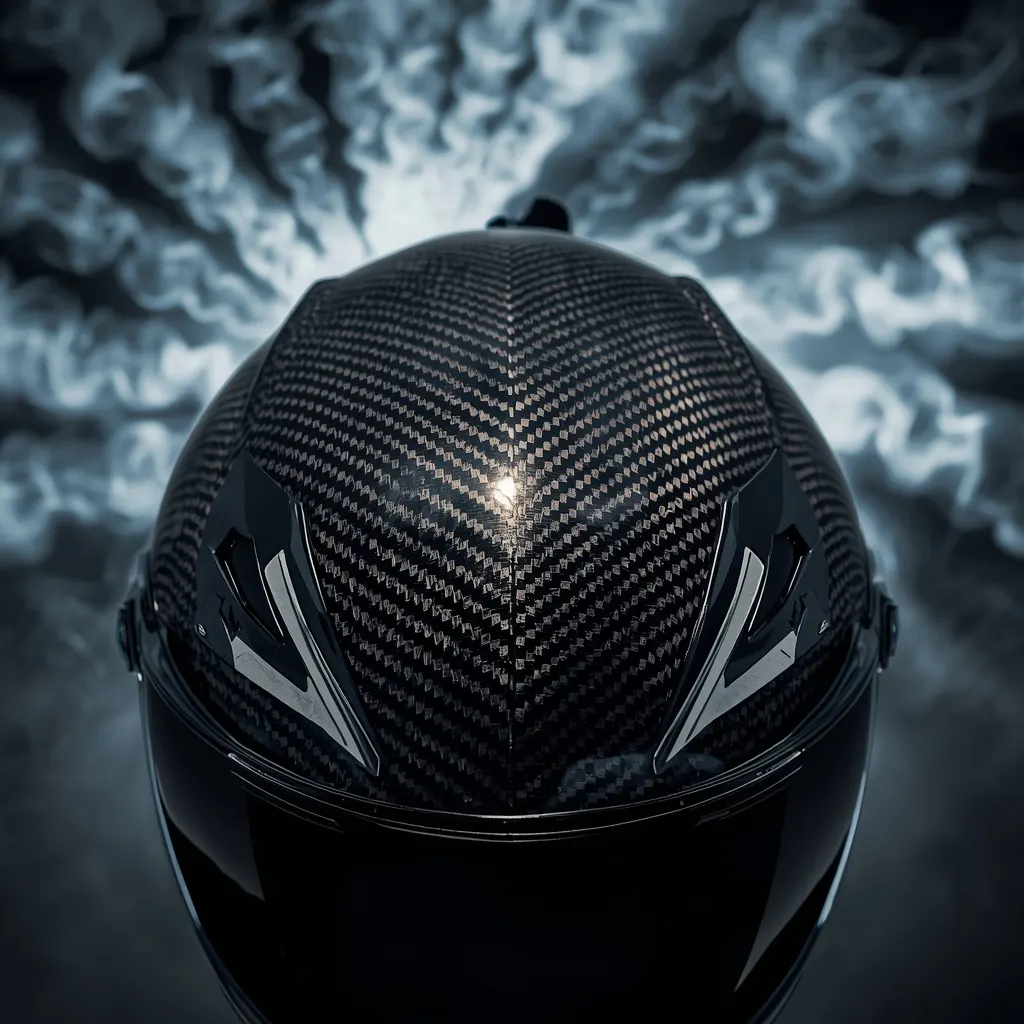
You can't cheat physics. The force the wind exerts on your neck increases with the square of the speed. If you ride twice as fast, your neck carries four times the load.
Static and dynamic helmet weight
A helmet can be light on the scales (static weight) and still perform poorly in the wind (dynamic weight).
- Lift: a poorly designed helmet wants to pull upwards at high speed. You then constantly press your head down actively, which puts enormous strain on your neck and shoulder muscles.
- Buffeting: this is the rapid shaking of the helmet caused by turbulence behind the windscreen. It forces your muscles into thousands of small corrections per minute. That tires you faster than steady wind pressure.
Our tip: look for helmets with spoilers and clean trailing edges. They make the airflow separate cleanly, and your head sits calmly in the wind.

5. The ergonomic triangle: how you sit on your bike
Your riding position results from three contact points: handlebars, seat and footpegs.
The problem on a supersport bike
On a sports bike you have to tilt your head far back (reclination) to see the road. That compresses the facet joints. If you lack core strength as well, you support yourself on the handlebars. Then every bump from the front wheel goes through your arms straight into your neck.
Cruisers and naked bikes
Here you sit upright but are fully in the wind. Without a fairing, the airflow constantly pulls your head backwards. If the handlebars are too wide, your shoulders are also under permanent tension.
6. Stress and the clenching reflex
Your jaw is directly linked to your neck. Under stress, for example in heavy traffic, rain or at high speed, many people unconsciously clench their teeth. Because the chewing and neck muscles are closely coupled neurologically, the neck then almost inevitably stiffens.
Breathing makes a difference too. In tricky situations many people only breathe shallowly into the chest. Accessory muscles in the neck join in, the shoulders go up, and the trapezius gets extra stress.
7. The "bulletproof neck" plan against neck pain
You don't have to be a bodybuilder. What you need is strength endurance in your neck. This plan takes about 10 minutes and prepares your muscles for the load. Do the exercises three times a week.
A. Mobilisation (2 minutes)
- Shoulder circles: large, slow circles backwards and downwards. Imagine you want to put your shoulder blades into your back pockets.
- Head turns: slowly turn your head towards your right shoulder, hold for 2 seconds, then to the left. Don't circle, just turn.
B. Isometric strengthening (4 minutes)
Build strength without moving.
- Resistance at the front: place your palm on your forehead. Press your head against your hand without moving it. Hold the tension for 10–15 seconds.
- Resistance at the back: interlock your hands behind your head and press against them.
- Resistance at the side: press your head against your palm at the temple, on both sides.
Repeat each position three times.
C. Posture correction (2 minutes)
- Chin tucks (double chin): gently pull your chin straight back as if making a double chin. The crown of your head moves upwards. This stretches the short neck muscles and activates the deep neck flexors.
D. Core stability (2 minutes)
- Forearm plank: a stable core means you don't cling to the handlebars. Hold the plank for as long as you can keep good form.
8. Technology: adjusting your bike to you
Before you reach for painkillers, check your hardware:
- Handlebar risers: often just 2 cm work wonders, because the angle of your cervical spine relaxes.
- Lever position: adjust the brake and clutch levers so your wrists don't bend. A bent wrist increases tension all the way up to your neck.
- Windscreen: sometimes a smaller screen or a clip-on spoiler is better, because it directs the turbulence (buffeting) away from the helmet.
- Earplugs: sounds strange, but helps. Noise is stress for the brain, and stress means muscle tension. Riding more quietly relaxes the neck.
9. Further links
If you'd like to learn more about cervical syndrome, you'll find a good overview there (in German). The MSF website has interesting articles on rider fatigue. Take time for it and do something about your neck pain during or after your motorcycle tour.
10. Frequently asked questions
Does a heavy helmet always cause neck pain?
Not necessarily. A well-balanced 1.6 kg helmet can feel lighter in the wind than a poorly balanced 1.3 kg one. From about 80 km/h, aerodynamics are what matter most.
Why do my fingers tingle when my neck is tense?
Often the cervical spine constricts the nerves that supply your arms. This is called cervicobrachialgia. Check your riding position and, if in doubt, see a physiotherapist.
Does stretching while riding help?
Static stretching while riding is dangerous and does little. Better: mobilise briefly during breaks, for example with shoulder circles. While riding, consciously relax your jaw and breathe deeply into your belly.
Are carbon helmets the solution to all problems?
They noticeably reduce the static load. That helps above all in town and with lots of shoulder checks. On the motorway, however, the shape with spoiler and ventilation matters more than the material.
Which motorcycle is best for the neck?
Adventure bikes usually offer the best ergonomic triangle. But even there, a poorly adjusted windscreen can cause a lot of neck stress through buffeting.
In a nutshell
You don't have to simply accept neck pain when riding a motorcycle. It's the result of overload, and you can get it under control in three places:
- Body: build the necessary stability with isometric training.
- Technology: adjust handlebars and levers properly and choose a helmet that sits calmly in the wind.
- Mind: watch out for stress signals such as jaw clenching and shallow breathing.
If you take this to heart, your next tour won't end with pain but with the sunset. Keep your neck relaxed and stay safe on the road.