When you put on your motorcycle gear, you rely on a simple promise: if it goes bang, this stuff will protect me. The visible sign of this is the CE label. Manufacturers advertise with AAA, Level 2 and EN 17092. But anyone who looks more closely at the test procedures knows that there are often worlds between a lab test and a real slide over rough asphalt. Even an expensive jacket with an AAA rating can reach its limits in a crash.
This article is about why an AAA certificate isn't a licence to ride fast and why the standards sometimes even slow down better protective clothing.
1. How the CE standard for motorcycle clothing came about
Before criticising the tests, it's worth looking at why they exist at all. Until 2018, things were pretty wild with motorcycle clothing. There were standards for gloves and boots, but jackets and trousers were often sold as pure leisurewear. That way manufacturers saved themselves expensive testing.
With EN 17092, motorcycle clothing officially counts as PPE (personal protective equipment). That was a big step forward for consumer protection. The catch: so that the industry could keep up, the test criteria were significantly relaxed compared with the old professional standard (EN 13595).
The trade-off: safety or comfort
EU regulators had two options:
-
Strict standards: only heavy leather and very thick textiles pass. The result: nobody wears it in summer because it's too hot and uncomfortable.
-
Flexible standards: lighter clothing gets certified too. The result: more people wear protective clothing, but protection per square centimetre drops.
They chose the second option. That's how today's classification from C to AAA came about.
2. Lab versus road: where physics contradicts the standard
The Darmstadt machine: sliding under lab conditions
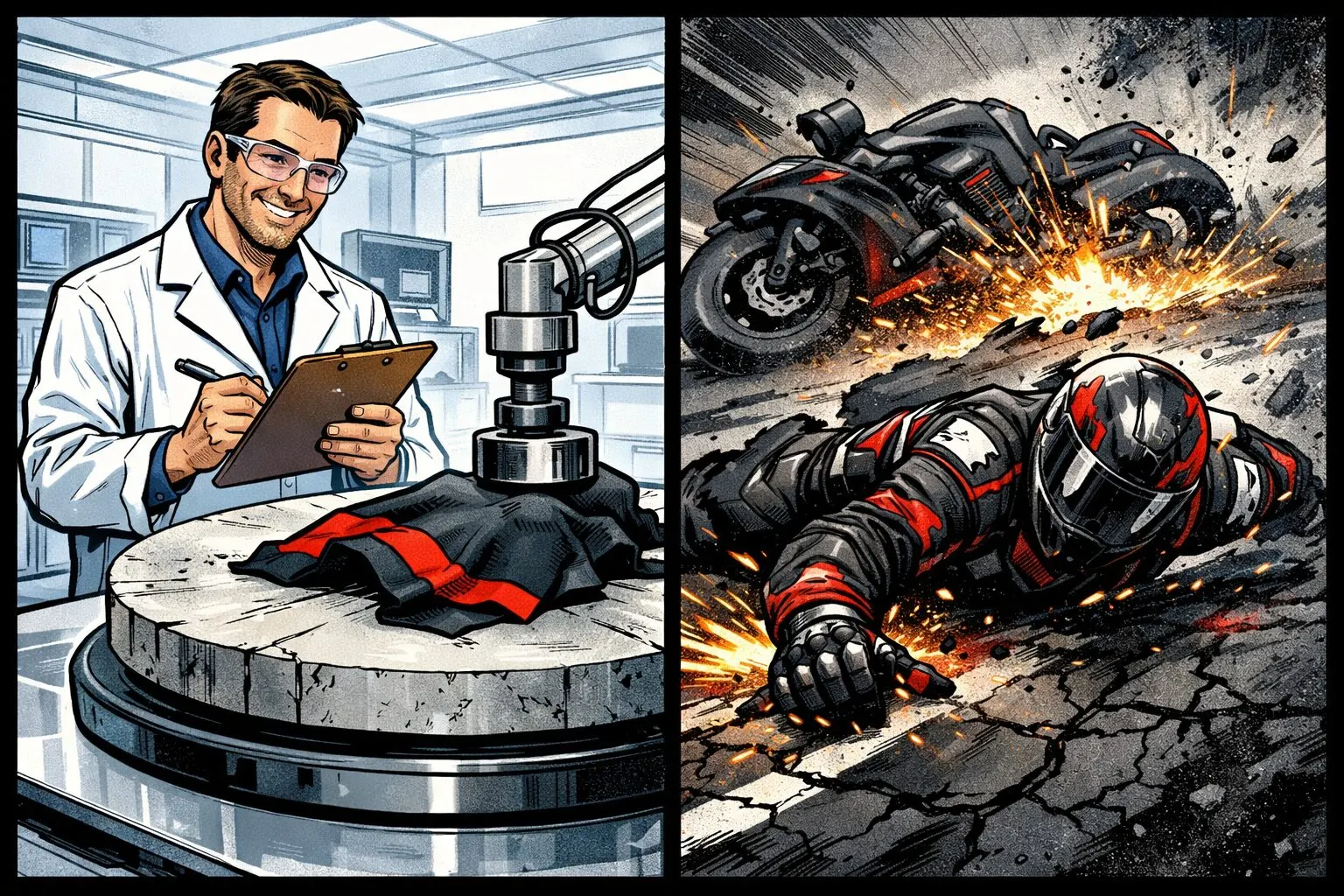
The core of the current test is the "Darmstadt machine". Fabric samples are mounted on three holders and dropped onto a rotating concrete plate.
-
The test: the sample is pressed from a standstill onto the rotating disc with a concrete surface. What's measured is how long it takes for the material to wear through.
-
The reality: a motorcycle crash almost never starts with you lying flat on the ground. First comes the impact, then an irregular sliding phase.
-
The criticism: the machine simulates a fairly smooth, even load. Real asphalt is rough and has potholes and edges. These edges bite into the fabric and tear it open instead of just slowly grinding it down. A fabric that does well on the concrete plate can tear open in milliseconds on a coarse country road.
Friction and heat
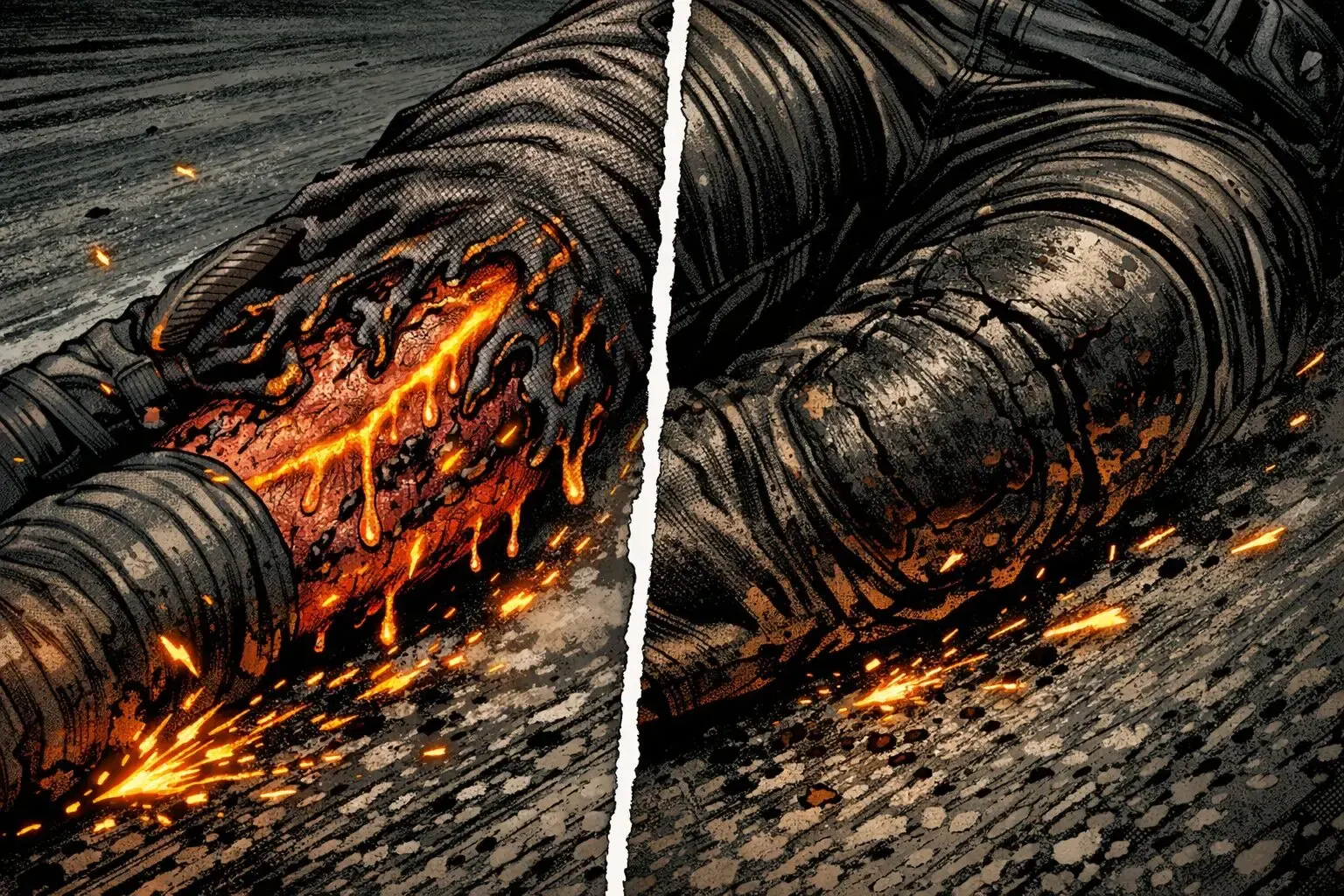
What CE tests often leave out is heat. When leather rubs over asphalt, temperatures well above 200 °C arise.
-
Leather is a natural material. It chars but keeps its structure.
- Synthetics (nylon, polyester) are plastic. And plastic melts.
Many cheap CE-tested textile trousers contain simple membranes or linings made of polyester. Once the outer skin is worn through (which happens quickly with class A), the plastic melts straight into the burn. The CE standard checks whether a hole develops. It doesn't assess how severe the burn from melted material is.
3. Protectors: understanding Level 1 and Level 2
Protectors are tested according to EN 1621. A 5 kg weight falls onto the protector, and what's measured is how much force (in kilonewtons, kN) still gets through underneath.
| Level | Test force (impact energy) | Permitted residual force (average) |
| Level 1 | 50 joules | < 35 kN |
| Level 2 | 50 joules | < 20 kN |
Why these numbers are deceptive
A human bone often breaks at forces between 4 and 8 kN. But a Level 2 protector lets up to 20 kN through on average. That's two and a half times what a shin or elbow can withstand.
Where the standard has gaps:
-
The area: the residual force is only measured at one point. How the protector distributes the energy over the whole area hardly plays a role.
-
The temperature: protectors made of visco foam (such as SAS-TEC or D3O) behave quite differently at 35 °C in summer than at 5 °C in autumn. The standard does test different temperatures, but many cheap protectors lose a lot of protective effect outside their comfort zone.
-
Coverage: a protector can be Level 2 and still be tiny. The standard specifies minimum sizes, but these often don't cover the sensitive joint heads when you move during a crash.
4. The AAA misunderstanding with motorcycle jackets
In marketing, "AAA" is considered the gold standard. What's really behind it?
An AAA rating according to EN 17092 means that the material passed the strictest abrasion test of the standard on the Darmstadt machine. You can't read from it a crash speed up to which you're protected.
That sounds like a lot. But the old EN 13595-1, intended for professional use, required abrasion resistance of 7 seconds on an abrasive belt (Cambridge machine) for its Level 2. That corresponds to a slide from a much higher speed on real asphalt.
The comparison makes it clear: a current AAA jacket often wouldn't come close to passing the old professional standard.
The risk for you as a buyer: you feel as safe in your AAA textile jacket as in a race suit. But good leather often has many times the abrasion resistance of typical textile fabric. The standard puts both in the same class (AAA), suggesting an equivalence that doesn't exist.
5. Seams and zones: the underestimated construction
What good is the best fabric if the seam opens like a zip? The standard divides clothing into zones:
-
Zone 1: shoulders, elbows, hips, knees. The material is strongest here.
-
Zones 2/3: less exposed areas.
Manufacturers save by using thinner material in zone 3. But in a highside, where you're thrown through the air, it's pure chance which part hits the ground first. If you land on the asphalt with the inside of your upper arm (zone 3), the CE certification only helps to a limited extent.
Then there's shifting. In the lab, the fabric sample is firmly clamped. In real life, the jacket may be a size too big. On impact the sleeve rides up, the protector turns away, and your skin scrapes over the ground. No certification can enforce a good fit.
6. Why the CE standard is still important
Despite all the criticism: the CE standard is the best thing that could have happened to the market. For three reasons:
-
Less junk: it has pushed out products that offered practically no protection, for example simple cotton hoodies without aramid reinforcement.
-
Control of chemicals: it ensures that leather isn't contaminated with chromium VI, which can trigger severe allergies on contact with sweat.
-
Comparability: it forces manufacturers to invest money in development and not just in design.
7. What to really look for when buying a motorcycle jacket
Next time you're in a shop, don't just look at the CE label. This checklist will help:
-
Feel of the material: does the textile feel very thin and soft? Then it's probably only class A or AA. For touring and motorways it should be AAA or a very sturdy AA.
-
Protector pockets: try to move the protector inside the jacket by hand. If you can easily push it away from the point of your elbow, it won't protect you in a crash.
-
Double seams: check whether the seams are concealed. Exposed seams are cut through immediately when sliding.
-
Leather: if you want maximum safety, there's no way around leather. No textile (except perhaps very expensive SuperFabric or special full-aramid fabrics) matches the protective properties of cowhide.
-
Airbag systems: if you want to raise your level of protection significantly, buy an airbag vest. It protects chest, back and neck in an impact much better than a back protector alone.

Conclusion
CE tests for motorcycle clothing are a necessary lower limit, but they don't reflect a real accident. A "pass" in the lab only means you're not left without protection the moment you first touch the ground.
Real safety only comes when material, fit and modern technology such as an airbag work together. If you think a cheap 150-euro AAA textile jacket makes you invulnerable, you're fooling yourself. The road tests harder than any lab.
Frequently asked questions
What exactly does "CE" on my motorcycle jacket mean?
CE stands for Conformité Européenne. It's not a quality seal in the classic sense but the legal proof that the product meets EU safety requirements for personal protective equipment (PPE). Without this label, a motorcycle jacket may not be sold as protective clothing in the EU.
Is class AAA always better than AA?
For abrasion resistance, yes. AAA offers the highest protection against wearing through at high speed. But AAA clothing is often heavier and stiffer. For pure city riding, a flexible pair of AA trousers can therefore be the better choice, because the greater comfort means you actually wear them.
Why do leather suits usually hold up better than textile jackets, even though both are AAA?
The standard only sets a minimum requirement for AAA. Many textiles only just reach this limit, while leather is often 5 to 10 times above it. The class is open at the top, and physically leather plays in a different league.
Is a Level 1 protector enough?
Level 1 is the basic certification. Level 2 reduces the residual force much more (under 20 kN instead of 35 kN). For your spine and joints you should choose Level 2 where possible.
Can I rely on the abrasion resistance of motorcycle jeans?
Only if they're CE-certified. Normal jeans last less than a second on asphalt (approx. 0.2 s). Certified motorcycle jeans (class A or AA) use aramid fibres (Kevlar) or Cordura and so manage several seconds of sliding time.
What happens to protective clothing in the rain?
Wet can change friction values. More importantly, though: soaked fabric becomes heavier, and the protectors shift more easily. Your body also cools down, which significantly reduces concentration and therefore safety.
Why are protectors only tested with 50 joules in the lab?
50 joules is roughly a 5 kg weight falling from a height of one metre. That sounds like little, but it's a standardised comparison value. Real crash energies are often higher. In the lab, the aim is to make the damping of materials comparable.
Does my clothing also protect against broken bones?
Only to a limited extent. Protectors protect against comminuted fractures and direct blows to the joint heads. They hardly prevent fractures caused by twisting (torsion) or severe overextension.
How can I tell whether a protector is really certified?
The protector itself must permanently carry the pictogram of a motorcyclist, the standard number (e.g. EN 1621-1) and the level (1 or 2), embossed or printed.
Does textile clothing really melt into the skin?
Yes, if it's made of simple polyester or nylon and there's no protective layer such as aramid underneath. The friction heat when sliding can liquefy the plastic, leading to burns that are hard to treat.
How long does a protector last?
Most manufacturers recommend replacement after 5 to 7 years. Plastic and damping foam can harden or become brittle over time, and then the protective effect decreases.
What is the "Darmstadt machine"?
It's the current test device for EN 17092. It drops fabric samples onto a rotating concrete plate to simulate abrasion. Critics consider it less realistic than the old "Cambridge machine", which worked with an abrasive belt.
Are airbag vests included in the CE standard?
Airbags have their own standard (EN 1621-4). Good airbags achieve much lower residual forces than conventional back protectors and protect a larger area.
Why are some areas of the jacket thinner than others?
The standard divides clothing into zones. In areas that touch the ground less often (e.g. the inside of the arms), manufacturers use thinner fabrics for better ventilation and more freedom of movement.
Do I have to throw my clothing away after a crash?
Textile clothing is almost always single-use: after a slide, the fibres are destroyed by heat and abrasion. Leather can often be repaired by a specialist as long as the seams and material thickness are still OK. You should always replace protectors after a hard impact.