Imagine you're riding along a country road at 100 km/h. Between you and the tarmac there's often only just over a millimetre of material. At that moment your motorcycle clothing is no longer a fashion item but your life insurance. That's exactly why a bit of materials knowledge is worthwhile before you buy your next jacket or trousers.
The technology behind the gear has developed a lot in recent years. Today it's no longer just about "simple leather", but about protective layers at molecular level, airbags with their own sensors and high-performance fibres originally developed for industry and protective equipment. So you don't get lost in the manufacturers' marketing jungle when buying, I've put together everything important here. Don't worry: it won't be as technical as it sounds right now.
1. Leather: the original material, technically upgraded
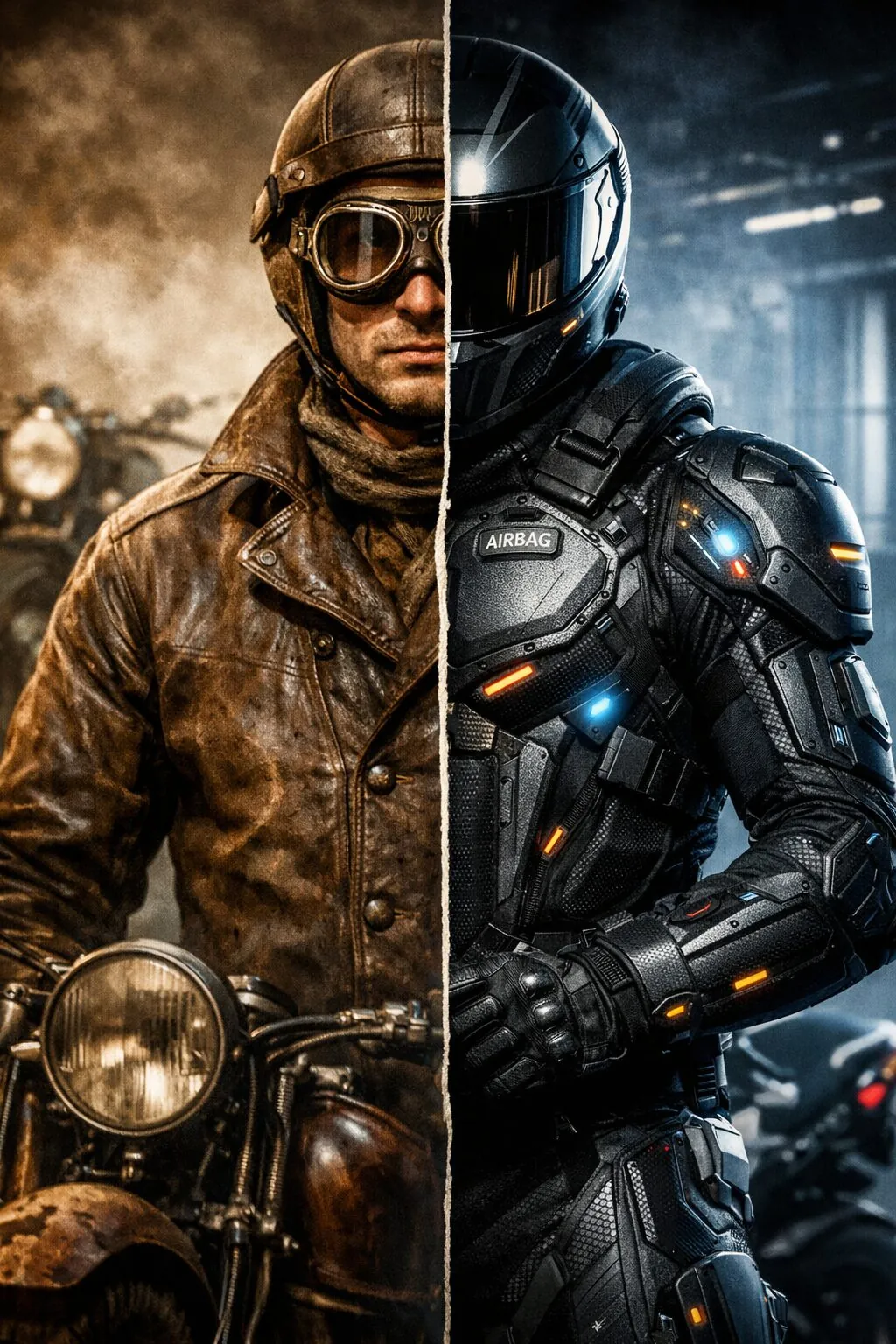
For many of us, leather is still the first choice. The reason: nature has created a fibre structure here that can hardly be replicated in the lab. The collagen fibres are interlinked three-dimensionally and keep their structure even under strong frictional heat.
Which type of leather suits you?
Every animal provides a slightly different protection package. Here's the overview:
Cowhide: the classic. At 1.1 to 1.4 mm thick it offers very good abrasion protection. It's robust, lasts a long time and adapts to your body shape over time. That's more important than it sounds, because that way your armour stays in place.
Kangaroo leather: the premium choice from racing. The fibres are denser and run parallel to the surface. That's why at only 0.8 to 1.1 mm thick it achieves the same or even higher tear strength than thick cowhide. A kangaroo suit is therefore noticeably lighter than a comparable cowhide one.
Goatskin: if you're looking for gloves with good feel for throttle and brake, this is the one. Goatskin is thin and light, but still surprisingly tear-resistant.
Buffalo leather: for the vintage look. It's coarser-grained and develops a nice patina faster. Its abrasion resistance is almost at cowhide level, but it's often somewhat stiffer.
The TFL Cool-System™ effect
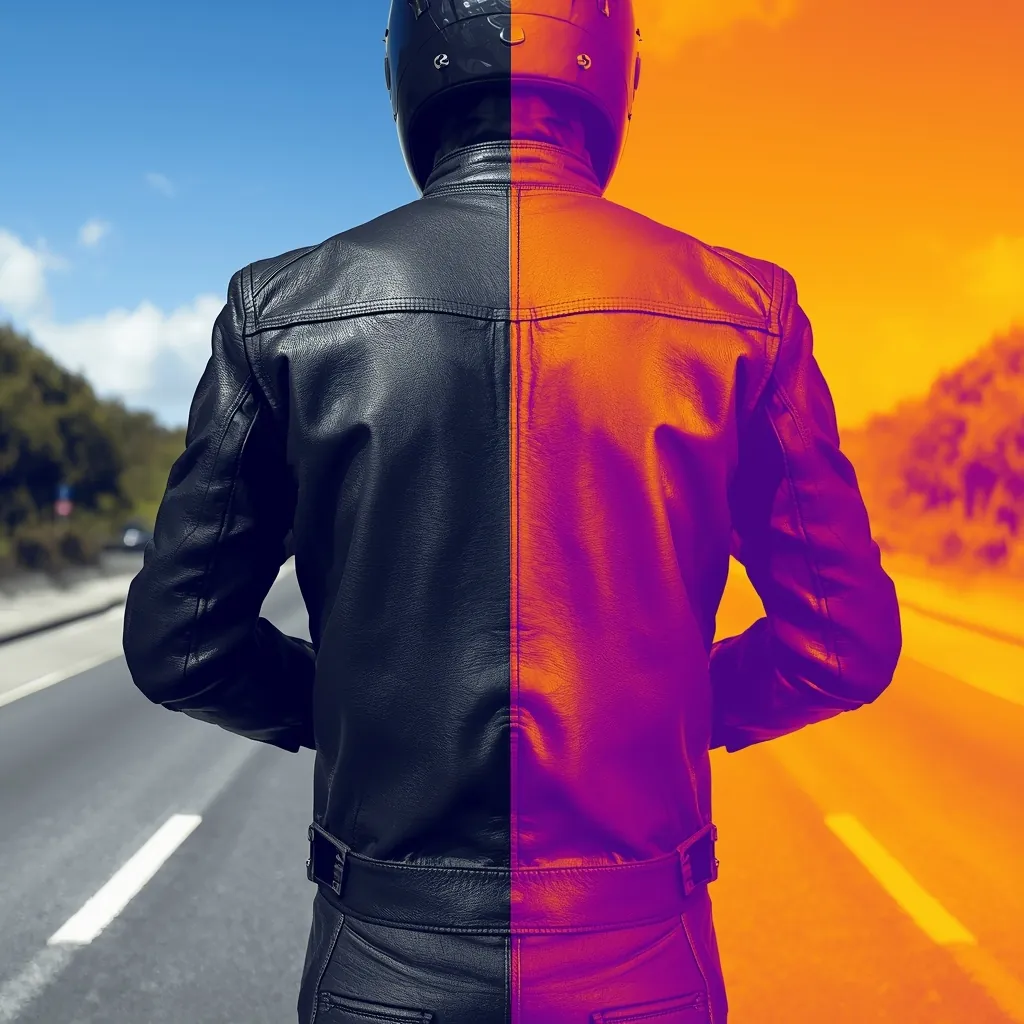
Black leather in blazing sun quickly feels like a microwave. TFL technology tackles exactly that. According to the manufacturer, special pigments in the leather reflect 60 % or more of infrared radiation. In motorcycle jackets it's supposed to stay 20 °C or more cooler as a result. These are manufacturer figures; in practice the values will probably differ somewhat.
Important for you: only care for cool leather with colourless products. Normal shoe polish clogs the pigments and the effect is gone.
2. Textiles: the numbers behind your jacket
Textile clothing today is often just as safe as leather and much more versatile. So you know what "600D" or "1000D" on the label means, here's a short excursion into textile maths:
Denier (D): this unit describes the weight of a yarn. 1 denier means 9,000 metres of thread weigh exactly 1 gram. So a jacket made of 1000 D Cordura consists of much thicker, heavier threads than a city jacket with 300 D.
Tex / decitex (dtex): this is the ISO standard. 1 tex equals 1 gram per 1,000 metres. Just remember: 1 tex = 9 denier.
Rule of thumb for your safety: material under 500 D has no place in crash zones such as elbows and shoulders. There it should be at least 1,000 D or special fibres such as Dyneema.
3. Motorcycle clothing materials: the key branded fabrics
Why does one pair of motorcycle jeans cost €100 and another €400? And why do some thin jackets protect better than thick leather armour? The answer is in the small print, more precisely in the brand names of the technologies.
Here comes the "alphabet of safety": the fabrics that lie between you and the tarmac when it counts.
3M™ Scotchlite™
How it works: the principle is called retroreflection. A mirror reflects light at the angle of incidence. With Scotchlite, on the other hand, millions of tiny glass beads mirrored on one side send the light back almost exactly in the direction it came from. That means: whoever sits behind the light source, i.e. the car driver, sees you glowing extremely brightly.
For: maximum visibility at dusk and at night, without the jacket looking like a high-vis vest during the day.
Example: the narrow silver stripes on the sleeves of your touring jacket or reflective logos on your boots.
3M™ Thinsulate™
How it works: the fibres are only about 15 micrometres thin, much thinner than the polyester fibres of conventional fillings and only a fraction of a human hair. As a result they have much more surface area and trap more air. Air conducts heat poorly, so this padding insulates very well.
For: thermal insulation with little bulk. Ideal if you still need feeling in your fingers despite the cold.
Example: winter gloves that aren't as bulky as ski gloves, so you can still operate indicator and brake cleanly.
Outlast® (phase change material)
How it works: the lining contains microcapsules (Thermocules™) with a special wax. If your skin temperature rises, the wax absorbs the energy, becomes liquid and stores the heat (latent heat). When you cool down, it solidifies again and releases the energy.
For: against temperature peaks. Outlast doesn't heat, it buffers.
Example: the lining of high-quality motorcycle jackets. You sweat less at the traffic lights and don't get cold as quickly on the country road afterwards.
CoolMax® / X-Static®
How it works: CoolMax fibres have four channels that draw moisture outwards by capillary action. X-Static is a fibre with a permanent layer of pure silver. Silver ionises in moisture and kills odour-causing bacteria.
For: moisture transport and hygiene.
Example: functional underwear or the helmet lining (X-Static), so the helmet doesn't smell musty after a season.
4. Abrasion resistance and textile technology
This is your second skin when you slide over the tarmac. With the right materials you get away from a motorcycle crash with far fewer injuries.
Aramid (Kevlar®, Twaron®, Pekev®)
How it works: aramids are aromatic polyamides with very firmly bonded molecular chains. Aramid is flame-retardant, doesn't melt (it only decomposes at very high temperatures) and is very tear-resistant. There's one catch: it's sensitive to UV.
For: heat protection and tear resistance in a crash.
Example: the yellow reinforcements inside motorcycle jeans at the knees and seat.
Dyneema® / UHMWPE
How it works: ultra-high molecular weight polyethylene with extremely long molecular chains. Weight for weight, it's up to 15 times stronger than steel according to the manufacturer. Compared with aramid it feels cooler and softer on the skin and is more cut-resistant. The catch: it melts at around 130 to 150 °C, so tested construction matters.
For: high-performance denim for "single-layer" trousers.
Example: motorcycle jeans with only one layer of fabric that still achieve CE certification to EN 17092.
Armacor™ (e.g. in GORE-TEX Pro)
How it works: Armacor is a blended fabric of Cordura nylon and very tear-resistant Kevlar fibres. In high-quality suits it's used as the outer material in a 3-layer laminate, for example with a Gore-Tex Pro membrane directly underneath.
For: the armour for round-the-world travellers. Waterproof and very abrasion-resistant.
Example: shoulder and elbow areas of high-end touring suits.
Cordura® / Cordura Denim®
How it works: air-textured nylon 6.6. The fibres are deliberately "roughed up" a little during spinning, which makes the surface rougher. That significantly increases the frictional resistance compared with normal polyester.
For: standard material for almost all textile suits.
Example: the base fabric of your entry-level textile jacket. Cordura Denim is woven into jeans so they look like jeans and still protect.
5. Leather and special hybrids
Aniline leather vs. semi-aniline
How it works: aniline leather is dyed through in the drum but gets no covering pigment layer. The pores stay open. It's the softest and highest-quality leather, but absorbs water immediately.
For: looks and comfort.
Example: stylish retro leather jackets for chopper or scrambler riders.
Corium+® Platinum
How it works: a laminate from Rukka made of perforated leather, a waterproof membrane and a light lining. Normal leather soaks up water in the rain and then weighs twice as much. Here the water beads off, and sweat escapes through the perforation.
For: leather clothing for the whole year.
Example: high-end leather suits for touring riders who like leather but don't want to put a rain jacket over it.
Matryx®
How it works: a technical fabric from the French manufacturer Chamatex in which high-performance threads (including aramid) are individually coated and then woven into a matrix. It's very thin, airy and still hard-wearing.
For: lots of ventilation with high safety.
Example: ventilation inserts in light gloves, for instance from Alpinestars, and many trail running shoes.
6. Impact protection: armour
This is where kinetic energy is absorbed so your bones stay intact.
D3O® and SAS-TEC®
How it works: these materials use non-Newtonian behaviour. Normally the molecules in the polymer are mobile and the protector is soft. On a fast impact they immediately lock together into a rigid structure.
- Differences:
- D3O: known for orange, very flat protectors. Good for "invisible" protection in streetwear.
SAS-TEC: a viscoelastic foam (usually yellow) that returns to its shape after an impact, so it protects several times. According to the manufacturer, the damping stays relatively stable in heat and cold too.
For: joint protection at shoulders, knees and elbows, and back protectors.
Example: swap the hard plastic shells of your old jacket for level 2 SAS-TEC protectors. You'll notice the difference in comfort immediately.
SuperFabric®
How it works: small, very hard epoxy resin plates ("guard plates") are applied to a base material. Because there's space between the plates, the fabric is flexible. If you slide over the tarmac, you glide on these plates like on small skids instead of the fabric tearing.
For: protection in areas with a lot of frictional heat and abrasion.
Example: the reinforcement on the palm heel of racing gloves.
7. Climate membranes: how you stay dry
So you stay dry in the rain without stewing in your own juice, your clothing needs a membrane. Two physical principles are behind it:
Microporous membranes
Imagine a net with billions of pores. According to Gore, each pore in the Gore-Tex membrane is 20,000 times smaller than a water droplet, but 700 times larger than a water vapour molecule. So rain can't get in, but your sweat can get out as vapour.
Additional info: there are now ePE membranes (expanded polyethylene) made without intentionally added PFAS chemicals.
Hydrophilic membranes
These membranes have no holes. Moisture is transported chemically via molecular chains that absorb it and pass it outwards. The advantage: without pores, nothing can be clogged by sweat salts or detergent. According to manufacturers, they're also 100 % recyclable.
Hydrostatic head: how waterproof is your motorcycle clothing?
The hydrostatic head tells you how much water pressure a material can withstand before the first drop comes through.
How it's measured
The material is clamped under a cylinder that's filled with water. The figure in millimetres shows how high the water can stand in the tube before it pushes through the fabric.
Everyday standard, 1,500 to 5,000 mm: under the European standard, a fabric is often considered waterproof from 1,300 mm. That's enough for a tent or the rain jacket for walking the dog.
Motorcycle minimum, 10,000 mm: it shouldn't be less. The airflow creates enormous dynamic pressure. At 100 km/h the water hits your clothing like a small pressure washer.
Premium class, 20,000 mm and more: high-quality membranes from brands such as GORE-TEX® or Sympatex® are usually in this range; 28,000 mm is often quoted for Gore-Tex.
Example: if you sit on a wet seat, your whole body weight presses on a small area. This localised pressure can easily exceed 10,000 mm. Only with a very high hydrostatic head does your backside stay dry.
Important: the best hydrostatic head is useless if the seams aren't sealed. When buying, always look for "taped seams". More in Buying a motorcycle rain suit.
8. The RET value: how breathable is the material?
What use is a jacket that keeps the rain out if you get soaking wet inside from your own sweat? That's the notorious plastic bag effect.
What's behind it
RET stands for resistance to evaporative heat transfer. The value measures how much resistance a fabric puts up against water vapour, i.e. your sweat. The lower the number, the better.
RET 0 to 6 (extremely breathable): the Champions League. Even under exertion, for example off-road or in stop-and-go city traffic, sweat is quickly transported outwards. You feel dry.
RET 6 to 13 (very breathable): standard for good touring clothing. For normal country road riding that's completely enough.
RET 13 to 20 (satisfactory): in heat or under exertion you clearly notice it getting damp under the jacket.
RET over 20 (not recommended): the material acts like a barrier. Sweat condenses inside, and as soon as it gets cooler you start to freeze because of your damp skin.
How to find the RET value: unfortunately, unlike the hydrostatic head, it's almost never shown prominently on the label. Manufacturers prefer vague terms such as "highly breathable". With a bit of research you'll still get the number.
Here's how:
Big brands often have detailed product descriptions on their websites. Don't just look at the shop page; download the technical manual or product data sheet as a PDF if available. The measured values are often in there. If in doubt, ask the manufacturer directly, they definitely have the data.
9. Why waterproof and breathable together is so expensive
The difficulty: you need a material with holes small enough to keep water droplets out (hydrostatic head) and at the same time large enough to let water vapour molecules out (RET).
A water droplet is many times larger than a water vapour molecule (see above: pores 20,000 times smaller than a droplet, but 700 times larger than a vapour molecule).
Cheap membranes are often simply waterproof. High hydrostatic head, poor RET value. You stay dry from the outside but get wet from the inside.
High-end laminates: here the membrane is bonded directly to the outer fabric. That gives a very low RET value and maximum hydrostatic head. In addition, the outer fabric doesn't soak up water, and you don't cool down through evaporative cooling.
Checklist for your next purchase
| Intended use | Recommended hydrostatic head | Recommended RET value |
|---|---|---|
| Fair-weather rider | 5,000 mm (for short showers) | RET 13 to 20 |
| Touring rider | 10,000 to 20,000 mm | RET 6 to 13 |
| Year-round / high-mileage rider | 28,000 mm | RET < 6 |
10. Safety check: the standards EN 17092 and EN 1621
When buying, always look for the CE label. It tells you objectively what the clothing can withstand. In another article we explain what a good motorcycle jacket must be able to do and how it's constructed.
The zone model: where it hurts in a crash
The standard divides your body into three zones:
Zone 1: shoulders, elbows, hips, knees. This is where you hit first. The highest abrasion requirements apply here, and this is where the armour sits.
Zone 2: outer sides of arms and legs. At risk when you slide.
Zone 3: inner sides. There's usually more ventilation here.
The protection classes in a km/h check
Testing is done with an impact abrasion test: fabric samples sit on rotating arms, hit a real concrete surface and slide to a stop. Afterwards the innermost layer must not have a hole of 5 mm or more. You'll often read km/h values such as 120, 75 or 45 km/h. They aren't in the standard like that; they're only rough comparison values from marketing.
AAA: highest abrasion resistance, armour at shoulders, elbows, knees and hips is mandatory. Your standard for brisk country road tours.
AA: the touring standard, also with armour at shoulders, elbows, knees and hips. A good compromise between protection and comfort.
A: light protection for the city or great heat; hip armour is optional here.
B and C: special solutions such as jackets without armour (B) or armoured shirts (C).
Armour: level 1 vs. level 2
The EN 1621 standard specifies how much impact force (in kilonewtons) still reaches you. The lower the value, the better.
Level 2 back protector: it may let through a maximum of 9 kN residual force on average. A level 1 protector may let through up to 18 kN, twice as much. My advice: always level 2 on the back. Your spine will thank you.
11. Airbags: active safety
The airbag is the biggest safety gain of the last ten years. It protects internal organs and the neck much better than any classic protector. More in Motorcycle airbag vests.
Electronic systems: they work autonomously. According to manufacturers, the sensors evaluate the data up to 1,000 times per second. In a highside, the system detects the crash within a few milliseconds and should be inflated before you touch the tarmac.
Mechanical systems: you're connected to the motorcycle by a lanyard. No battery needed, and you can usually change the cartridge yourself after deployment.
moto-guide tip: look for clothing marked "airbag-ready". These jackets have stretch inserts so they don't burst when the airbag deploys underneath.
12. Care: how to keep your motorcycle clothing fit
The most expensive suit is of little use if you care for it wrongly. Below is the short version. There's more in our guide to caring for your motorcycle clothing (leather & textile).
The washing trick
Sweat salts and grease clog the pores of your membrane.
Washing: armour out, zips closed. Use liquid detergent, never fabric softener.
Reactivating: the water-repellent coating (DWR) on the outer fabric needs heat so the polymer chains stand up again. After washing, put the jacket in the dryer at a low temperature for 20 to 30 minutes. No dryer? Then iron carefully on a low setting with a cloth in between.
Leather care in three steps
Cleaning: only with a damp cloth or pH-neutral leather cleaner.
Drying: never on the radiator. Otherwise the leather becomes brittle and tears like paper in a crash. Always let it dry at room temperature.
Greasing: once a year apply leather grease or a beeswax-based balm so it stays supple. Greasing too often softens the leather unnecessarily.
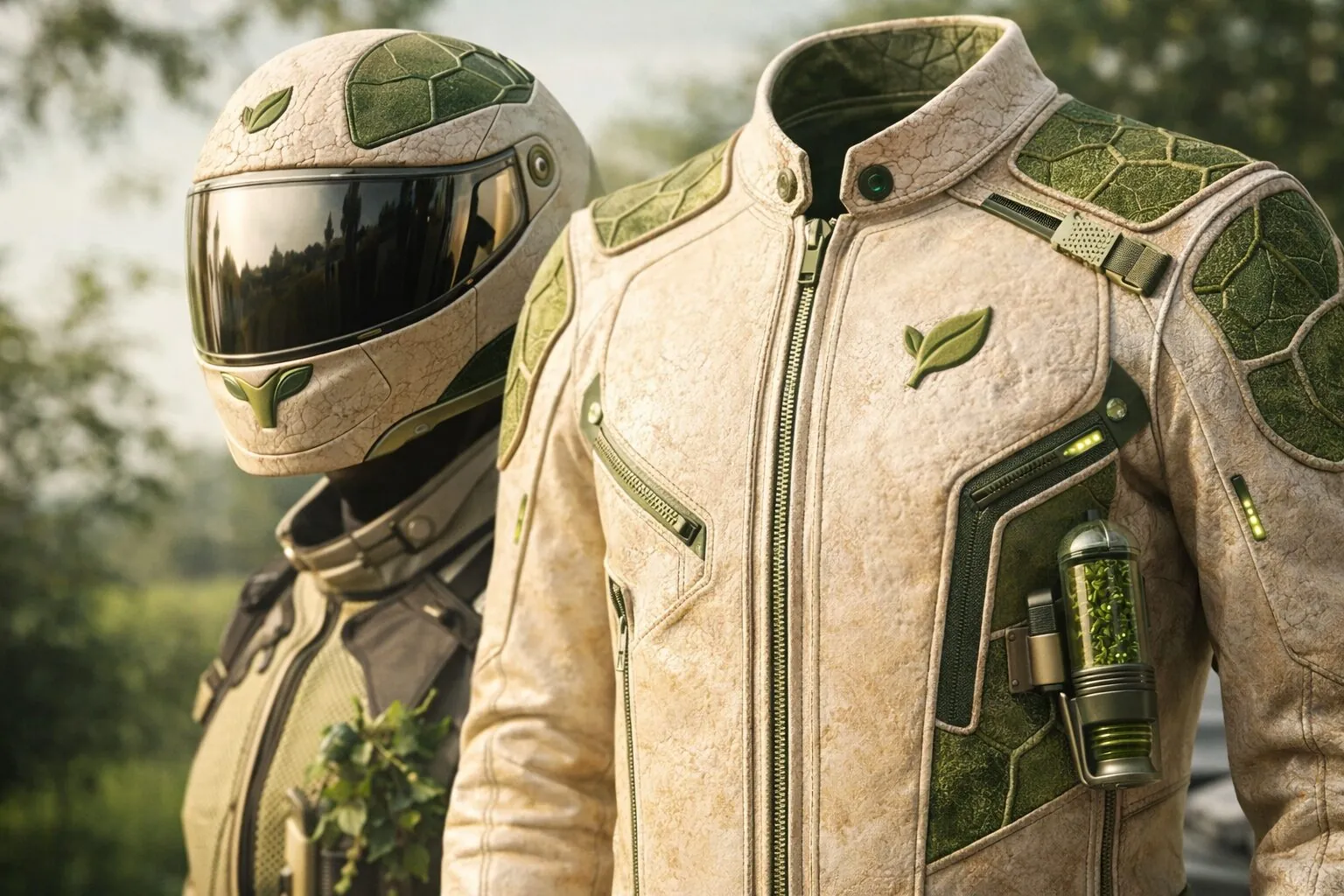
13. Sustainability: vegan and recycled
There are now good alternatives. You no longer have to wear leather to be safe on the road.
Mushroom leather (mycelium): grown biotechnologically from fungi. According to manufacturers, production needs little water. So far it's hardly used in real crash zones; what counts there in the end is the CE test.
PETA-Approved Vegan: this logo shows that the product contains no animal materials.
Certificates: look for Bluesign® (strict requirements for chemicals in production) and the Global Recycled Standard (GRS), which confirms the proportion of recycled materials.
14. Your checklist for the next purchase
Before you spend money, check these five points:
Protection class: at least AA for touring, AAA if it gets fast.
Armour: are level 2 protectors fitted, especially on the back?
Fit: does everything fit snugly enough? If the jacket is too loose, the armour shifts in a crash and doesn't help you at all.
Material mix: are special fibres such as SuperFabric or Keprotec used in the crash zones?
Service: can you service the airbag yourself, or does it have to be sent in?
Summary
The best protection is useless if you don't wear it because it's uncomfortable. With materials such as Dyneema, Outlast and modern membranes there's no excuse for that any more today. Better invest once in AAA quality; your skin will thank you. See you on the road.
Frequently asked questions about materials
Here are 15 questions motorcyclists keep asking about materials and gear, with short answers.
Leather or textile: which protects better in a crash?
For abrasion, leather is still ahead because it's very tough and doesn't melt. But modern high-end textiles such as Armacor or Armalith come close and are much more comfortable in bad weather.
Can I wash my membrane jacket in the washing machine?
Yes, you even should. Dirt and sweat clog the membrane's pores and worsen the RET value. Use a special detergent, no fabric softener, and follow the label. A short spell in the dryer on low heat often reactivates the water-repellent treatment of the outer fabric.
Why do I still sweat in my "waterproof and breathable" jacket?
Usually the RET value is too high. If the membrane doesn't let the water vapour out quickly enough, it condenses inside. You then don't get wet from the outside, but from the inside. When buying, look for values under RET 13.
Are motorcycle jeans safe enough for the motorway?
Only if they're made of materials such as Armalith or Dyneema or are extensively reinforced with aramid (Kevlar). Normal fashion jeans wear through after just a few metres of sliding in a crash at 100 km/h.
What's the difference between level 1 and level 2 armour?
It's about residual force. Level 2 damps the impact much more than level 1, so less energy reaches the bone in an impact. Level 2 protectors are usually somewhat thicker, but always the better choice for safety.
Is a hydrostatic head of 10,000 mm enough?
For short showers, yes. But at 120 km/h on the motorway the airflow presses the water against the fabric at high pressure. That's why premium membranes are usually 20,000 mm or more, so you stay dry even in continuous rain.
What does Outlast in the jacket do for me?
Outlast doesn't heat, it buffers. It stores excess body heat and releases it again when it gets cooler. That way you feel comfortable across a wider temperature range without constantly changing the lining.
Why are gloves with SuperFabric so expensive?
SuperFabric carries tiny, hard plates. If you catch yourself with your hands in a crash, it prevents snagging on the tarmac and protects against heavy abrasion. On the palm heel that can make the difference between a bruise and a flesh wound.
What is a laminate in motorcycle clothing?
In a laminate, the waterproof membrane is bonded directly to the outer fabric. The advantage: the jacket doesn't soak up water, doesn't get heavy and dries much faster. With cheaper jackets with a Z-liner, the outer fabric soaks up water and you cool down a lot through evaporation.
Why is there so often aramid (Kevlar) in motorcycle clothing?
Aramid is very heat-resistant. That's important because very high temperatures arise from friction on the tarmac in a crash. Cheap plastics would melt and fuse with the skin; aramid stays stable.
What does the silver coating (X-Static) in the helmet do?
Real silver is antibacterial. You inevitably sweat in the helmet, and X-Static prevents bacteria from multiplying. Result: the helmet doesn't start to smell even after long tours.
How can I tell whether my protector is still good?
Protectors made of viscoelastic foam such as SAS-TEC or D3O age and can become brittle in severe cold. If they feel hard or no longer return to their shape after being pressed, you should replace them. Many manufacturers recommend replacing them after about 5 years, but at the latest after a crash.
Does my gear lose protection due to UV light?
Yes, aramid in particular is sensitive to UV. That's why it usually sits under an outer fabric. If your jacket is badly faded, the fibres underneath may have suffered too.
What is CoolMax, and do I need it?
CoolMax is ideal for hot summer days. The fibres wick sweat away from the skin very quickly. As functional underwear under a leather suit, it prevents the leather from sticking to you and noticeably improves your body climate.
What's the advantage of SAS-TEC over hard plastic?
Hard plastic often just passes the energy on; SAS-TEC absorbs it. In normal riding it's soft and adapts to your body; it only becomes hard on impact. So you have more safety and still wear it more comfortably.
Sources
- EN 17092: Protective clothing for motorcycle riders (SATRA)
- The GORE-TEX Membrane: What it is, how it works (Gore)
- What is Dyneema: The Fabric Explained (Pando Moto)
- TFL Cool System chills even the sun (Leather International)
- Matryx Technology (Chamatex)
- Rukka leather suit Aramos Corium+ Platinum (Tourenfahrer, German)
Last checked: September 2026. Manufacturer information can change.