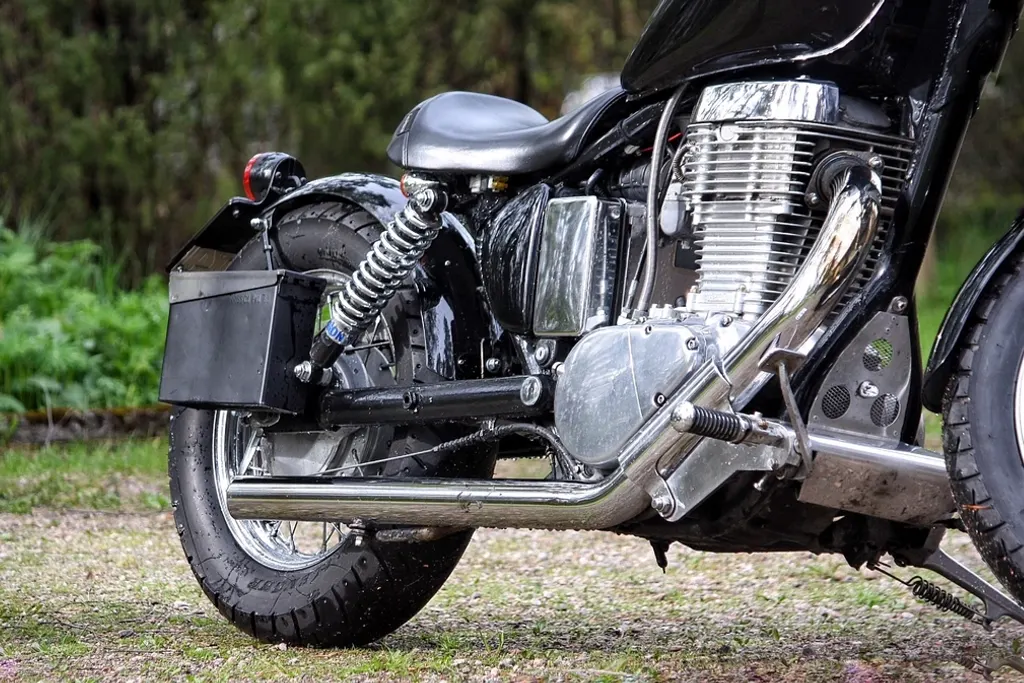
In November many riders in Germany park their bike in the garage, and then the question comes up: keep the plate, switch to a seasonal number plate for your motorcycle or deregister the bike? All three options are legal, but they cost different amounts of money and effort. Here you find what each option means for tax, insurance and the roadworthiness test (HU), and when which one pays off.
The three options at a glance
| Option | Tax and insurance | Riding in winter | Effort |
|---|---|---|---|
| Registered all year | all year | possible at any time | none |
| Seasonal plate | only for the chosen period | not allowed outside the season | re-register once, automatic after that |
| Deregister (Außerbetriebsetzung) | no tax from deregistration, policy is suspended | not allowed | deregister and re-register every year |
How the seasonal plate works
The seasonal plate (Saisonkennzeichen) is governed by § 10(3) of the German Vehicle Registration Ordinance (FZV). You choose an operating period in full months, at least two and at most eleven. It is shown on the right of the plate: the first month at the top, the last at the bottom. A plate with “03” and “10” is valid from 1 March to 31 October, every year again, without a trip to the registration office.
Outside this period you may neither ride nor park the motorcycle on public roads. It has to stand in a garage, on private property or another non-public space.
What the seasonal plate costs
The fees follow the fee schedule and vary between registration offices. Berlin quotes 30.10 € in the cheapest case, Nuremberg from 30 € plus possibly 1.20 to 3.20 € for the transmission to the Federal Motor Transport Authority. On top come new plates, because the months are embossed. To re-register you need, among other things, an electronic insurance confirmation (eVB) that states the seasonal period, and proof of a valid HU.
Vehicle tax with a seasonal plate
German vehicle tax for motorcycles is 1.84 € per started 25 cc of displacement per year (§ 9 KraftStG). With a seasonal plate you only pay it for the months of the operating period. An example with 800 cc: all year that is 32 × 1.84 € = 58.88 €, with a season from March to September (7 months) around 34 €. So the tax on a motorcycle is modest, the bigger saving is usually the insurance.
Insurance and dormant cover
Your motor insurer calculates the premium by the months in which the motorcycle may be ridden. Outside the season the policy continues free of charge as so-called dormant cover (Ruheversicherung). According to the German Insurance Association (GDV), third-party liability and any existing partial cover stay in force, so partial cover still pays for things like theft, fire, marten bites, storm and hail.
The condition: the motorcycle stands in a garage or on a space separated from public traffic by a fence, hedge or wall. Exactly how far the cover goes is set out in your insurer's terms.
On the no-claims discount the GDV says: if the vehicle is insured for at least six months in a year, the discount improves the following year, with less than six months it does not. A season from April to September therefore still moves you up a no-claims class every year, a season from May to September does not.
Roadworthiness test during the winter break
If the HU falls in the months in which your motorcycle is off the road, the registration authorities say you have to catch up in the first month of the next operating period. You may not ride to the test during the rest period. With a season starting in March, the HU appointment belongs in March. How the HU works and which faults are common on motorcycles is covered in our article on the motorcycle HU.
What happens if you ride outside the season?
The ADAC quotes a fine of 50 € for riding outside the operating period and 40 € for parking in public space. Something else weighs more heavily: dormant cover does not include riding. According to the ADAC, anyone who rides during the rest period breaches the Compulsory Insurance Act and commits a criminal offence. In an accident you would then have no liability cover.
Deregistering your motorcycle: when it pays off
When you deregister, officially Außerbetriebsetzung, the registration office takes the motorcycle temporarily out of service. The plates lose their seals, tax stops from that day, and the office informs the tax authority and the insurer. The insurance policy is then usually suspended free of charge. For how long depends on the insurer's terms, Stiftung Warentest mentions up to 18 months.
The fee in person is usually between about 15 and 20 €, in Berlin for example 17.10 €. Online through your registration authority's portal (i-Kfz) deregistration is cheaper if your documents carry the necessary security codes. If you want to keep your old registration number, you can have it reserved, in Berlin for up to twelve months for 2.60 €. In spring re-registration costs fees again, and you need a new eVB and a valid HU.
Deregistering mainly pays off if the motorcycle stands for longer than one season, for example during a rebuild, a long repair or a break due to injury. For the normal winter break it is usually more hassle and in the long run more expensive than the seasonal plate, because the fees come up every year.
Which option suits you?
- You also ride on dry winter days: Stay registered all year. Anyone who wants to go for a ride on a sunny day in February will otherwise be annoyed.
- Your motorcycle stands safely in a garage every winter: The seasonal plate is usually the best choice. Re-register once, after that you save automatically every year.
- The motorcycle will stand for more than one winter: Deregister and have the registration number reserved.
- You park outside on the street in winter: Neither a seasonal plate nor deregistration is an option. Both require a space away from public traffic. Tips for storage are in our article on winter storage without a garage.
Do the maths on the insurance: ask your insurer what a seasonal period of, say, March to October costs compared with a full-year policy. The difference shows you whether switching is worth it. How to look after your motorcycle over the winter is explained in our winter care guide.
In short
The seasonal plate is valid for two to eleven full months and repeats every year. You only pay tax and insurance for that time, outside it the policy is dormant as long as the motorcycle stands in a garage or on an enclosed private space. At least six months of season keep your no-claims discount improving every year. Deregistering mainly pays off for longer breaks.
Frequently asked questions
What is the minimum period for a seasonal plate?
At least two and at most eleven full months. This is set by § 10(3) FZV.
Can I ride briefly in winter with a seasonal plate?
No. Outside the operating period you may neither ride nor park the motorcycle on public roads. According to the ADAC you face a 50 € fine and a breach of the Compulsory Insurance Act.
Do I lose my no-claims discount with a seasonal plate?
No. According to the GDV the discount keeps improving if the motorcycle is insured for at least six months a year. With a shorter season the class stays where it is.
What if the HU is due during the rest period?
Then you catch up in the first month of the next operating period. You may not ride to the test centre during the rest period.
Can I change the seasonal period later?
Yes, but only with a new registration. The fees are charged again, and you need new plates.
Sources
- § 10 FZV: seasonal plates (Federal Ministry of Justice, German)
- § 9 KraftStG: tax rates (Federal Ministry of Justice, German)
- Seasonal plates: insurance and discount (GDV, German)
- Seasonal plates for the summer (ADAC, German)
- Applying for a seasonal plate (State of Berlin, German)
- Seasonal plate (City of Nuremberg, German)
- Deregistering a vehicle (State of Berlin, German)
- How to deregister a car (Stiftung Warentest, German)
As of October 2026. Fees vary between registration offices and may change.