On the first cold morning the rear tyre feels softer than in September. That is not a feeling but physics. Around tyre pressure in the cold there are also half-truths: from a blanket top-up to a supposed winter tyre obligation for motorcycles. Here is what tyre and vehicle makers and the law actually say, and what is not proven. General points on tyre choice, age and the legal situation are in Motorcycle Tyres: Choice, Pressure and Rules. The legal part below describes German law.
In short
- When the temperature falls, tyre pressure falls. Continental gives a rule of thumb of about 0.1 bar per 10 °C, though in a piece for car drivers.
- The benchmark remains the motorcycle maker's specification, measured on a cold tyre. The manufacturer pages we checked give no separate winter value.
- Cold tyres have less grip even at the right pressure. We found no manufacturer statement that more pressure compensates for it.
- There is no winter tyre obligation for motorcycles in Germany: the rule in the road traffic code exempts single-track motor vehicles.
The physics: why pressure drops with temperature
The air in a tyre behaves like any gas: when it gets colder the pressure falls, when it gets warmer it rises. How much depends on the temperature difference. In its winter guide Continental gives the rule of thumb that pressure falls by about 0.1 bar per 10 °C drop in temperature. The page is aimed at car drivers. We found no figure for motorcycle tyres from the makers, but the order of magnitude gives a guide. An example to put it in context: if you set the target pressure at 20 °C in summer and it is 0 °C later, the car rule of thumb would mean about 0.2 bar less. That is a worked example, not a measurement on your motorcycle.
Cold is not the only reason for falling pressure. Pirelli lists, among others, a faulty valve, tyre damage, leaking rims or corrosion on valve and rim as causes of air loss. If the pressure drops noticeably from one week to the next, it is not automatically the cold.
Measuring cold pressure correctly
All makers we checked name cold pressure as the basis for measuring. Pirelli says: tyres must be cold and the motorcycle on level ground, measured with a well-calibrated gauge. Michelin defines cold as tyres that have not run for at least two hours or have run less than 3 km at reduced speed. Continental says to check or change the pressure for normal use only on cold tyres.
- According to Michelin, check every two weeks and before long trips.
- Never let air out of a hot tyre.
- Put the valve caps back on.
- Correct nitrogen-filled tyres only with nitrogen.
The air in the tyre takes on the ambient temperature. If you measure in a warm garage and then ride into the cold, the pressure on the road will be lower than measured. That follows from physics; we found no manufacturer statement on it.
The manufacturer's specification as the benchmark
Pirelli always recommends the pressure the motorcycle maker gives and points to the handbook. Continental adds that the prescribed pressure varies with use, above all with the weight of solo rider, passenger and luggage. Michelin names the manufacturer's pressure explicitly for riding in cold and snow too. A blanket winter top-up or reduction is not in the manufacturer pages we checked. Figures from guides or tables do not replace the value in the handbook or on the sticker on the motorcycle.
For Bridgestone and Metzeler we could not retrieve a suitable statement. What they say about pressure in the cold therefore stays open here.
Grip: what cold tyres do not fix with pressure
Michelin explains that every tyre has an ideal operating temperature. In winter the rubber compound stiffens, grip drops, and the temperature is hard to reach and hold. Tyre warmers would also help only briefly, because tyres cool quickly in the cold. The German Institute for Two-Wheeler Safety (ifz) writes in a press release of 15 October 2025 that on cold asphalt reliable grip does not build up as quickly as in summer. On wet roads there is the danger of freezing wetness. The Austrian club ÖAMTC likewise calls grip on cold asphalt poorer.
For you that means: the right pressure is the basis but does not replace a careful start. For unavoidable winter rides Michelin advises pulling away gently, braking gently and mixing front and rear brake. In snow Michelin recommends leaving the motorcycle at home. What else counts in the wet is in Riding a Motorcycle in the Rain.
Winter tyre obligation: does it apply to motorcycles?
Not in Germany. The rule is in section 2 (3a) of the road traffic code (StVO): in black ice, snow-covered or icy roads, slush or hoar frost, a motor vehicle may only be driven with tyres meeting the requirements of section 36 (4) StVZO. By sentence 2 no. 2 this duty explicitly does not apply to single-track motor vehicles, so not to motorcycles either. The ÖAMTC says the same for Austria: the winter tyre obligation does not apply to motorcycles and scooters there, but winter tyres are recommended for powered two-wheelers, and for motorcycles they exist in only a few sizes.
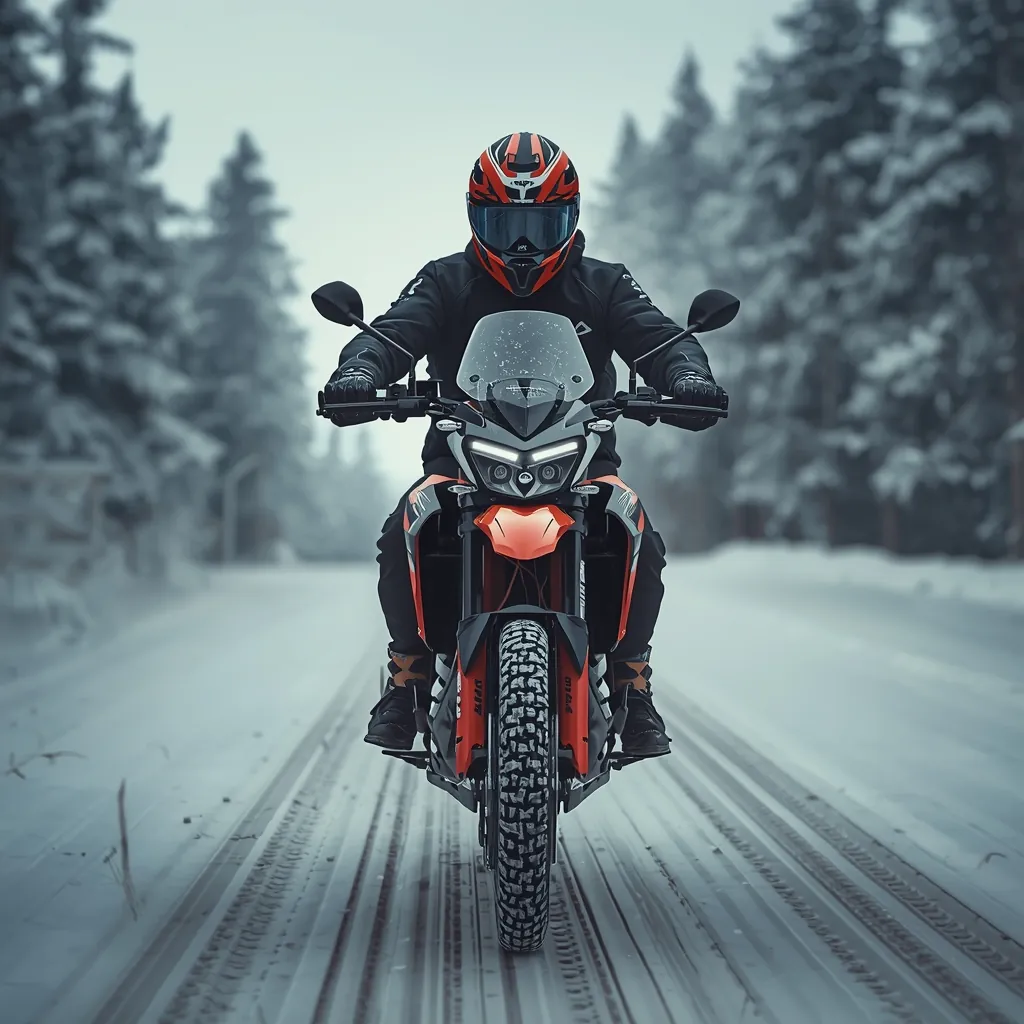
Michelin says it does not offer motorcycle snow tyres and gives safety as the reason. No obligation does not mean that riding on ice is a good idea. You have to adapt your riding to the conditions anyway.
Storage: pressure before the winter break
When a motorcycle stands for months the issue is flat spots, not cold. ADAC recommends raising the pressure for the standing period by about 0.5 bar above normal operating pressure and taking the load off the tyres with a centre or paddock stand. If that cannot be done fully, move the motorcycle slightly every few weeks or turn the wheels. In spring you set the pressure back to the manufacturer's value, on a cold tyre. More in Motorcycle Winter Care and Winter Storage Without a Garage. If you ride through, the items in Motorcycle Winter Gear and Accessories help.
Frequently asked questions
How much pressure does a motorcycle tyre lose in the cold?
We found no figure specifically for motorcycles. Continental gives about 0.1 bar per 10 °C drop in temperature for car tyres.
Do I need more pressure in winter?
The makers we checked give no value for it. The motorcycle maker's specification, measured on a cold tyre, is what counts.
Is there a winter tyre obligation for motorcycles?
Not in Germany. Section 2 (3a) StVO exempts single-track motor vehicles from the duty.
When is a tyre cold?
According to Michelin, when it has not run for at least two hours or has run less than 3 km at reduced speed.
Sources
- StVO section 2, in German (Gesetze im Internet)
- Tyre pressure in winter, in German (Continental)
- Tyre pressure for motorcycles, in German (Continental)
- Motorcycle tyre pressure guide (Michelin, as of February 2025)
- Are motorcycle snow tyres required to ride in winter? (Michelin, 2025)
- Motorcycle FAQ, tyre pressure (Pirelli)
- Motorrad-Jahreszeit 4.0, in German (Institut für Zweiradsicherheit, 15 Oct 2025)
- Motorrad richtig einwintern, in German (ADAC)
- Motorrad und Roller: einwintern oder weiterfahren, in German (ÖAMTC)
As of November 2026. The values in your motorcycle's handbook take precedence.